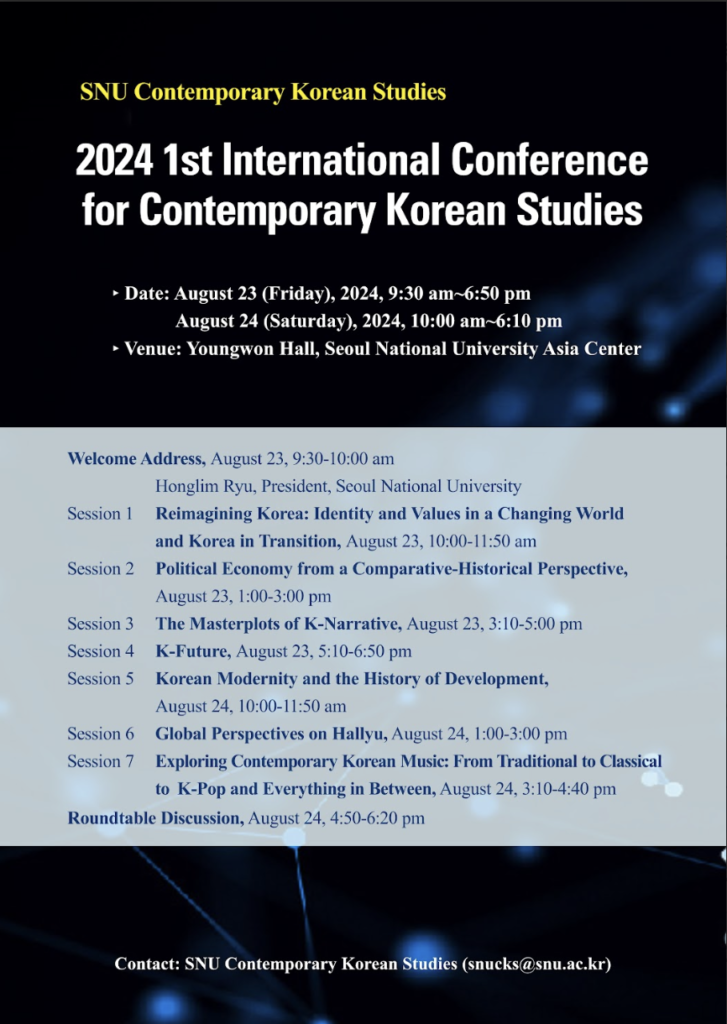
서울대학교 현대한국종합연구단은 2024년 8월 23일(금)부터 24일(토)까지 양일간 서울대학교 아시아연구소 영원홀에서 「제1회 현대한국연구 국제컨퍼런스(The 1st International Conference for Contemporary Korean Studies)」를 개최합니다.
이번 국제컨퍼런스에서는 문화, 예술, 종교, 역사, 정치, 사회, 기술 등 다양한 분야의 연구자들이 모여 현대 한국의 여러 현상을 다각도로 분석합니다. 또한 국내외 연구자들이 학문 분야와 지역의 경계를 넘어 교류하며 새로운 연구 네트워크를 형성하는 장을 마련하고자 합니다.
현대 한국에 관심 있는 학내 구성원 및 연구자 여러분의 많은 관심과 참여를 바랍니다.
행사 개요
- 행사명: 제1회 현대한국연구 국제컨퍼런스
(The 1st International Conference for Contemporary Korean Studies) - 일시:
2024년 8월 23일(금) 09:30–18:50
2024년 8월 24일(토) 10:00–18:10 - 장소: 서울대학교 아시아연구소 영원홀
- 진행 방식: 대면 및 유튜브 생중계
- 유튜브: https://www.youtube.com/@SNUCKS2024
- 문의: snucks@snu.ac.kr
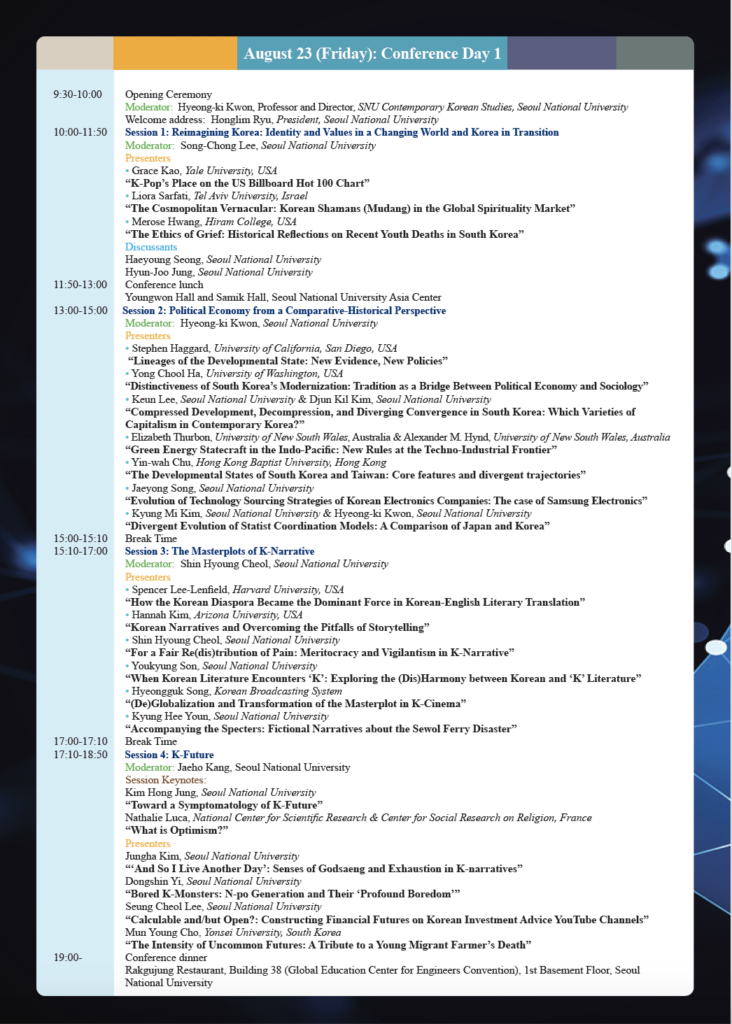
8월 23일(금) — 대회 1일차
09:30–10:00 | 개회식
사회: Hyeong-ki Kwon
(Professor and Director, SNU Contemporary Korean Studies, Seoul National University)
환영사: Honglim Ryu
(President, Seoul National University)
10:00–11:50 | 세션 1
변화하는 세계 속 한국의 정체성과 가치, 그리고 전환기의 한국
Reimagining Korea: Identity and Values in a Changing World and Korea in Transition
- Grace Kao (Yale University, USA)
“K-Pop’s Place on the US Billboard Hot 100 Chart” - Liora Sarfati (Tel Aviv University, Israel)
“The Cosmopolitan Vernacular: Korean Shamans (Mudang) in the Global Spirituality Market” - Merose Hwang (Hiram College, USA)
“The Ethics of Grief: Reflections on Recent Youth Deaths in South Korea”
13:00–15:00 | 세션 2
비교역사적 관점에서 본 정치경제
Political Economy from a Comparative-Historical Perspective
- Stephen Haggard (University of California, San Diego, USA)
“Lineages of the Developmental State: New Evidence, New Policies” - Yong Chool Ha (University of Washington, USA)
“Distinctiveness of South Korea’s Modernization: Tradition as a Bridge Between Political Economy and Sociology” - Keun Lee (Seoul National University) & Djun Kil Kim (Seoul National University)
“Compressed Development, Decompression, and Diverging Convergence in South Korea: Which Varieties of Capitalism in Contemporary Korea?” - Elizabeth Thurbon (University of New South Wales, Australia) & Alexander M. Hynd (University of New South Wales, Australia)
“Green Energy Statecraft in the Indo-Pacific: New Rules at the Techno-Industrial Frontier” - Yin-wah Chu (Hong Kong Baptist University, Hong Kong)
“The Developmental States of South Korea and Taiwan: Core Features and Divergent Trajectories” - Jaeyong Song (Seoul National University)
“Evolution of Technology Sourcing Strategies of Korean Electronics Companies: The Case of Samsung Electronics” - Kyung Mi Kim (Seoul National University) & Hyeong-ki Kwon (Seoul National University)
“Divergent Evolution of Statist Coordination Models: A Comparison of Japan and Korea”
15:10–17:00 | 세션 3
K-서사의 마스터플롯
The Masterplots of K-Narrative
- Spencer Lee-Lenfield (Harvard University, USA)
“How the Korean Diaspora Became the Dominant Force in Korean-English Literary Translation” - Hannah Kim (Arizona University, USA)
“The Unexpected Perils of Pervasive Story Telling” - Shin Hyoung Cheol (Seoul National University)
“For a Fair Re(dis)tribution of Pain: Meritocracy and Vigilantism in K-Narrative” - Youkyung Son (Seoul National University)
“When Korean Literature Encounters ‘K’: Exploring the (Dis)Harmony between Korean and ‘K’ Literature” - Hyeongguk Song (Korean Broadcasting System)
“(De)Globalization and Transformation of the Masterplot in K-Cinema” - Kyung Hee Youn (Seoul National University)
“Accompanying the Specters: Fictional Narratives about the Sewol Ferry Disaster”
17:10–18:50 | 세션 4
K-미래
K-Future
- Kim Hong Jung (Seoul National University)
“Toward a Symptomatology of K-Future” - Nathalie Luca (National Center for Scientific Research, Center for Social Research on Religion, France)
“What Is Optimism?”
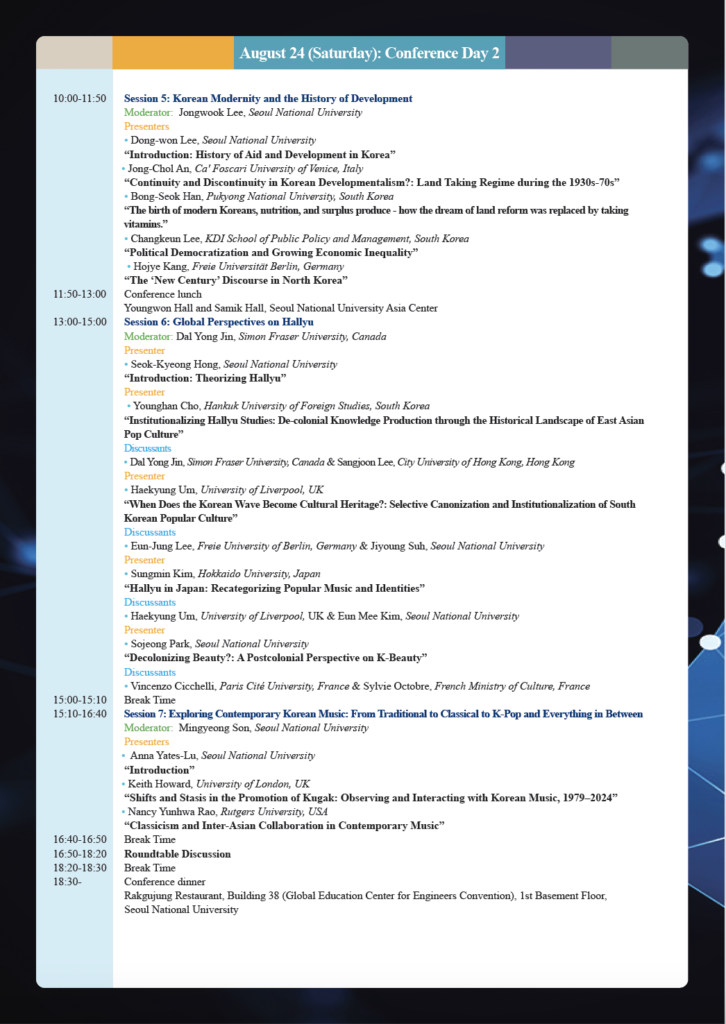
8월 24일(토) — 대회 2일차
10:00–11:50 | 세션 5
한국의 근대성과 발전의 역사
Korean Modernity and the History of Development
- Dong-won Lee (Seoul National University)
“Introduction: History of Aid and Development in Korea” - Jong-Chol An (Ca’ Foscari University of Venice, Italy)
“Continuity and Discontinuity in Korean Developmentalism?: Land Taking Regime during the 1930s–70s” - Bong-Seok Han (Pukyong National University, South Korea)
“The Birth of Modern Koreans, Nutrition, and Surplus Produce: How the Dream of Land Reform Was Replaced by Taking Vitamins” - Changkeun Lee (KDI School of Public Policy and Management, South Korea)
“Political Democratization and Growing Economic Inequality” - Hojye Kang (Freie Universität Berlin, Germany)
“The ‘New Century’ Discourse in North Korea”
13:00–15:00 | 세션 6
글로벌 관점에서 본 한류
Global Perspectives on Hallyu
- Seok-Kyeong Hong (Seoul National University)
“Introduction: Theorizing Hallyu” - Younghan Cho (Hankuk University of Foreign Studies, South Korea)
“Institutionalizing Hallyu Studies: De-colonial Knowledge Production through the Historical Landscape of East Asian Pop Culture” - Haekyung Um (University of Liverpool, UK)
“When Does the Korean Wave Become Cultural Heritage?: Selective Canonization and Institutionalization of South Korean Popular Culture” - Sungmin Kim (Hokkaido University, Japan)
“Hallyu in Japan: Recategorizing Popular Music and Identities” - Sojeong Park (Seoul National University)
“Decolonizing Beauty?: A Postcolonial Perspective on K-Beauty”
15:10–16:40 | 세션 7
현대 한국 음악 탐구: 전통음악에서 클래식, K-Pop, 그리고 그 사이의 모든 것
Exploring Contemporary Korean Music: From Traditional to Classical to K-Pop and Everything in Between
- Anna Yates-Lu (Seoul National University)
“Introduction” - Keith Howard (University of London, UK)
“Shifts and Stasis in the Promotion of Kugak: Observing and Interacting with Korean Music, 1979–2024” - Nancy Yunhwa Rao (Rutgers University, USA)
“Classicism and Inter-Asian Collaboration in Contemporary Music”
16:50–18:20 | 라운드테이블 토론
Roundtable Discussion