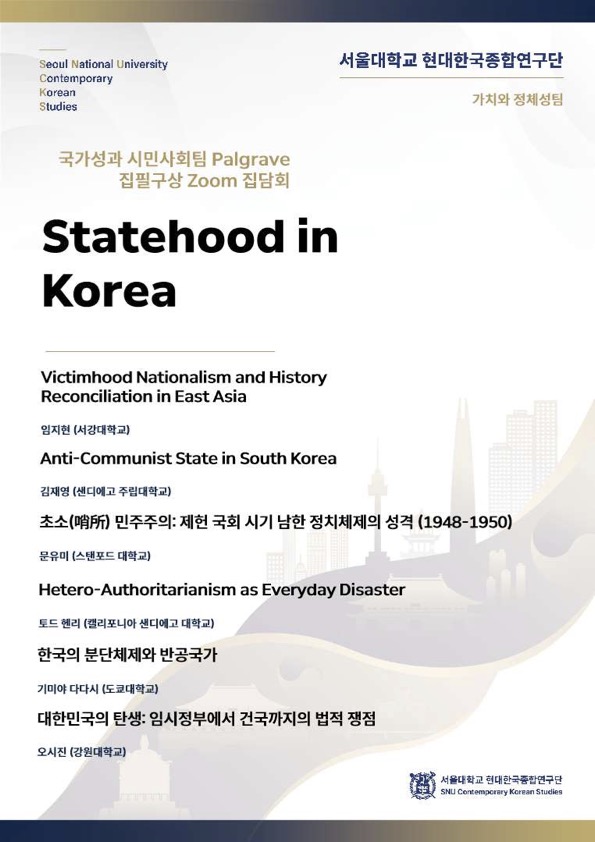
[Academic] Statehood and Civil Society Team Palgrave Book Project Planning Zoom Roundtable – Statehood in Korea
This seminar was organized to provide a space for participating scholars to share their research directions and key questions, and to identify points of intersection through discussion, prior to the full-scale commencement of handbook writing. Rather than understanding statehood through a single political institution or historical event, the seminar was meaningful in that it sought to reinterpret Korean statehood across multiple dimensions, including colonial experience and memory politics, the Cold War and anti-communism, the coexistence of democracy and violence, gender and citizenship, as well as issues of international law and political legitimacy. It also proposed that the chapters should not be developed as isolated units but rather in ways that strengthen dialogue and coherence across the volume.
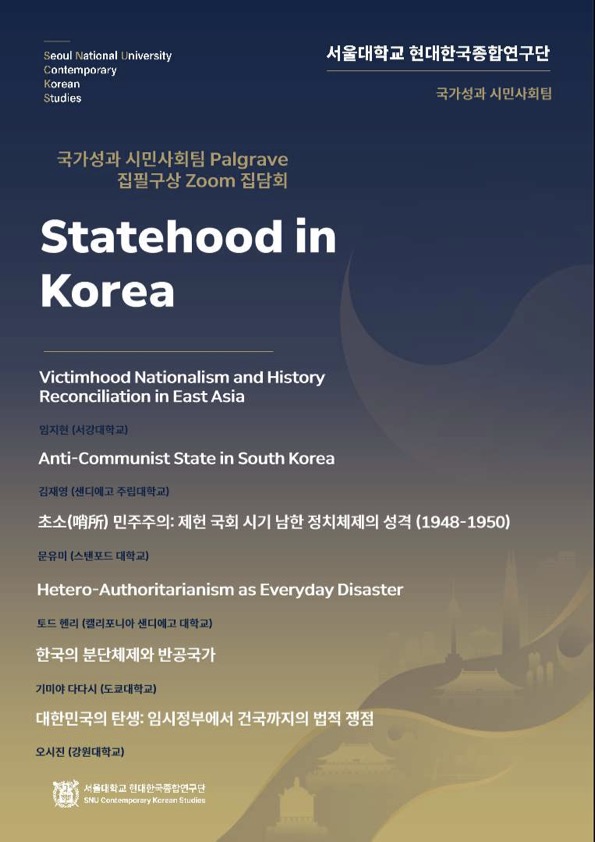
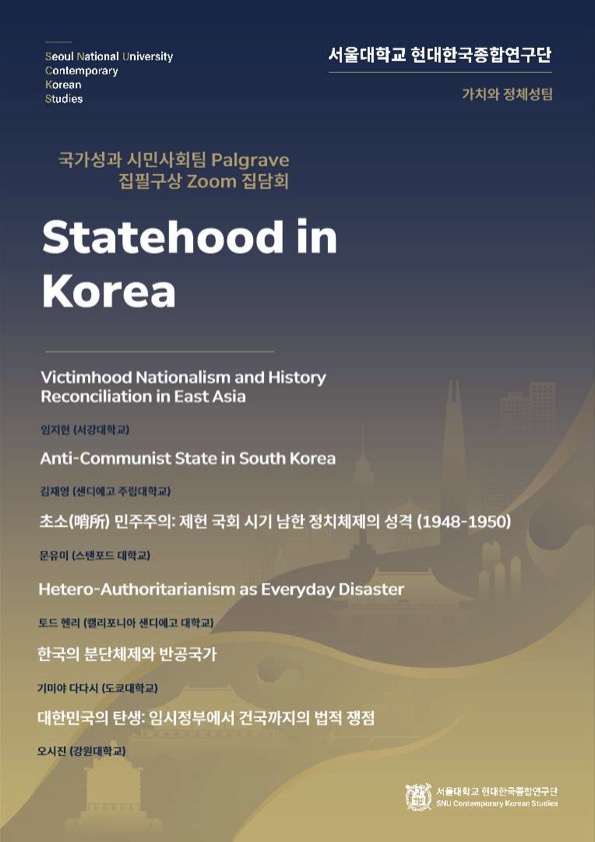
The first presentation was delivered by Professor Ji-Hyun Lim (Sogang University), who revisited Hannah Arendt’s concept of collective innocence within a postcolonial framework and introduced the concept of “colonial innocence” in relation to colonial memory and victim nationalism. The presentation focused on how victim narratives formed after liberation have shaped collective identity and nationalism. Discussions centered on how this concept should be situated between lived colonial experience and later memory politics. In particular, the shift from hero-centered narratives to victim-centered narratives in the twenty-first century was highlighted as a key observation.
The next presentation was given by Professor Jae-Young Kim (San Diego State University), who introduced a framework for analyzing the anti-communist state through an integrated political, economic, and diplomatic perspective. He emphasized that anti-communism exerted structural influence on state formation and policy-making. Discussion addressed whether anti-communism functioned as a fundamental driving force or rather as a tool used to legitimize other political structures. The need to adjust the scope of the chapter in light of potential overlap with other contributions was also raised.
In the following presentation, Professor Yoo-Mi Moon (Stanford University) proposed the concept of “garrison democracy” to explain the coexistence of democratic institutions and violent realities during the period of the Constitutional Assembly. She framed the concept not as a fully developed regime type but as a way of describing a constitutional order in formation. Discussions focused on how this framework differs from existing concepts of democracy and on the appropriate range of its application.
Next, Professor Todd Henry (University of California, San Diego) introduced the concept of hetero-authoritarianism, reinterpreting authoritarianism through the lens of gender and bodily norms. The presentation examined how state power defines normative bodies and forms of citizenship while managing or excluding non-conforming subjects. This perspective offered a distinct analytical layer compared to existing narratives centered on development or democratization. Discussions focused on the persistence and transformation of these norms after democratization.
Professor Kimiya Tadashi (University of Tokyo) then addressed the relationship between the division system and the anti-communist state. He emphasized how the continued structure of division after the Cold War has shaped South Korean statehood. Through comparative cases, the presentation highlighted the specific characteristics of the Korean Peninsula’s division and examined how anti-communist elements have persisted in transformed forms even after democratization. Discussions also explored how the concept of the anti-communist state might be defined and connected to other contributions.
Finally, Professor Si-Jin Oh (Kangwon National University) reexamined the birth of the Republic of Korea from the perspective of international law. The presentation addressed key issues such as the status of the Provisional Government, debates over the legitimacy of state formation, and the legal nature of inter-Korean relations. The presenter analyzed how Korea’s position has been formed and interpreted within international legal discourse, while discussions explored questions including constitutional inheritance of legal legitimacy, the legal framing of colonialism, and the significance of the Inter-Korean Basic Agreement.
Overall, the seminar was significant in expanding research on modern Korean statehood into a space where diverse academic approaches intersect. Although each presentation addressed different themes, the discussions confirmed that key issues such as anti-communism, division, colonial memory, democracy, gender, and international law are deeply interconnected. Building on these discussions, it is expected that future stages of the handbook project will further deepen dialogue across chapters and produce a more multidimensional understanding of modern Korean statehood.