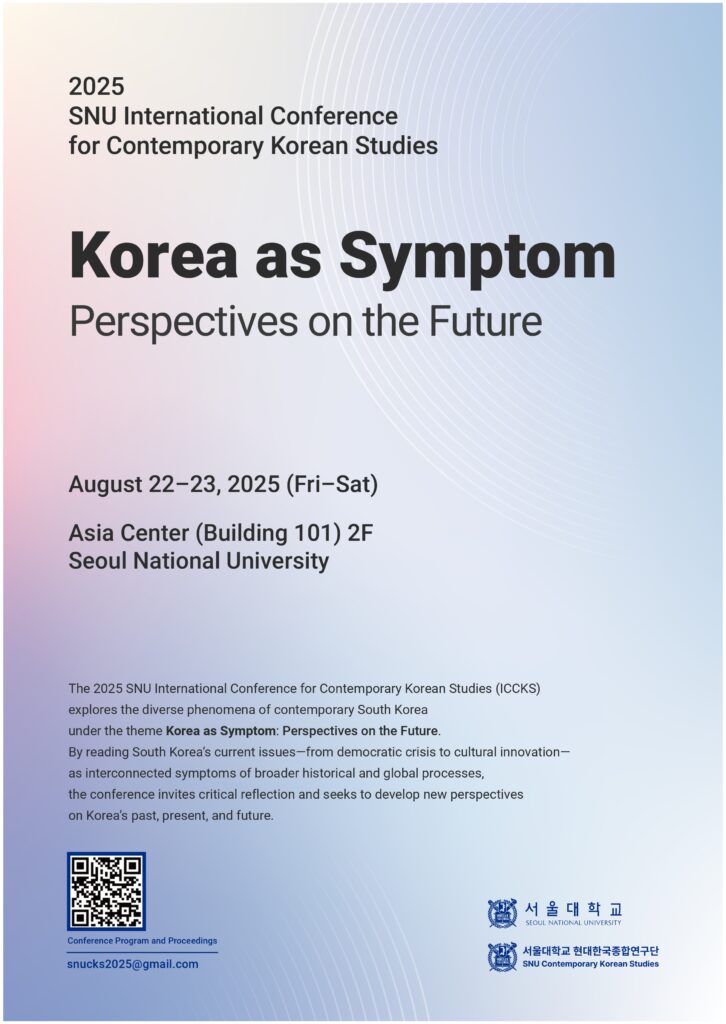
Seoul National University’s Center for Contemporary Korean Studies held an international conference titled “Korea as Symptom” over two days, on August 22 and 23. On the second day of the conference, the Global Hallyu Team organized the second session, titled “K-pop, Fandom, and Cultural Practices,” in Room 240, Building 101, at Seoul National University. Chaired by Professor Cho Younghan of Hankuk University of Foreign Studies, the session featured the following four presentations.
In the first presentation, William Dunkel, a doctoral student at the University of California, Irvine, analyzed Korean esports fandom in his presentation, “‘Anything to Say to Your Fans?’: Gendered Fandom and Labor in Korean Esports.” According to the presentation, unlike in the West, Korean esports fandom relies heavily on the participation of female fans. Based on interviews, the presenter explained how gender roles are performed within the Korean esports scene.
Second, Tabitha Adler, a doctoral student at Goethe University Frankfurt, presented on “Self-Made K-pop Photocards in South Africa: Local Fan Practices as a Way of Dealing with South Korean Popular Culture.” Her presentation examined fan-made merchandise practices in sub-Saharan Africa, where official merchandise is often limited. In response, fans create and distribute their own photocards. Adler analyzed these fans not merely as consumers, but as people who actively develop an interest in Korea and promote Korean culture.
Third, Lim Hyemi, a doctoral student at Université Paris Cité, presented on “Performing Korea: K-pop Cover Dance and the Transformation of Public Space in France.” Her presentation highlighted K-pop as a global practice that reshapes urban space and youth culture. According to the presentation, K-pop cover dance goes beyond simple fan activity, taking place in plazas, transportation hubs, and cultural landmarks across France. Through these performances, young people form a sense of community and develop artistic identities.
Finally, Professor Meicheng Sun of Beijing Language and Culture University presented on “K-poppers and Hip Hoppers in Beijing: Dance, Professions, and Mobilities.” The presentation compared the professional positions of K-pop and street dance instructors, with particular attention to how geographic, social, and virtual mobilities shape their identities and status within the industry.
This session showed that K-pop fandom culture has transformed K-pop into more than simply popular music, making it a form of cultural practice across different parts of the world. In France, K-pop reconfigures urban space; in China, it creates forms of professional mobility; and in South Africa, it generates distinctive fan cultures of its own. Together, these diverse cultural practices revealed broader cultural transformations mediated through music.