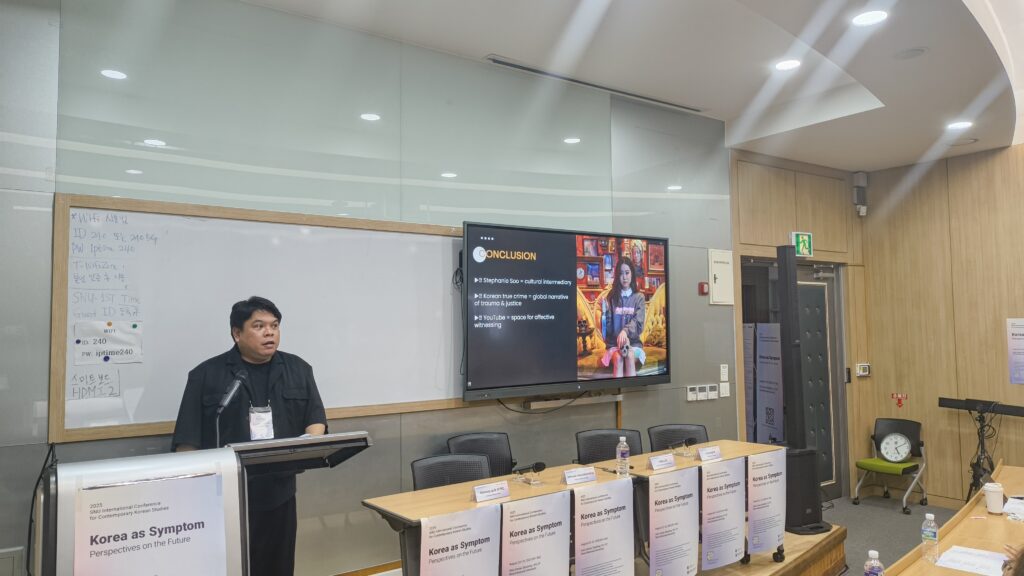
Seoul National University’s Center for Contemporary Korean Studies held an international conference titled “Korea as Symptom” over two days, on August 22 and 23. As the final session of the conference, the K-Narrative Team organized a session titled “Korean Narratives Today II” in Room 240, Building 101, at Seoul National University. Chaired by Song Hyung-guk, a KBS journalist and film critic, the session featured the following two presentations.
The first presenter was Jeremiah Estela Magonica of Ateneo de Manila University, who delivered a presentation titled “Korea as a Narrative: Digital Mediation Through True Crime.” He understood Korea as a symptomatic space of global anxiety and analyzed it within digital culture. In particular, by exploring true crime content, he showed how Korea’s local traumas are translated into globally relatable narratives, revealing points of connection between Korean and Western sensibilities.
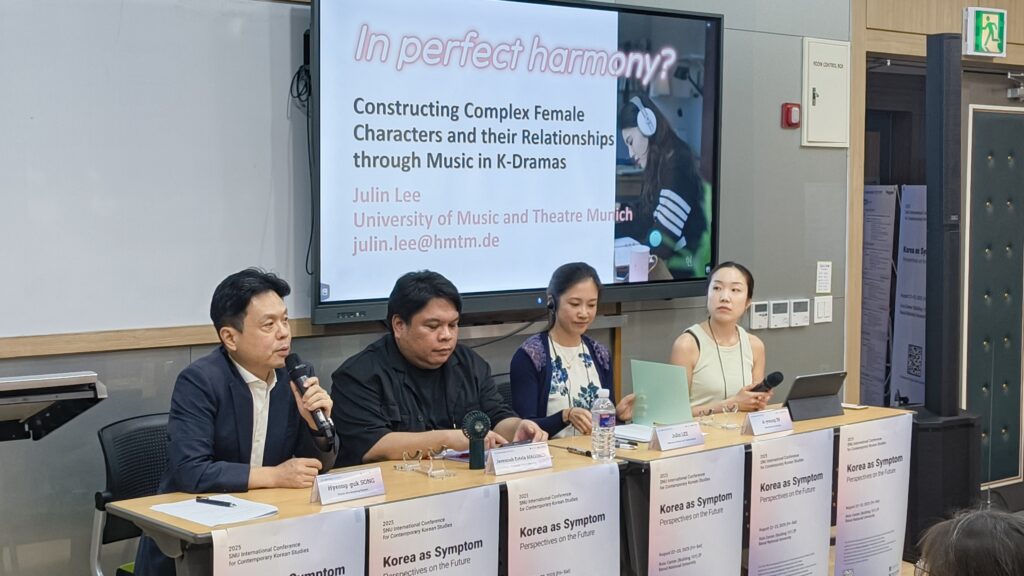
The second presenter was Julin Lee of the University of Music and Theatre Munich, who presented on “In Perfect Harmony? Constructing Complex Female Characters and Their Relationships Through Music in K-Dramas.” Lee analyzed the impact of music on narrative and reception in the K-romance genre. Bringing together popular music studies, screen music studies, and postfeminism, the presentation examined the relationship between music and female characters, arguing that music serves as a crucial medium for constructing complex female characters and developing narratives of their relationships.
This session provided a valuable opportunity to examine how Korean narratives are reconstructed through digital culture and popular music. In particular, by bringing together two distinct cases—the true crime genre and music in K-romance—it gathered different fragments of Korean narrative in one place and contributed to forming a broader picture of contemporary Korean narratives.