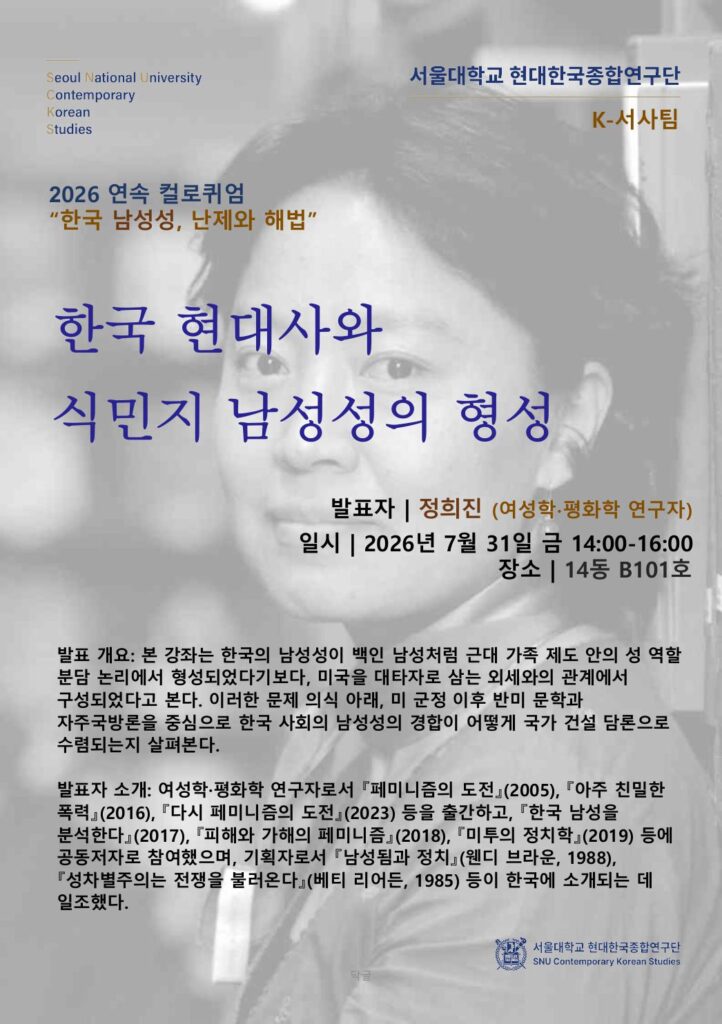
On July 31, 2026, a lecture organized by the Narrative Team of the SNU Contemporary Korean Studies was held in Room B101, Building 14, at Seoul National University. At the event, feminist and peace studies scholar Chung Hee-jin delivered a presentation titled “The Formation of Colonial Masculinity in Modern Korean History: Focusing on Anti-American Narratives.”
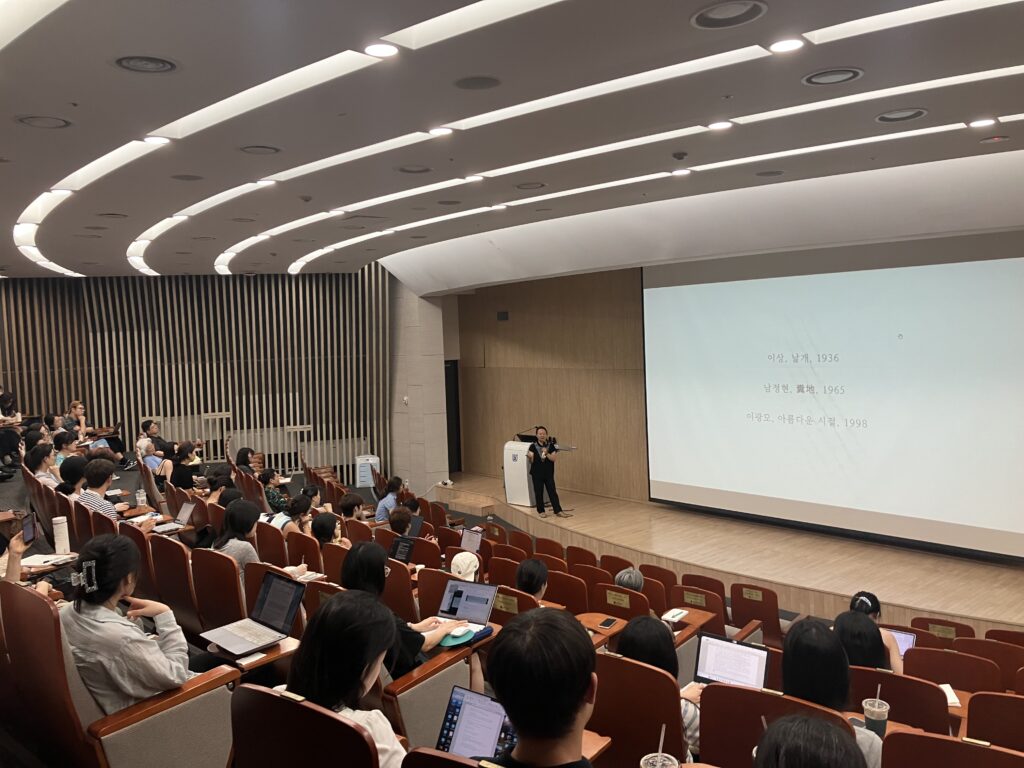
Drawing on qualitative research methods, postcolonialism, and feminist theory, the speaker emphasized that masculinity and femininity are not inherent or essential realities, but ideologies constructed within particular social relations. She also explained that masculinities always exist in the plural, shaped by differences such as class, race, nationality, region, and age. Traits commonly associated with masculinity, she argued, are likewise not fixed essences but socially accepted ideas that operate differently according to historical and social contexts.
In particular, the speaker argued that Korean masculinity should be understood not simply as the extension of gender roles formed within the modern Western family into the public sphere, but as a form of “colonial masculinity” constructed through Korea’s relationship with foreign powers, especially the United States. From this perspective, masculine culture in modern Korean history was formed not merely through gender relations within Korean society, but within a triangular structure involving “Korean men–American men, particularly U.S. military personnel–Korean women.” She analyzed anti-American literature produced between the establishment of the U.S. military government in 1945 and the 1990s as an important body of material revealing Korean men’s feelings of inferiority, guilt, psychological complexes, and nationalist desires.
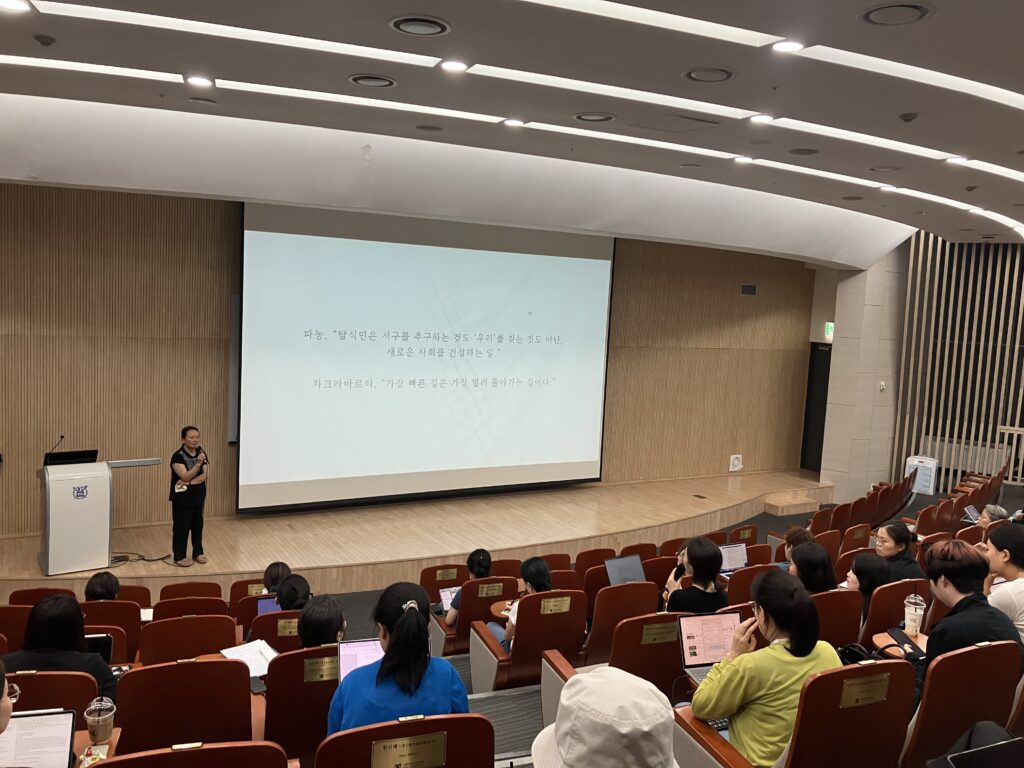
The lecture concluded with the argument that the task of decolonization lies neither in following the West nor in restoring a fixed notion of “us,” but in constructing new social and political agendas grounded in the concrete realities and relationships of Korean society.