The SNU Center for Contemporary Korean Studies held its 3rd International Conference on August 21 and 22 under the theme “Korea as Method.” On the first day of the conference, the Values and Identity Team convened its first session, “Inventing the Real: Religion, Truth, and Boundary-Making,” at Youngwon Hall (Room 210) of the SNU Asia Center. Chaired by Sung-Chung Lee (Seoul National University), the session featured three presentations.
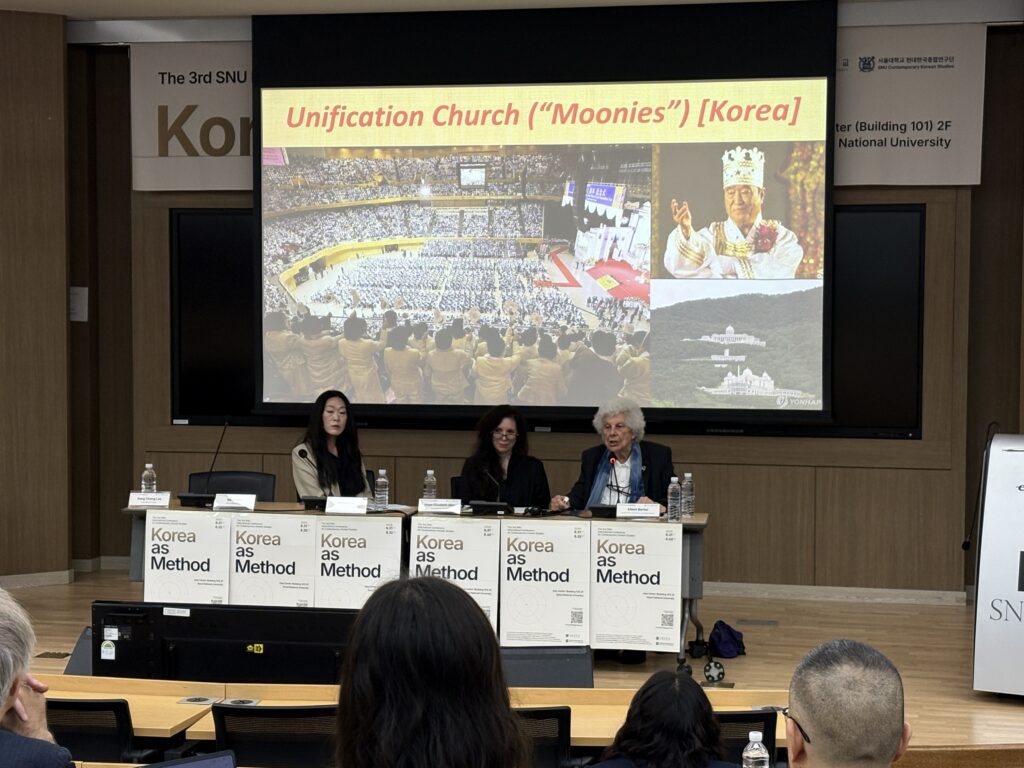
Eileen Barker (London School of Economics and Political Science), in her presentation “Fifty Years of Observing New Religious Movements: What Were They Like? And How Did They Change?,” reflected on the recurring characteristics and transformations of new religious movements (NRMs) that she has observed over the past half-century since the 1970s. Her focus was on minority religions that became particularly visible after the Second World War, especially groups commonly labeled as “cults.”
While emphasizing that these movements cannot be reduced to a single model, Barker identified a number of characteristics that have repeatedly appeared among them. Because many of their adherents are first-generation members, converts often display an unusually high degree of enthusiasm. Their demographic profiles tend to differ from those of the wider population, they frequently emerge around founders invested with charismatic authority, and they may develop dualistic worldviews structured around oppositions such as truth and falsehood or good and evil. At the same time, they are often subjected to suspicion and persecution by mainstream society. Drawing on examples including the Unification Church, Jehovah’s Witnesses, Scientology, Daesoon Jinrihoe, and Soka Gakkai, Barker particularly emphasized that new religious movements tend to undergo change far more rapidly and radically than established religions.
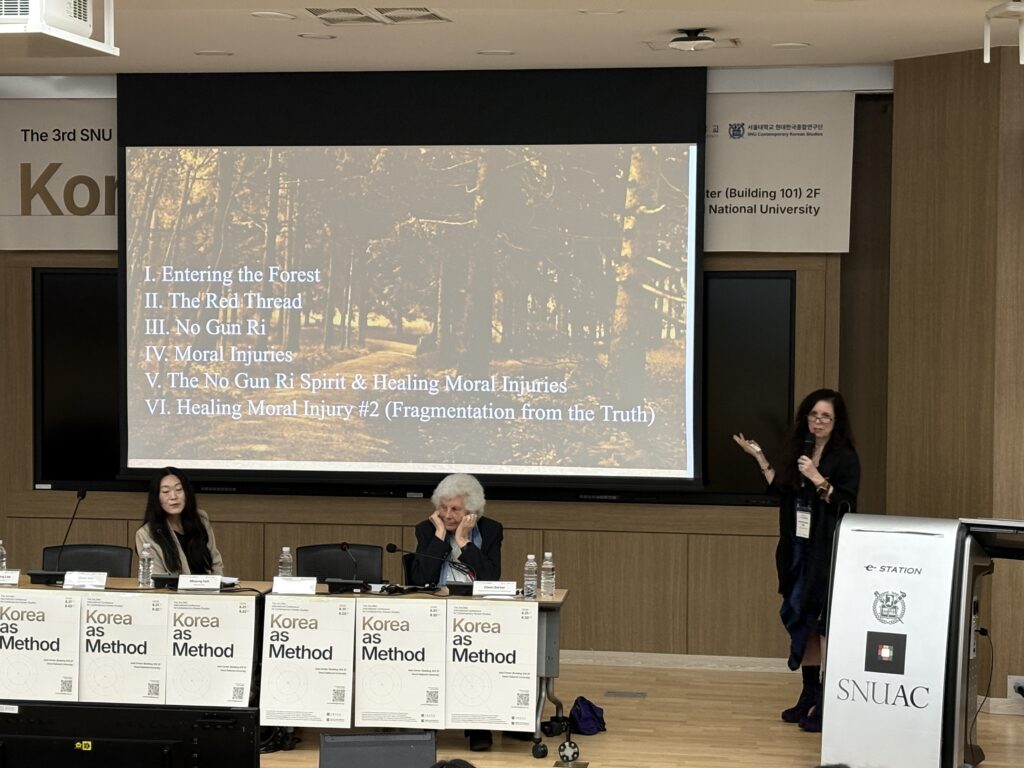
Hope Elizabeth May (Central Michigan University), in “The No Gun Ri Spirit: An Ethic of Witness, Moral Repair, and the Search for Meaning,” examined the survivor-led No Gun Ri movement, which emerged in response to the killing of civilians by U.S. forces during the early months of the Korean War, through the lens of recovery from “moral injury.” Developed by Jonathan Shay, the concept refers to the lasting wound produced when a legitimate authority violates a moral order that it was expected to uphold. No Gun Ri, May argued, represents such a betrayal: soldiers of the U.S. First Cavalry Division, deployed with the ostensible responsibility of protecting civilians, instead killed the very people they were expected to protect.
Tracing the movement from Chung Eun-yong to his son Chung Koo-do, May argued that their efforts went beyond the pursuit of factual truth and constituted an “ethic of witness” directed toward the restoration of human dignity. Acts of testimony and commemoration, she suggested, help create a “community of trustworthy listeners” willing to share the burden of suffering. She further proposed that education itself can constitute a form of moral repair, responding to the demand for meaning that persists in the aftermath of atrocity.
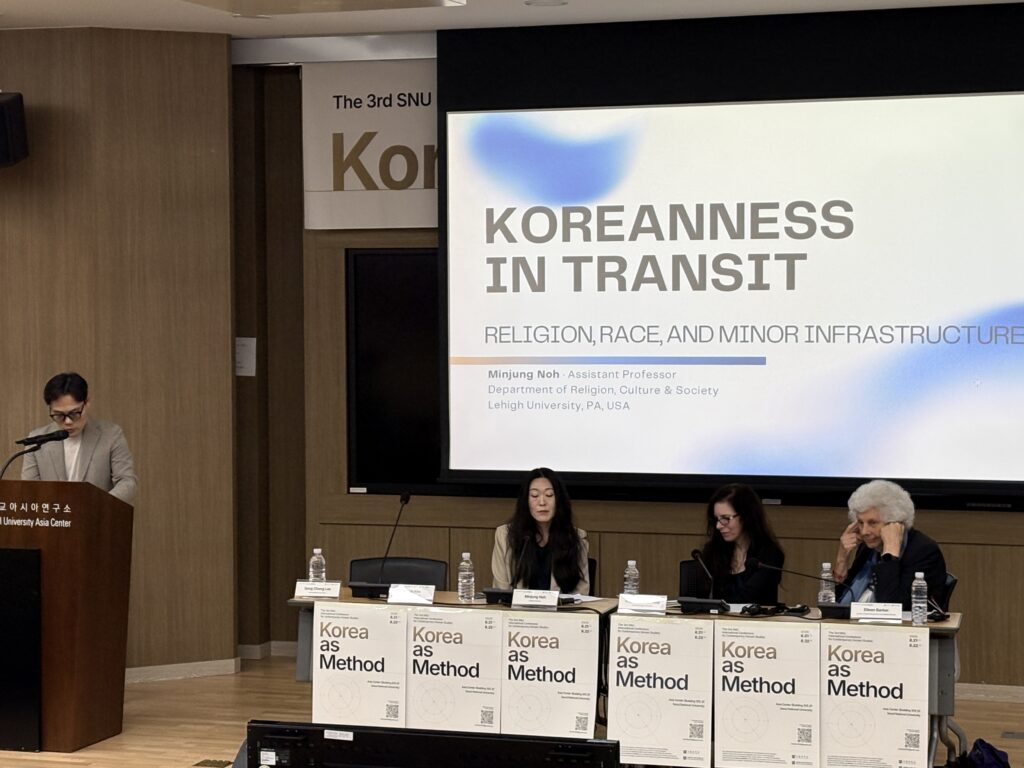
Minjung Noh (Lehigh University), in “Koreanness in Transit: Religion, Race, and Minor Infrastructure,” examined the routes through which forms of “Koreanness” travel across the Pacific and the political meanings they acquire in the process. She distinguished between “major infrastructure”—clearly authored and institutionalized channels such as treaties, missions, cultural heritage regimes, and streaming platforms—and “minor infrastructure,” the accumulated arrangements of objects, rhythms, and rules that fill and animate those channels. It is the latter, she argued, that allows cultural forms to cross oceans even in the absence of their original practitioners.
Examples included the Hwanghae-do shamanic ritual attire featured in the opening sequence of KPop Demon Hunters (2025), as well as the fan dance performed in Korean American churches in North America despite its roots in ritual traditions that the performers themselves may explicitly disavow. Noh paid particular attention to a striking transnational reversal: forms that Korean modernity once rejected as “superstition” and later administratively recategorized as cultural heritage can, once abroad, become established as racialized expressions of ethnic style. Having acquired a form of legitimacy overseas that domestic classificatory regimes had not originally granted them, these forms can then return to Korea with altered meanings and authority. Noh concluded that understanding such circulations requires bringing the perspectives of Korean Studies and Asian American Studies into conversation.
Following the three presentations, Mina Kim (Incheon National University) offered comments on the panel.
Taken together, the three presentations examined the politics of boundary-making between religion and culture through a diverse range of cases. Whether in the classification and transformation of new religious movements, the struggle to restore moral truth and human dignity after historical violence, or the transpacific circulation and reclassification of Korean religious and cultural forms, the presentations demonstrated that the categories through which societies distinguish the religious from the cultural, the legitimate from the suspect, and the real from the unreal are neither fixed nor self-evident. Rather, they are continually produced, contested, and authorized through social and political processes. In this sense, the session illuminated how the “real” itself is not simply given, but invented through practices of classification, recognition, and boundary-making.