The 2nd International Conference for Contemporary Korean Studies, organized by the Seoul National University Contemporary Korea Research Group, concluded with a closing roundtable titled “Korea as Symptom: Why Symptomatology in Korean Studies?” Chaired by Jaeho Kang (Seoul National University), the session brought together Woo-sung Kang and Hong Jung Kim (Seoul National University) to reflect on the theoretical meaning of the conference’s overarching theme, “Korea as Symptom,” and to explore the possibility of developing symptomatology as a methodological approach to Contemporary Korean Studies.
Woo-sung Kang began by tracing how the concept of the “symptom” has changed across medicine, psychoanalysis, and critical theory. In its classical medical sense, a symptom is a visible sign through which an underlying disease can be diagnosed and ultimately eliminated. In Freudian and Lacanian psychoanalysis, however, the symptom acquires a different significance. Rather than being merely an abnormality to be removed, it becomes an expression of the underlying structure through which repression, desire, and conflicting forces are made visible. Reading a symptom therefore means tracing the tensions and structural contradictions that make its appearance possible.
Kang extended this discussion to symptomatic reading and the work of Gilles Deleuze. A symptomatic reading does not focus only on what is explicitly present in a text or social reality. It asks what has been omitted, marginalized, repressed, or left unsaid and considers how those absences disclose the structure beneath the surface. From this perspective, “Korea as Symptom” should not be understood as a search for a fixed or exceptional Korean essence. Rather, Korean phenomena must be situated within broader structures, including global neoliberal capitalism, the divided Korean Peninsula, and the historical residues of colonialism and the Cold War.
Kang drew particular attention to the coexistence of different historical temporalities in contemporary Korea. Colonial legacies and the unresolved division of the peninsula persist alongside a globally successful economy and cultural industries. He also identified what he described as the labor-intensive character of Korean society, connecting seemingly disparate phenomena such as the long training systems of K-pop performers, rapid delivery services, ppalli-ppalli culture, catch-up capitalism, and other forms of highly disciplined performance. A symptomatological perspective, he suggested, directs attention not only to the visible efficiency or success of such phenomena but also to the forms of labor and historical structures that sustain them.
Hong Jung Kim then developed symptomatology more explicitly as a possible methodology for Contemporary Korean Studies. His presentation revolved around three questions: What is a symptom? Why might Korean Studies adopt a symptomatological approach? And how could such an approach actually be practiced? Rather than offering a finished methodology, Kim presented these questions as an invitation for scholars from different disciplines to explore the possibilities of symptomatology together.
Kim distinguished a symptom from a self-contained “fact.” Whereas a fact appears objective, complete, and already established, a symptom remains enigmatic. It demands interpretation and draws the observer toward forces and structures that are not immediately visible. Symptomatology therefore offers a way of moving beyond a simple positivism in which social reality is understood primarily through the accumulation of observable facts.
Drawing on figures including Georges Didi-Huberman, Carlo Ginzburg, and Gilles Deleuze, Kim summarized the logic of symptoms through four concepts: eventfulness, fragmentariness, affectivity, and the relationality of care. A symptom is eventful because it emerges unexpectedly rather than according to a predetermined logic. It is fragmentary because it appears through gaps, ruptures, and incomplete traces rather than as a coherent whole. It is affective because it is not merely an object of detached observation but something that captures the researcher’s concern and involvement. Finally, engaging with a symptom entails a relation of care: interpretation involves responding to the social, historical, and affective forces that have shaped it.
Kim argued that contemporary Korea provides a particularly rich field for such an approach because of the compressed temporality of Korean modernization. Different historical times, institutions, values, and forms of social life have been layered upon one another at extraordinary speed, generating unfamiliar and sometimes contradictory phenomena across politics, economics, religion, and culture. Recent political turbulence and new political and religious mobilizations coexist with new forms of democratic participation, including demonstrations led by younger women using light sticks and other symbols of popular culture. At the same time, the global success of K-culture exists alongside persistently high suicide rates, extremely low fertility, inequality, regional disparities, intense competition, meritocratic pressures, neoliberal self-discipline, and pervasive survivalism.
Rather than reducing these phenomena to a single causal structure, Kim proposed approaching them as a “montage” of symptoms. Before deciding whether contemporary Korea represents a viable alternative for the future or a negative case of accelerated modernization, scholars should first attend closely to these heterogeneous signs and explore the relationships among them.
For Kim, practicing symptomatology also requires adopting the perspective of an “outsider.” This does not necessarily mean being a foreign researcher. Rather, it means creating sufficient distance from one’s habitual ways of seeing so that what appears ordinary or self-evident can become strange and worthy of explanation. He illustrated this through the Korean poet Kim Soo-young, who encountered his own society anew through the writings of the British traveler Isabella Bird Bishop. Instead of discovering Koreanness solely in monumental traditions or canonical heritage, Kim Soo-young came to recognize meaning in trivial objects, marginal figures, and fragments of everyday life. Such moments of defamiliarization, Kim argued, exemplify a symptomatological encounter.
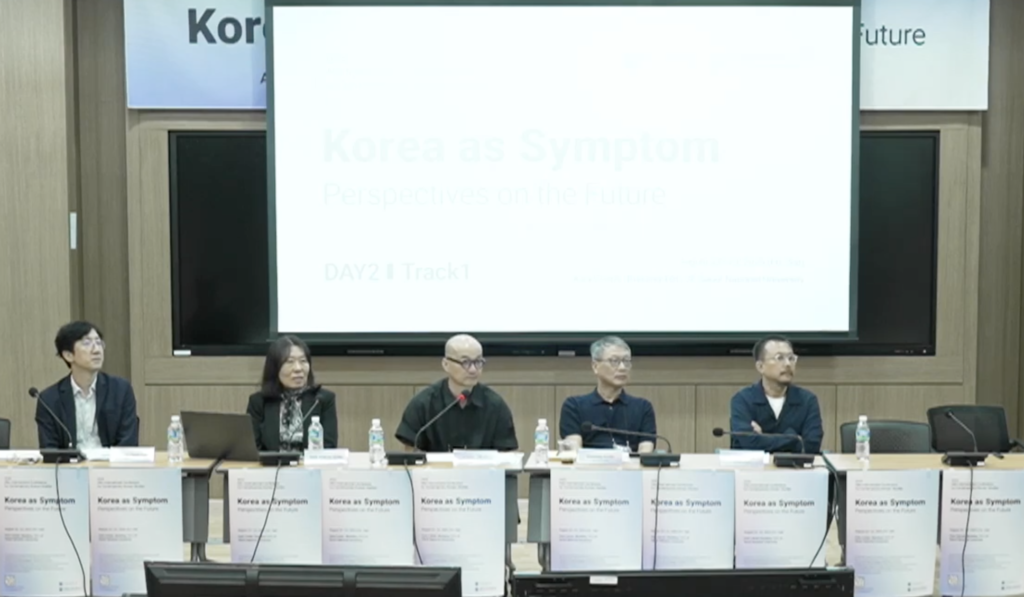
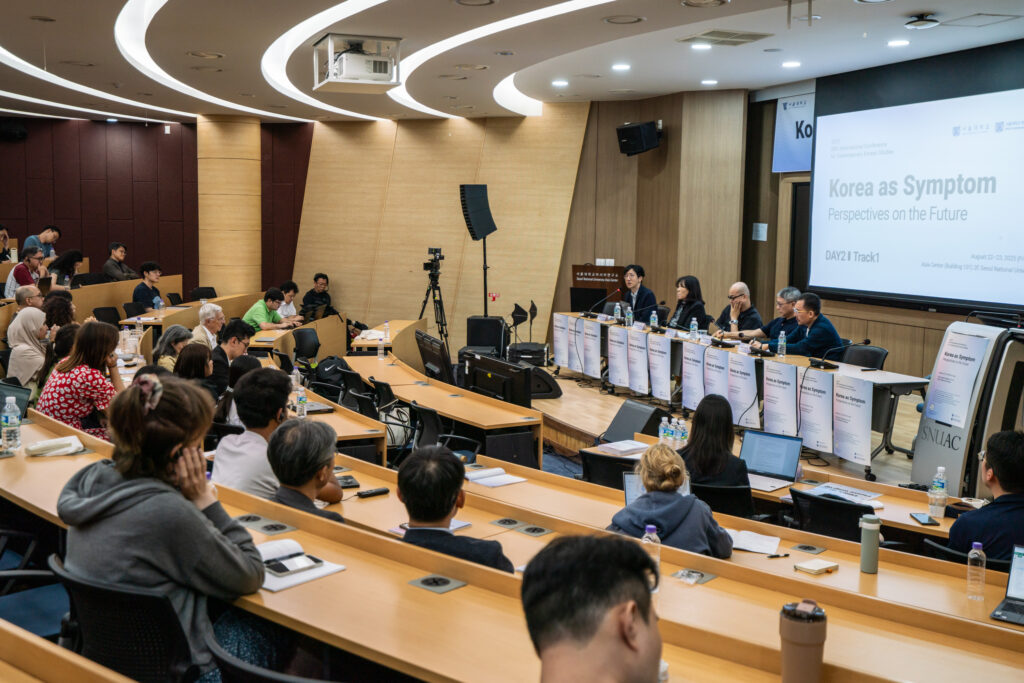
The discussion that followed raised a fundamental question about the theoretical foundations of this approach. One participant asked what could be gained by grounding “Korea as Symptom” so heavily in Western intellectual traditions such as Freud, Lacan, Deleuze, psychoanalysis, and continental philosophy. Given the increasing breadth and sophistication of Korean Studies, the participant asked whether the field should move beyond the reactive translation of established theoretical frameworks and develop theoretical approaches that emerge more directly from Korea’s historical and social specificity while remaining in conversation with global scholarship.
Kim responded that theory should not be understood simply as a body of established knowledge applied to empirical reality. Theory, he argued, is above all a way of seeing. A genuine theoretical encounter can unsettle what researchers believe they already know and allow familiar realities to appear differently. From this perspective, the growing number of theoretical experiments surrounding Korea can itself be regarded as a productive sign: contemporary Korea has become sufficiently complex and intellectually compelling to demand new ways of seeing and explaining it.
Kang likewise described theoretical intervention as a form of metacritical engagement. From the position of an outsider, theory can disrupt established assumptions and help scholars think beyond existing disciplinary frameworks. He also suggested that theory can serve as an academic lingua franca through which researchers working in different regions and disciplines communicate with one another. The value of theory, in this sense, lies not in its Western origin but in whether concepts can be mobilized, transformed, and contested through encounters with different empirical and historical realities.
At the same time, participants emphasized that Korean Studies should not remain merely a recipient of theories developed elsewhere. The encounter between existing concepts and Korean experience may itself modify established theories and generate new concepts. Even the process of translating theoretical terms into Korean can expose semantic differences that open new directions for thought. The discussion thus pointed toward a more reciprocal relationship between Korea and theory: Korea can be interpreted through theory, but the Korean experience can also challenge and transform the conceptual frameworks through which it is interpreted.
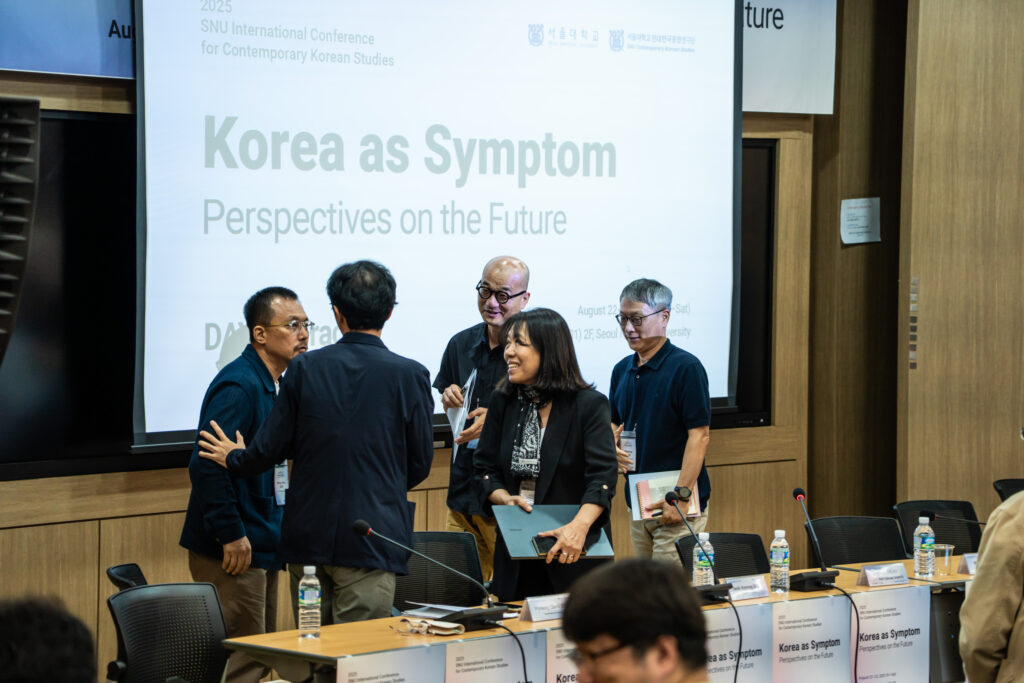
The closing roundtable therefore did not define “Korea as Symptom” as a catalog of social pathologies. A symptom was understood instead as an unfamiliar or contradictory sign emerging on the surface of contemporary life through which less visible historical and social forces can be perceived. Korea, from this perspective, becomes neither a single coherent model nor an exceptional case, but a complex field in which different temporalities, desires, institutions, memories, and structures intersect and generate multiple symptoms.
The final question of the conference consequently shifted from “Which existing theory can best explain Korea?” to “What new questions do the symptoms emerging from Korea pose to existing theory?” Symptomatology was proposed as a way of remaining attentive to fragments and contradictions rather than reducing contemporary Korea to a single explanatory structure, while connecting different disciplines and perspectives in the search for new concepts and forms of knowledge.