From Korean Democracy to K-pop — A Comprehensive Overview Kim Doyeon | August 21, 2025
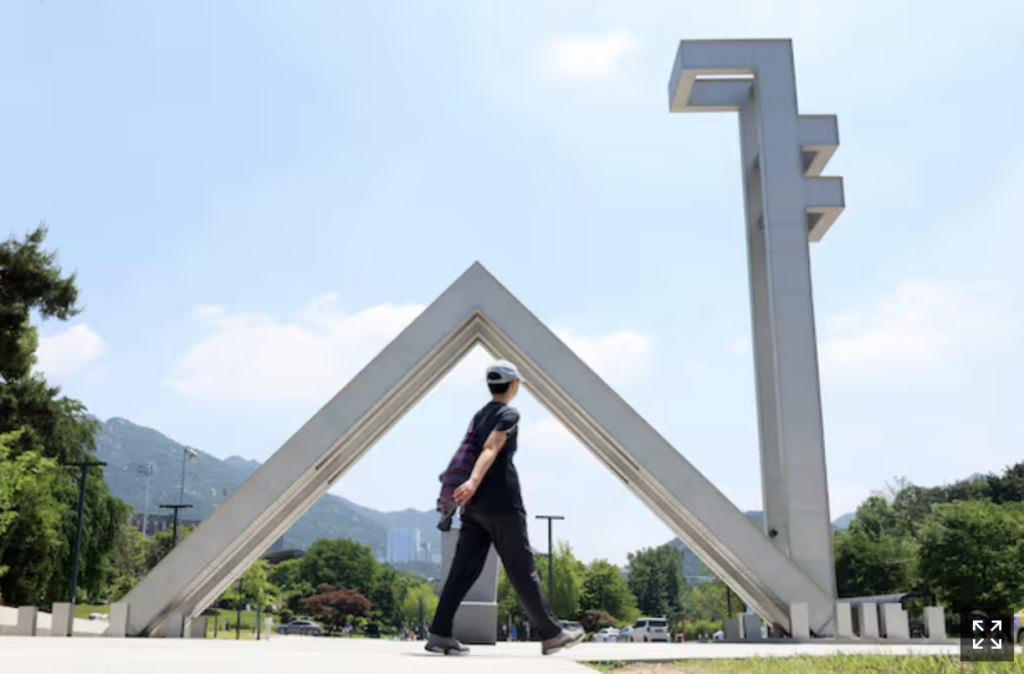
Korean studies researchers from around the world will convene at Seoul National University (SNU) for an international academic conference covering topics ranging from Hallyu phenomena such as K-pop to Korean labor issues including the Yellow Envelope Act.
The SNU Contemporary Korean Studies Network will host the 2025 SNU International Conference on Contemporary Korean Studies over two days, August 22–23, at the SNU Asia Research Institute. This year’s conference will bring together 111 researchers from 15 countries, including Korea, China, Japan, Israel, Canada, the United Kingdom, and Germany.
Now in its second year, the conference will explore Korean social phenomena under the theme “Korea as Symptom” across fields including K-pop, Korean literature, religion, gender, diplomacy, political economy, democracy, and modern history. Simultaneous interpretation will be available at all sessions, and the conference will also be livestreamed on YouTube.
Among the international participants are Donald Baker, Professor at the University of British Columbia and a leading Canadian scholar of Korean studies and new religious movements, and Valérie Gelézeau, Professor at the École des Hautes Études en Sciences Sociales (EHESS) in France, known for her research on Korean spatial culture and shifting perceptions of borders.
Also attending are Hyong-ki Kwon, Director of the Korean Studies Institute at the University of Washington’s Jackson School, who focuses on the globalization of Korean studies and expanding research networks, and Park Myung-jun of the Korea Labor Institute, whose research covers the Yellow Envelope Act (amendments to Articles 2 and 3 of the Trade Union and Labor Relations Adjustment Act) and the Gwangju-type job model.
The SNU Contemporary Korean Studies Network was established in 2023 with the goal of providing a comprehensive academic response to the growing global interest in contemporary Korea. The network aims to consolidate domestic and international research capabilities on modern Korea and to raise the overall quality of Korean studies. Future plans include establishing a dedicated Institute of Contemporary Korean Studies to train researchers and integrate academic work with education.
A representative of the network noted, “Korean studies has traditionally centered on language and the Joseon period, but global interest has now broadened considerably to encompass contemporary Korean culture, economy, and politics. There is a clear need to move beyond popular-level inquiry toward research with systematic rigor and structural depth.”
The network continues to collaborate with international researchers and publish the results of its work. Last year’s conference featured research and discussion on shifts in Korean values, Hallyu, and emerging technologies. Upcoming conferences are planned under the themes “Korea as Method” and “Korea as Alternative” in the following two years respectively.
Kwon Hyong-ki, Professor of Political Science and International Relations at SNU and Director of the network, stated, “At prominent universities across the United States and Europe — including UC Berkeley, the University of Iowa, and Freie Universität Berlin — hundreds of students are enrolling in Korean studies courses, and institutions are actively hiring faculty in this field. In response, the network must continue its comprehensive and interdisciplinary research on contemporary Korea, with the goal of establishing a global hub that leads the field.”
Lee Seung-cheol, Professor of Anthropology at SNU and chair of the organizing committee for this year’s conference, remarked, “This conference will be an attempt to read the contemporary phenomena of Korean society — from the crisis of democracy to the global spread of K-pop — within the broader context of historical and worldwide transformation.”
출처:https://www.chosun.com/national/national_general/2025/08/21/4AKN2E3SGBDUBIEWY65OYXB5AY/?utm_source=kakaotalk&utm_medium=shareM&utm_campaign=Mnews