The 1st International Conference: Introduction
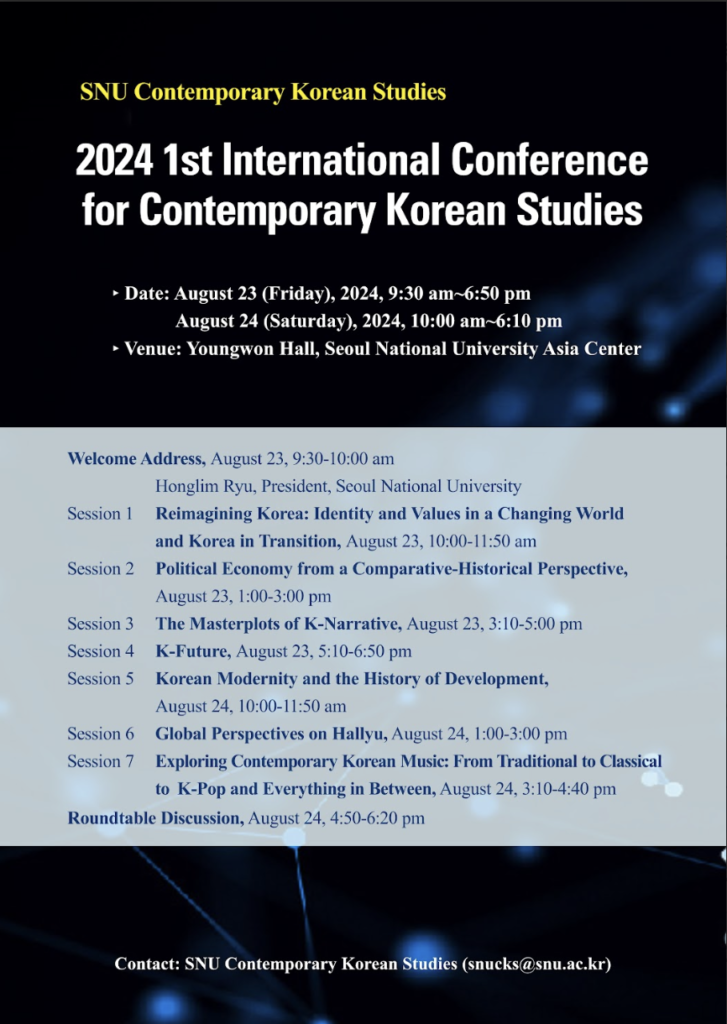
The SNU Center for Contemporary Korean Studies will host The 1st International Conference for Contemporary Korean Studies on August 23–24, 2024, at Youngone Hall, SNU Asia Center.
Bringing together scholars working across culture, the arts, religion, history, politics, society, technology, and other fields, the conference will explore contemporary Korea from a wide range of disciplinary perspectives. It also aims to provide a forum for scholars from Korea and abroad to engage across disciplinary and geographical boundaries and to build new networks for collaborative research.
We warmly invite members of the SNU community, researchers, and all those interested in contemporary Korea to join us.
- Event: The 1st International Conference for Contemporary Korean Studies
- Date & Time:
August 23 (Fri), 2024, 09:30–18:50
August 24 (Sat), 2024, 10:00–18:10 - Venue: Youngone Hall, SNU Asia Center, Seoul National University
- Format: In person and livestreamed on YouTube
- YouTube: https://www.youtube.com/@SNUCKS2024
- Contact: snucks@snu.ac.kr
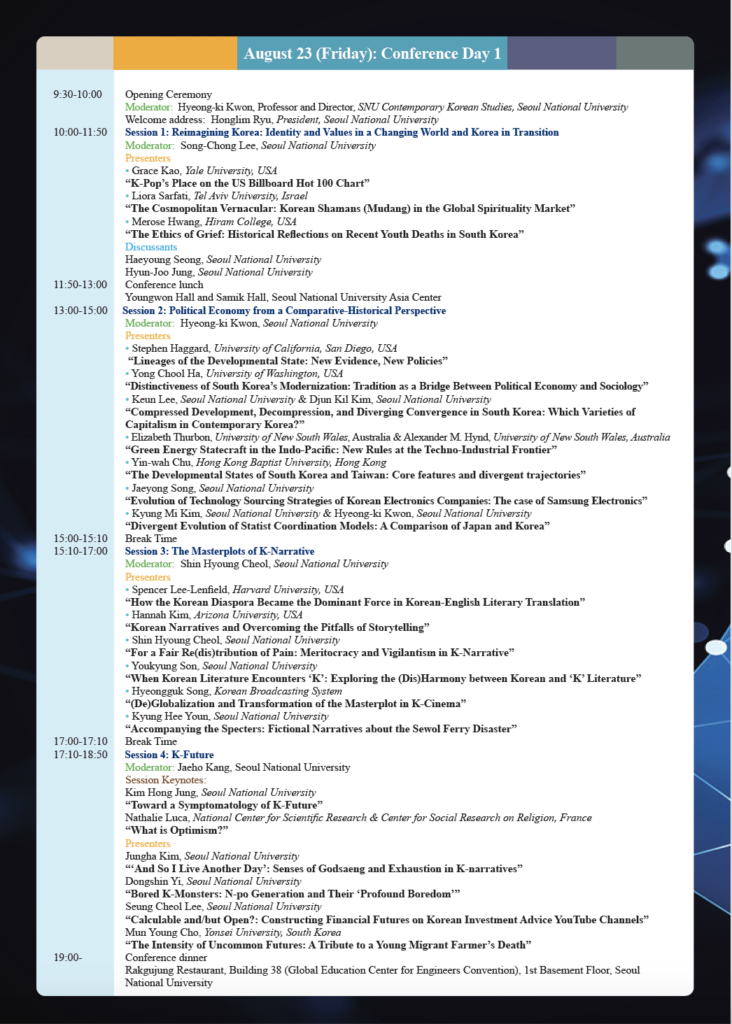
August 23 (Friday) — Conference Day 1
09:30–10:00 | Opening Ceremony
Moderator: Hyeong-ki Kwon
Professor and Director, SNU Contemporary Korean Studies, Seoul National University
Welcome Address: Honglim Ryu
President, Seoul National University
10:00–11:50 | Session 1
Reimagining Korea: Identity and Values in a Changing World and Korea in Transition
- Grace Kao (Yale University, USA)
“K-Pop’s Place on the US Billboard Hot 100 Chart” - Liora Sarfati (Tel Aviv University, Israel)
“The Cosmopolitan Vernacular: Korean Shamans (Mudang) in the Global Spirituality Market” - Merose Hwang (Hiram College, USA)
“The Ethics of Grief: Reflections on Recent Youth Deaths in South Korea”
13:00–15:00 | Session 2
Political Economy from a Comparative-Historical Perspective
- Stephen Haggard (University of California, San Diego, USA)
“Lineages of the Developmental State: New Evidence, New Policies” - Yong Chool Ha (University of Washington, USA)
“Distinctiveness of South Korea’s Modernization: Tradition as a Bridge Between Political Economy and Sociology” - Keun Lee (Seoul National University) & Djun Kil Kim (Seoul National University)
“Compressed Development, Decompression, and Diverging Convergence in South Korea: Which Varieties of Capitalism in Contemporary Korea?” - Elizabeth Thurbon (University of New South Wales, Australia) & Alexander M. Hynd (University of New South Wales, Australia)
“Green Energy Statecraft in the Indo-Pacific: New Rules at the Techno-Industrial Frontier” - Yin-wah Chu (Hong Kong Baptist University, Hong Kong)
“The Developmental States of South Korea and Taiwan: Core Features and Divergent Trajectories” - Jaeyong Song (Seoul National University)
“Evolution of Technology Sourcing Strategies of Korean Electronics Companies: The Case of Samsung Electronics” - Kyung Mi Kim (Seoul National University) & Hyeong-ki Kwon (Seoul National University)
“Divergent Evolution of Statist Coordination Models: A Comparison of Japan and Korea”
15:10–17:00 | Session 3
The Masterplots of K-Narrative
- Spencer Lee-Lenfield (Harvard University, USA)
“How the Korean Diaspora Became the Dominant Force in Korean-English Literary Translation” - Hannah Kim (Arizona University, USA)
“The Unexpected Perils of Pervasive Story Telling” - Shin Hyoung Cheol (Seoul National University)
“For a Fair Re(dis)tribution of Pain: Meritocracy and Vigilantism in K-Narrative” - Youkyung Son (Seoul National University)
“When Korean Literature Encounters ‘K’: Exploring the (Dis)Harmony between Korean and ‘K’ Literature” - Hyeongguk Song (Korean Broadcasting System)
“(De)Globalization and Transformation of the Masterplot in K-Cinema” - Kyung Hee Youn (Seoul National University)
“Accompanying the Specters: Fictional Narratives about the Sewol Ferry Disaster”
17:10–18:50 | Session 4
K-Future
- Kim Hong Jung (Seoul National University)
“Toward a Symptomatology of K-Future” - Nathalie Luca (National Center for Scientific Research, Center for Social Research on Religion, France)
“What Is Optimism?”
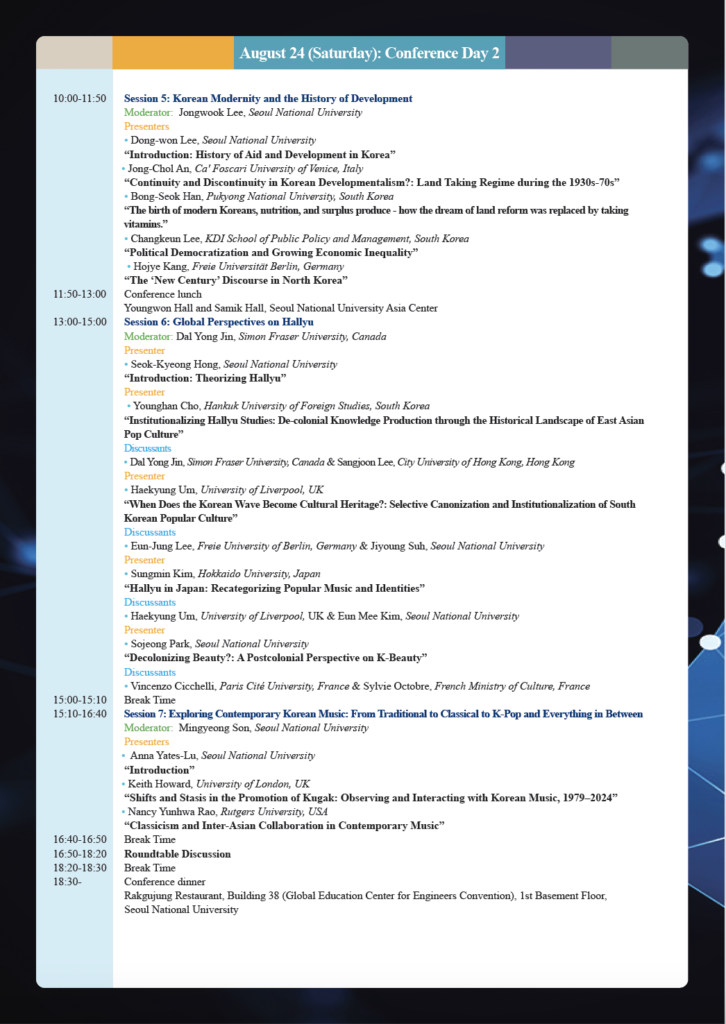
August 24 (Saturday) — Conference Day 2
10:00–11:50 | Session 5
Korean Modernity and the History of Development
- Dong-won Lee (Seoul National University)
“Introduction: History of Aid and Development in Korea” - Jong-Chol An (Ca’ Foscari University of Venice, Italy)
“Continuity and Discontinuity in Korean Developmentalism?: Land Taking Regime during the 1930s–70s” - Bong-Seok Han (Pukyong National University, South Korea)
“The Birth of Modern Koreans, Nutrition, and Surplus Produce: How the Dream of Land Reform Was Replaced by Taking Vitamins” - Changkeun Lee (KDI School of Public Policy and Management, South Korea)
“Political Democratization and Growing Economic Inequality” - Hojye Kang (Freie Universität Berlin, Germany)
“The ‘New Century’ Discourse in North Korea”
13:00–15:00 | Session 6
Global Perspectives on Hallyu
- Seok-Kyeong Hong (Seoul National University)
“Introduction: Theorizing Hallyu” - Younghan Cho (Hankuk University of Foreign Studies, South Korea)
“Institutionalizing Hallyu Studies: De-colonial Knowledge Production through the Historical Landscape of East Asian Pop Culture” - Haekyung Um (University of Liverpool, UK)
“When Does the Korean Wave Become Cultural Heritage?: Selective Canonization and Institutionalization of South Korean Popular Culture” - Sungmin Kim (Hokkaido University, Japan)
“Hallyu in Japan: Recategorizing Popular Music and Identities” - Sojeong Park (Seoul National University)
“Decolonizing Beauty?: A Postcolonial Perspective on K-Beauty”
15:10–16:40 | Session 7
Exploring Contemporary Korean Music: From Traditional to Classical to K-Pop and Everything in Between
- Anna Yates-Lu (Seoul National University)
“Introduction” - Keith Howard (University of London, UK)
“Shifts and Stasis in the Promotion of Kugak: Observing and Interacting with Korean Music, 1979–2024” - Nancy Yunhwa Rao (Rutgers University, USA)
“Classicism and Inter-Asian Collaboration in Contemporary Music”
16:50–18:20 | Roundtable Discussion
The 1st International Conference: Overview
The Seoul National University Contemporary Korea Research Group held the 1st International Conference for Contemporary Korean Studies on August 23–24, 2024. Over the course of two days, scholars from Korea and abroad gathered to examine a wide range of issues shaping contemporary Korea, including identity and values, political economy, narrative, the future, modernization and development, Hallyu, and music. Opening with welcoming remarks by SNU President Honglim Ryu, the conference explored how scholarship might respond to the rapidly expanding and diversifying global interest in contemporary Korea while building on the foundations established by traditional Korean Studies in language, literature, and history.
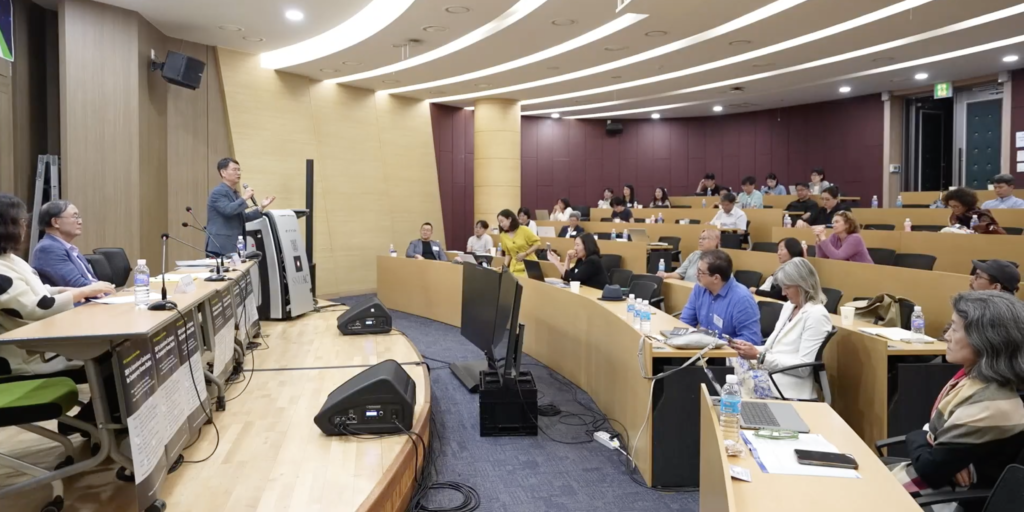
The discussions on the first day began with a fundamental question: what constitutes the “Korean” in contemporary Korea? The session “Reimagining Korea: Identity and Values in a Changing World and Korea in Transition” examined how Korean identities and values are transformed through domestic and transnational interactions. Presentations on the globalization of K-pop, the transnational expansion of Korean shamanism, and practices of mourning and remembrance surrounding the Sewol Ferry disaster and the Itaewon tragedy demonstrated that contemporary Korean identity cannot be understood as a fixed cultural essence. In particular, the discussion of Korean shamanism as a “living tradition” continually reshaped through urbanization, globalization, and media illustrated the need to understand Koreanness through processes of adaptation, interaction, and change.
The session “Political Economy from a Comparative-Historical Perspective” reconsidered Korean capitalism and economic development beyond a singular narrative of the developmental state. Presentations examined the historical lineages of the developmental state, the persistence of traditional social relations, transformations of Korean capitalism after compressed development, divergent trajectories in South Korea and Taiwan, Samsung Electronics’ transition from technological catch-up to innovation, and the emergence of “green energy statecraft” in the context of climate change and economic security. Together, these studies showed that Korea’s development experience is not simply a completed success story of the past, but an ongoing process continually reshaped by transformations in the global political economy. The convergence of green transition, technological competition, and U.S.–China strategic rivalry further demonstrated the need to analyze Korean industrial policy through the interconnected lenses of technology, energy, and national security.
“The Masterplots of K-Narrative” approached contemporary Korean society through recurring narrative forms in literature, film, translation, and popular culture. The session addressed the growing role of diasporic translators in bringing Korean literature into English, the possibilities and dangers of pervasive storytelling, meritocracy and retributive justice, the formation of K-Literature through translation, transformations in K-Cinema, and literary narratives of the Sewol Ferry disaster. Here, the “K” in K-Narrative appeared not as a category determined simply by language or cultural content, but as something continually reconstructed through translation and global circulation. The session also asked whether Korean narratives might challenge established conventions of storytelling through genre hybridity, open endings, and other narrative forms, thereby offering alternative ways of organizing stories—and, by extension, understanding life itself.
The final session of the first day, “K-Future,” introduced a new temporal perspective by reading various phenomena in contemporary Korean society as “symptoms” of possible futures. Presentations examined Korean “survivalism,” the distinction between an optimism grounded in concrete action and neoliberal positive thinking, the coexistence of self-improvement and exhaustion among younger generations, the difficulty of imagining alternative futures, and the financialized practices through which the future is calculated and anticipated. From this perspective, the future was presented not simply as a time yet to arrive, but as an analytical lens through which possibilities and crises already embedded in present-day emotions, lifestyles, cultural forms, and economic practices might be identified. Phenomena such as Korea’s extremely low fertility rate and high suicide rate were thus interpreted as symptoms prompting the question of what kinds of futures are becoming possible—or increasingly impossible.
The second day turned more directly to the historical processes that have shaped contemporary Korea and the ways in which Korea has interacted with the wider world. “Korean Modernity and the History of Development” revisited Korean modernization through the histories of foreign aid and development, land regimes from the 1930s to the 1970s, nutrition and surplus agricultural products, economic inequality after democratization, and North Korea’s discourse of the “new century.” These presentations approached “development” not simply as economic growth, but as a historical process involving land, everyday life, political institutions, inequality, and the divergent modernization experiences of North and South Korea.
“Global Perspectives on Hallyu” extended the study of Hallyu beyond the global success of Korean cultural products and treated it as a central problem of knowledge production in Contemporary Korean Studies. The session situated Hallyu within the history of East Asian popular culture, explored the possibilities of “Inter-Asia referencing” as an alternative to Western-centered knowledge production, examined the transformation of Hallyu into cultural heritage through museums, considered both the postcolonial possibilities and new hierarchies associated with K-beauty, and traced how K-pop reshaped Japan’s music industry and perceptions of Korea. Hallyu emerged not as culture simply “exported” from Korea to the world, but as a process moving between Korea, East Asia, and the global sphere, continually transforming cultural categories, identities, and relationships between centers and peripheries.
The music session, “Exploring Contemporary Korean Music: From Traditional to Classical to K-Pop and Everything in Between,” asked what can be understood as “Korean music” today. Moving beyond the disciplinary separation of kugak, Western classical music, and popular music, the session emphasized the need to connect musicology, ethnomusicology, anthropology, and practice-based research while incorporating diasporic musicians, performers outside Korea, and transnational collaboration into the field of Korean music studies. The observation that “Korean music does not take place only in Korea, nor is it made only by Koreans” raised a broader question for Contemporary Korean Studies: rather than defining its object through fixed territorial or ethnic boundaries, how might it reconsider “Koreanness” through movement, interaction, and changing relationships?
The subjects addressed over the two days ranged widely—from political economy to shamanism, translation and literature, K-pop and K-beauty, traditional and contemporary music, financial investment, and imaginaries of the future. Yet across these diverse discussions, contemporary Korea was consistently approached not as a completed model or a fixed cultural essence, but as something continually reconstructed through historical transformation and interaction with the wider world. Korea-to-world, world-to-Korea, and regional and global circulations that eventually return to reshape Korea all emerged as important processes constituting contemporary Korean society. In the final roundtable, Yong Chool Ha described these movements as multiple “arrows of interaction” and argued that Korean Studies was already undergoing a process of “deprovincialization”: Korea was no longer merely a peripheral case to be introduced to the outside world, but a subject worthy of study in its own right and a vantage point from which other societies and broader global phenomena could be understood.
The concluding “Roundtable Discussion” developed these questions into a future agenda under the heading “Contemporary Korean Studies 2.0.” Hyeong-ki Kwon observed that global interest in Korea had expanded rapidly beyond popular culture to encompass political economy, democracy, science and technology, religion, values, and everyday life. At the same time, existing fields of research remained fragmented, and infrastructures for connecting and accumulating research findings and data remained insufficient. Contemporary Korean Studies 2.0 was therefore proposed as a project that would broaden the scope of research, connect different fields to develop shared interdisciplinary agendas and theories, and establish a global research hub at Seoul National University linking researchers and educators around the world. Its ultimate aim was to study Korea not as an isolated case of “Korean particularism,” but through comparative perspectives and within the broader context of human history.
The discussion went one step further. Participants asked whether Contemporary Korean Studies should do more than apply existing theories and methods from political science, sociology, economics, philosophy, and other disciplines to Korea. Could the experience of Korea itself generate new questions and concepts capable of reshaping those disciplines? Alongside an “outside-in” approach that uses established theories to understand Korea, participants therefore proposed an “inside-out” approach in which Korea’s historical and social experiences become a starting point for contributing to broader academic debates. Contemporary Korea, in this sense, would no longer remain merely a case to which universal theories are applied and tested, but could become a site from which new concepts, comparisons, and theoretical interventions emerge.
The 1st International Conference for Contemporary Korean Studies was therefore more than an effort to expand the range of subjects included within Korean Studies. It represented an initial collective experiment in connecting previously separated disciplines and scholarly communities, discovering new research questions within the concrete experiences of contemporary Korea, and placing those questions in dialogue with broader debates about history, society, and culture around the world. To understand Korea more deeply while simultaneously using Korea to reconsider established ways of understanding the world—this was the new starting point for Contemporary Korean Studies proposed by the first international conference.