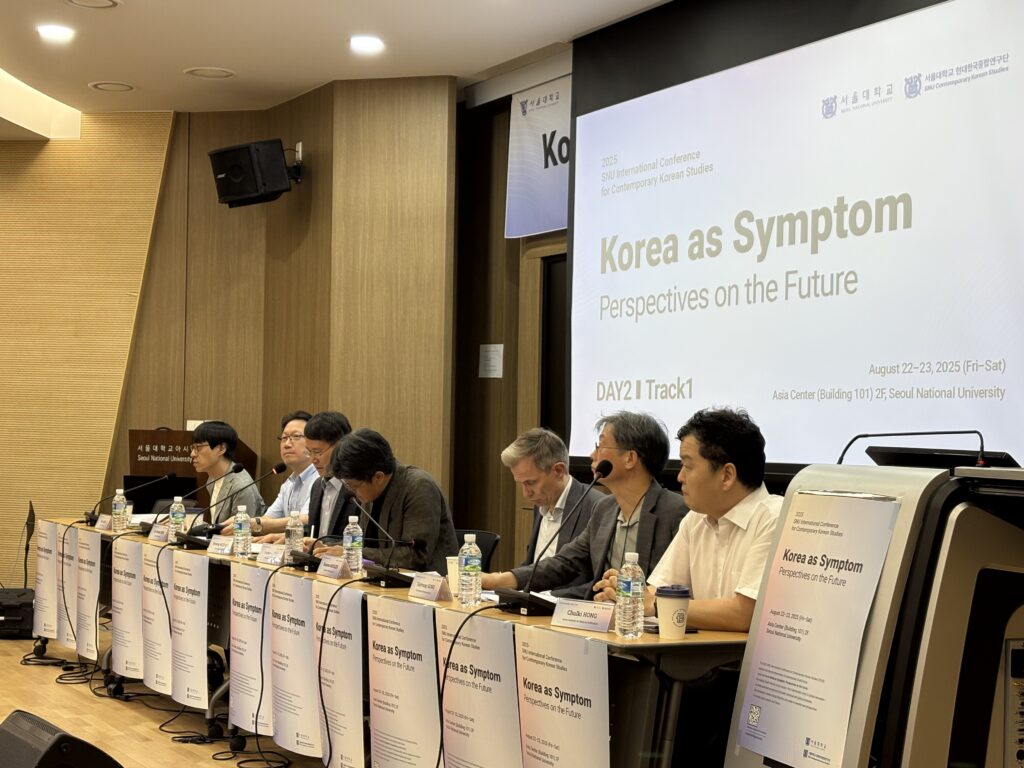
The SNU Center for Contemporary Korean Studies held an international conference titled “Korea as Symptom” over two days, August 22 and 23. As the second session on the second day of the conference, the Political Economy Team and the Democracy and Democratization Team jointly organized a panel titled “Korean Democracy at a Crossroads” at Youngone Hall, SNU Asia Center. Chaired by Professor Hyungkee Kwon (Seoul National University), the session featured four presentations.
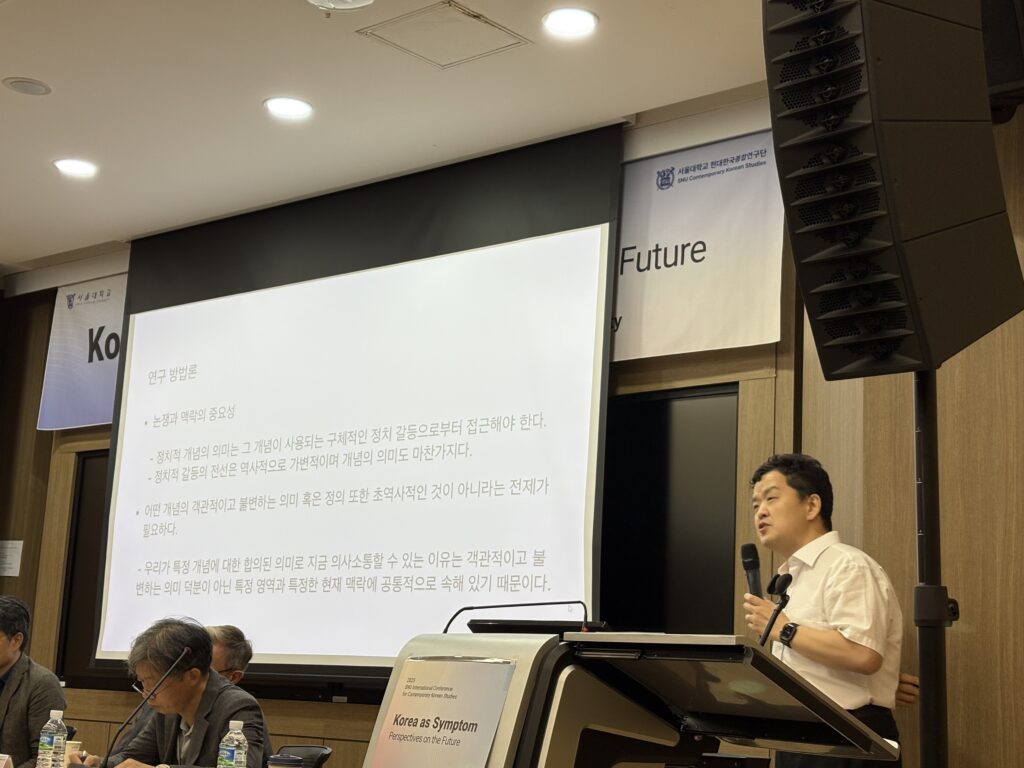
In the first presentation, Professor Cheol-Ki Hong (Korea Institute for National Unification), in “How Liberal Democracy Became the ‘Founding Doctrine’ of South Korea,” offered a critical examination of the conventional view that liberal democracy constituted the founding ideology of South Korea. He first demonstrated that the expression “liberal democracy” was rarely used at the time of the country’s founding and, moreover, was not employed in the same sense that it carries today. He further argued that between 1945 and 1963, “liberal democracy” did not function simply as a translation of the term liberal democracy, but rather served as a political tool for legitimizing anti-communist dictatorship.
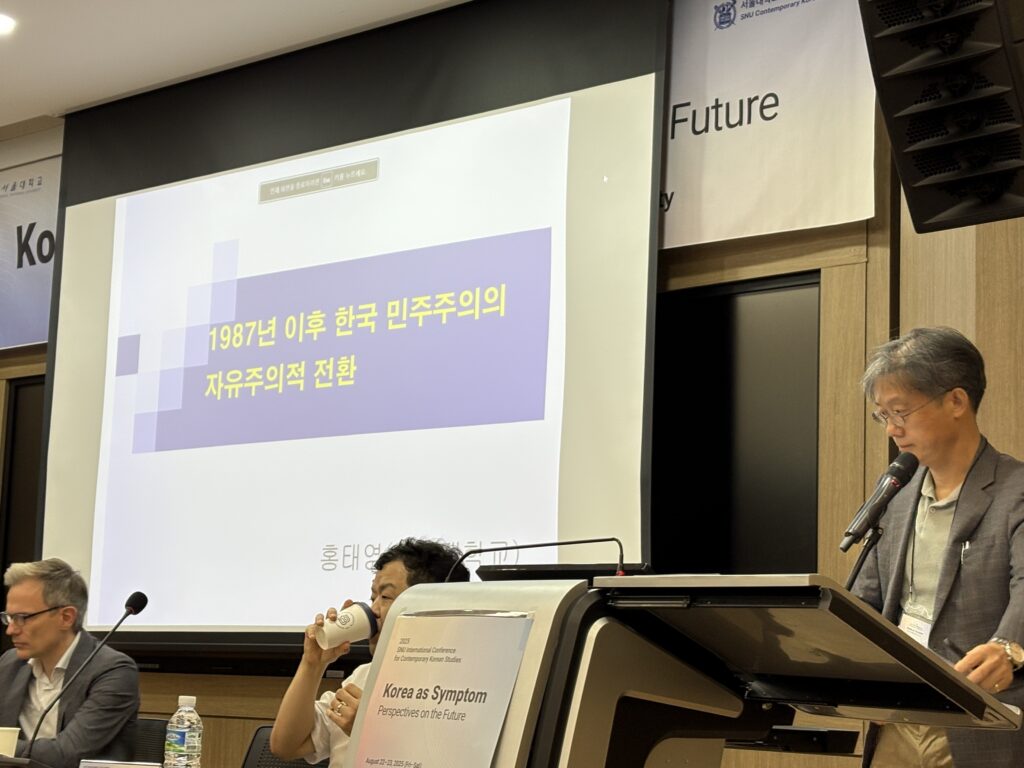
In the second presentation, Professor Taeyoung Hong (Korea National Defense University) presented “Liberal Transition of Korean Democracy after 1987,” analyzing the causes of liberalism’s failure in the period between democratization in 1987 and the 1997 Asian financial crisis. He argued that although liberalism became the dominant ideology of South Korean politics after democratization, it failed to take root as a form of liberal self-government due to the convergence of several factors: the neoliberal turn after 1997, the incomplete institutionalization of the labor movement, the narrow structure of representative democracy, and the conservative character of democratization.
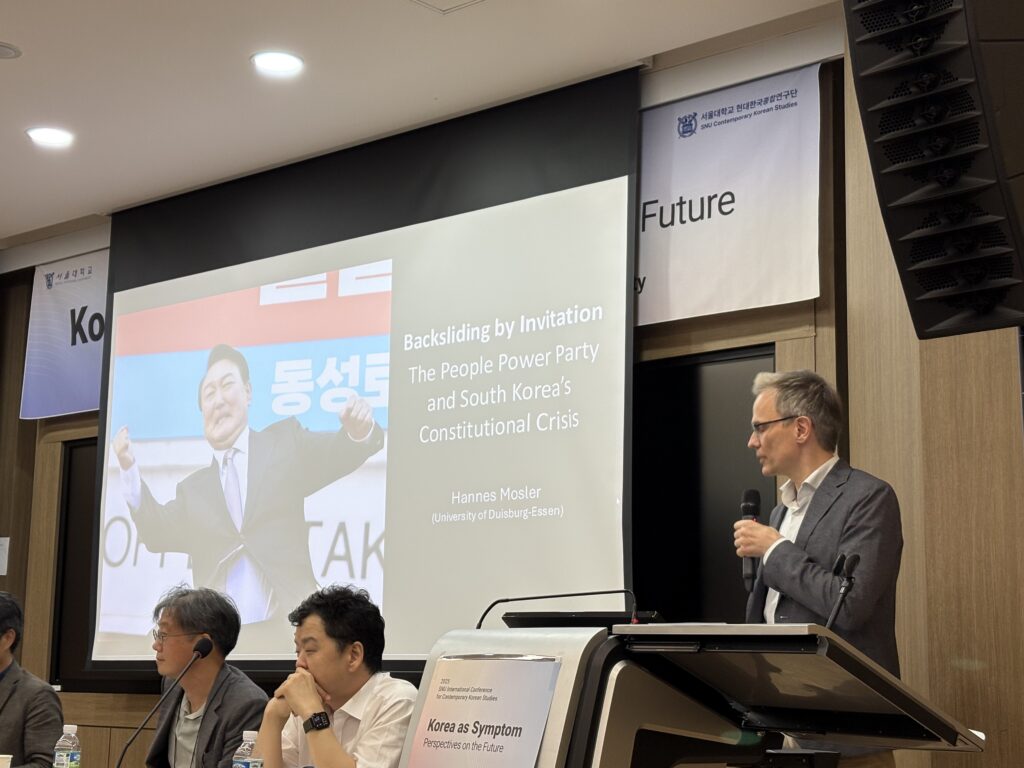
In the third presentation, Professor Hannes Mosler (University of Duisburg-Essen) characterized President Yoon Suk Yeol’s “self-coup” as the culmination of South Korea’s current constitutional crisis. In particular, he analyzed in three stages how the People Power Party has contributed to democratic backsliding and constitutional corruption, situating the crisis of Korean democracy within the broader international context of democratic backsliding.
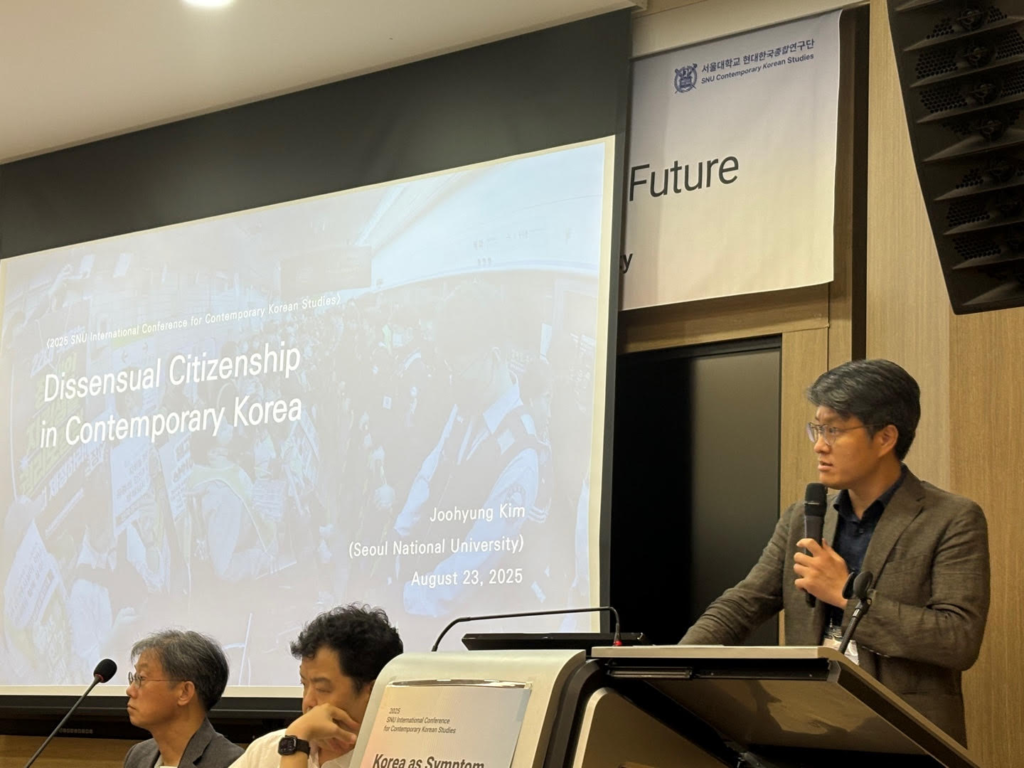
In the final presentation, Professor Juhyung Kim (Seoul National University), in “Dissensual Citizenship in Korean Politics,” interpreted the subway protests of the Solidarity Against Disability Discrimination (SADD) through Jacques Rancière’s concept of democracy as dissensus. Kim explained democracy as the assertion of “the part of those who have no part,” arguing that such moments generate new political subjects. He further suggested that the subway protests of SADD in South Korea constitute a site of such political performance, and that dissensual citizenship may contribute to the further democratization of democracy.
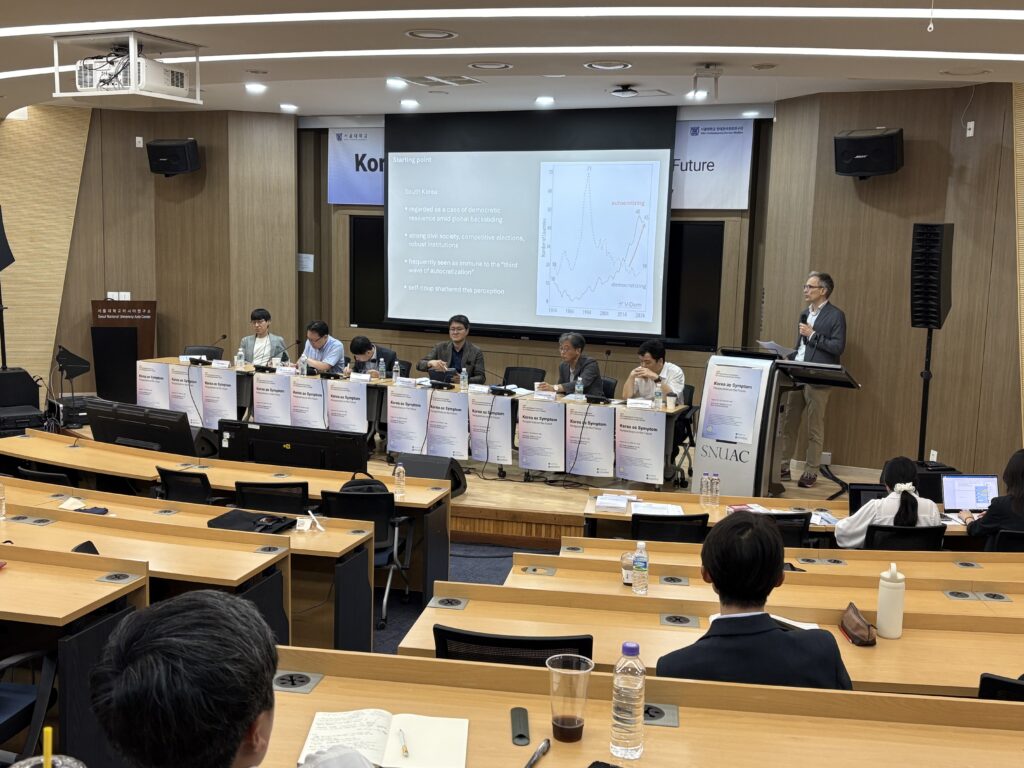
The session focused on how South Korean democracy has been formed and developed, while drawing out the various political implications embedded in that process. By shedding light on the current condition of Korean democracy, the session also helped to reposition it within an international context and contributed to a deeper understanding of democracy more broadly.