The SNU Center for Contemporary Korean Studies held an international conference titled “Korea as Symptom” over two days, August 22 and 23. As the third session on the second day of the conference, the K-Narrative Team organized a panel titled “Narrative Alternatives Imagining the Post-1987 System” in Room 230 of Building 101 at Seoul National University. Chaired by Professor Hyungchul Shin (Seoul National University), the session featured two presentations.
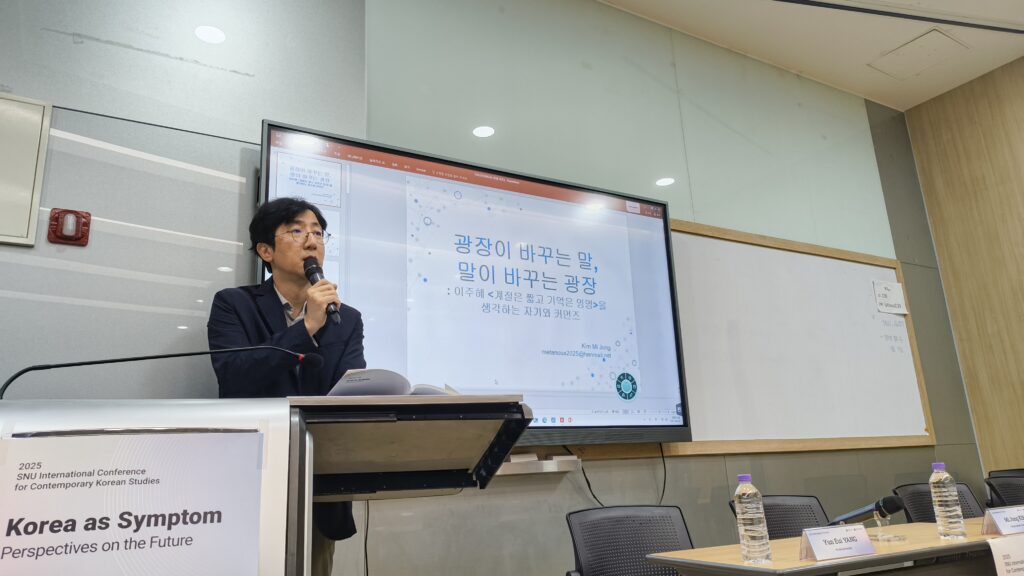
In the first presentation, Dr. Mijeong Kim (Sungkyunkwan University) spoke on “The Square Changes Words; Words Change the Square,” examining the significance of the public square in South Korea. According to Kim, the square has traditionally symbolized revolution and social transformation, but its meaning has changed considerably in contemporary Korea. In particular, the square is no longer a space dominated by a single political force, but one in which complex desires and emotions intersect. Kim explored the conditions under which political squares have taken shape in South Korea since the 2010s and, through literary works, analyzed the reciprocal relationship between the square and the language that emerges within it.
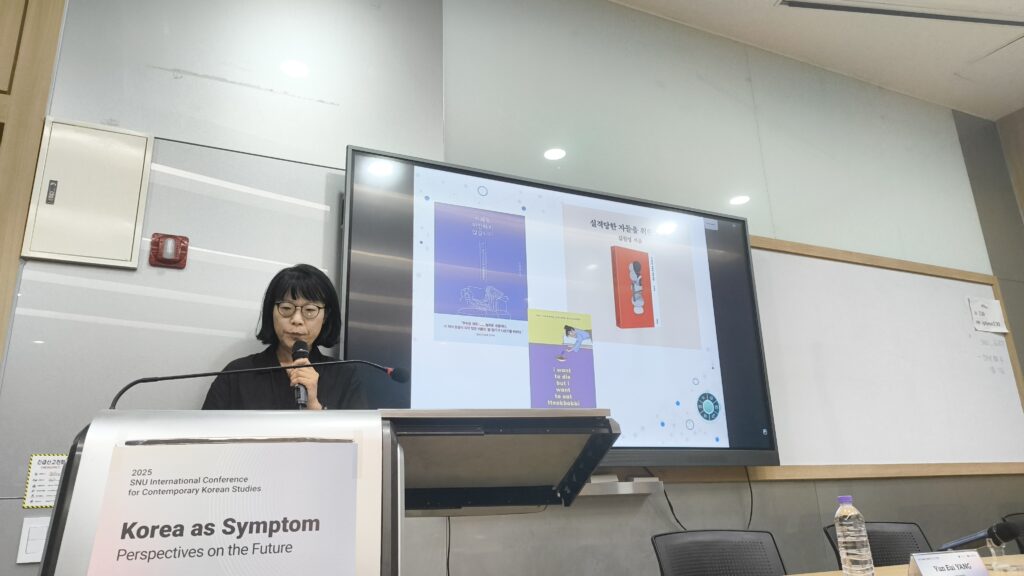
The second presentation was delivered by Professor Jinseok Choi (Seoul National University of Science and Technology) under the title “Justice and Community Beyond the Law: Questions and Responses in Korean Literature and Film after 1987.” Choi examined how Korean literature and cinema have exposed the contradictions of the law and its entanglement with political power in the post-democratization era. Focusing in particular on the film The Man Standing Next and Un-su Kim’s novel The Plotters, he explored the role of alternative narratives that imagine forms of justice and community beyond the existing legal framework.
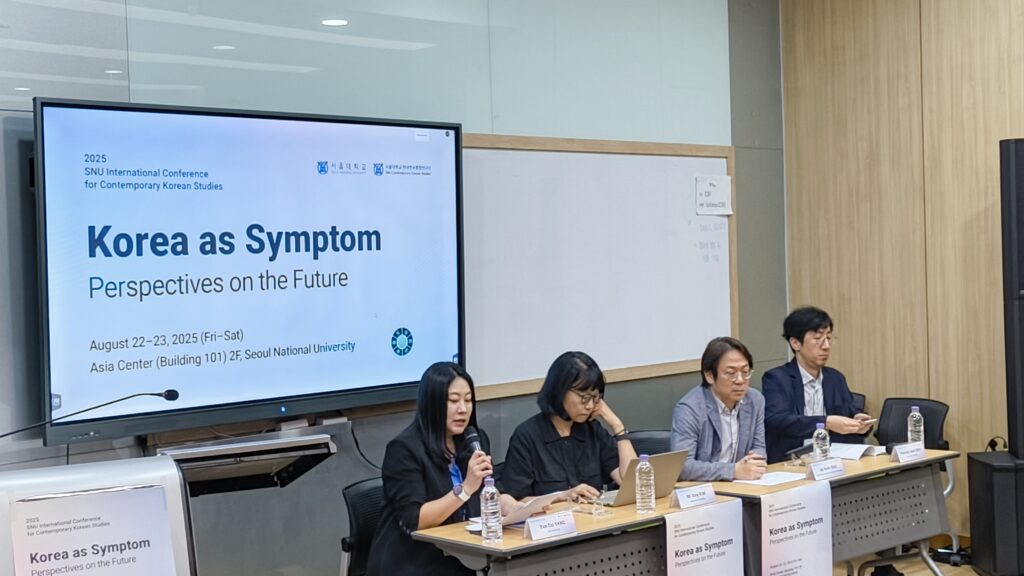
The session sought to portray South Korean society after democratization through literary and cinematic works. By focusing on alternative narratives and examining both the political significance of the public square and representations of law in works of art, the presentations offered new perspectives on contemporary Korea. At the same time, the session opened up possibilities for imagining a more inclusive political community beyond the limitations of existing institutions and narratives.