

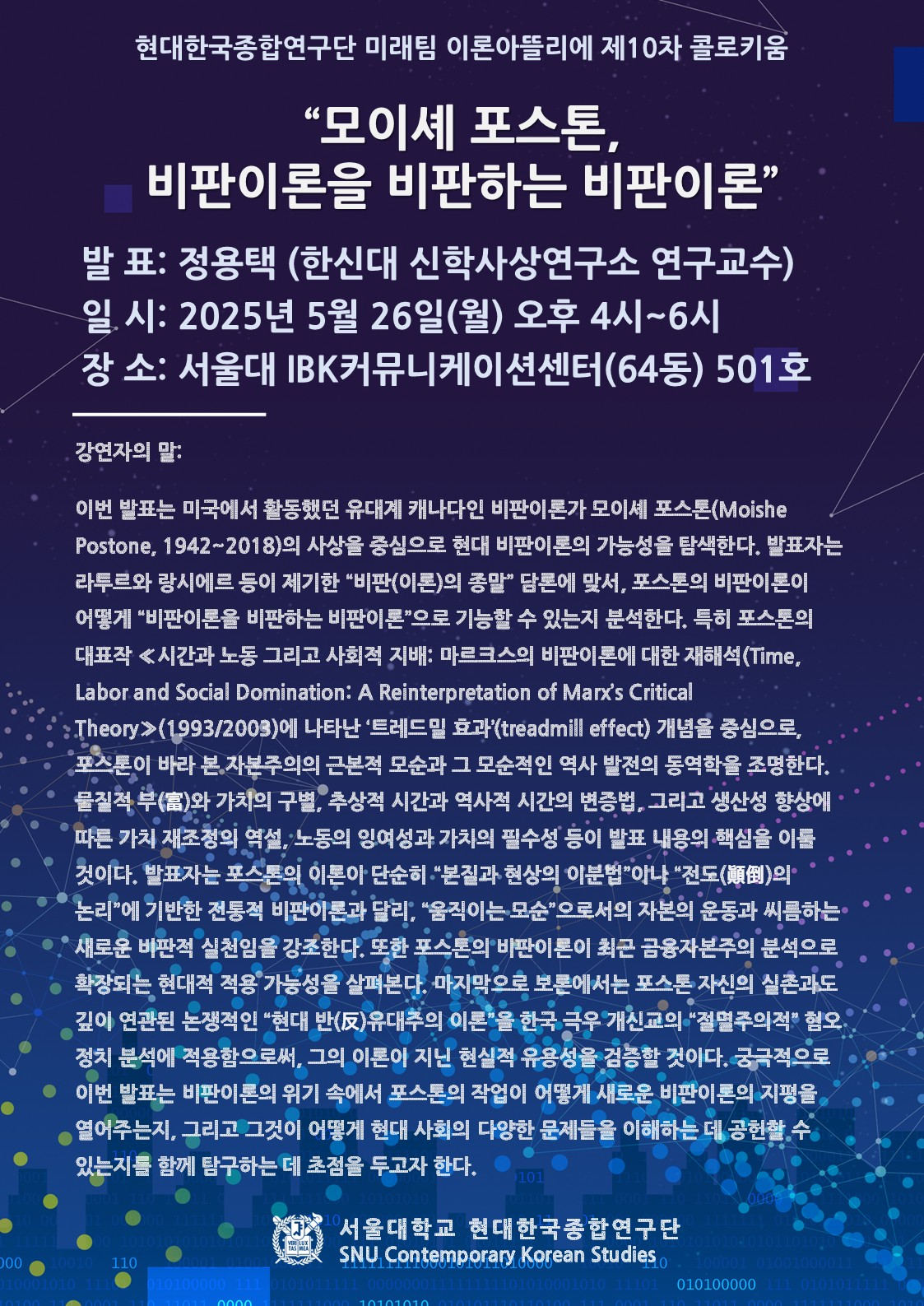
The K-Future Team of the Center for Contemporary Korean Studies invites you to a colloquium with Professor Yong-Taek Chung.
- Title: Moishe Postone: A Critical Theory that Critiques Critical Theory
- Speaker: Prof. Yong-Taek Chung (Research Professor, Institute for Theological Ideas, Hanshin University)
- Date & Time: Monday, May 26, 2025, 4:00–6:00 PM
- Venue: Room 501, IBK Communication Center (Bldg. 64), Seoul National University
Lecture Overview:
This lecture explores the possibilities of contemporary critical theory through the work of Moishe Postone (1942–2018), a Jewish-Canadian theorist based in the United States. In response to the discourse surrounding the “end of critique” articulated by figures such as Bruno Latour and Jacques Rancière, the speaker examines how Postone’s approach offers a “critical theory that critiques critical theory” itself.
Focusing on Postone’s seminal work, Time, Labor, and Social Domination: A Reinterpretation of Marx’s Critical Theory (1993/2003), the lecture highlights his concept of the “treadmill effect” as a key to understanding the internal contradictions of capitalism and the paradoxical dynamics of its historical development. Central themes include:
● the distinction between material wealth and value,
● the dialectic of abstract and historical time,
● the paradox of value reconfiguration in response to productivity increases, and
● the surplus character of labor versus the necessity of value in capitalist systems.
The speaker emphasizes that, unlike traditional critical theory rooted in dichotomies such as essence vs. appearance or the logic of inversion, Postone’s critique engages directly with capital as a “moving contradiction.” This positions his work as a new form of critical praxis that confronts the structural motion of capital itself.
The lecture also considers the contemporary applicability of Postone’s theory in analyzing financial capitalism. A concluding excursus examines his controversial theory of modern antisemitism, drawing connections between Postone’s insights and the “exterminatory” hate politics of Korea’s far-right evangelical movements. Through this, the speaker assesses the practical utility of Postone’s framework in confronting real-world political phenomena.
Ultimately, the session seeks to illuminate how Postone’s work opens up new horizons for critical theory amidst its current crisis—and how his contributions can help us better understand and respond to the complex challenges of contemporary society.