On September 26, the Political Economy Team of Seoul National University’s Center for Contemporary Korean Studies held its regular open seminar, inviting Professor Emeritus Chang Kyung-Sup of Seoul National University, a world-renowned scholar in the field of sociology. The seminar was organized to commemorate the publication of Professor Chang’s latest book, The Risk of Compressed Modernity (2025), and to share the book’s core theoretical arguments with both academic and general audiences.
In his lecture, Professor Chang analyzed the rapid industrialization, democratization, and cultural transformation that Korean society has experienced over the past half-century through his original framework of “compressed modernity.” In particular, he offered an in-depth examination of the logical and causal relationship through which Korea’s modernity—unlike Western modernization, having unfolded under conditions of temporal and spatial compression—has produced both remarkable developmental achievements and structural vulnerabilities in the form of “normalized crisis.”
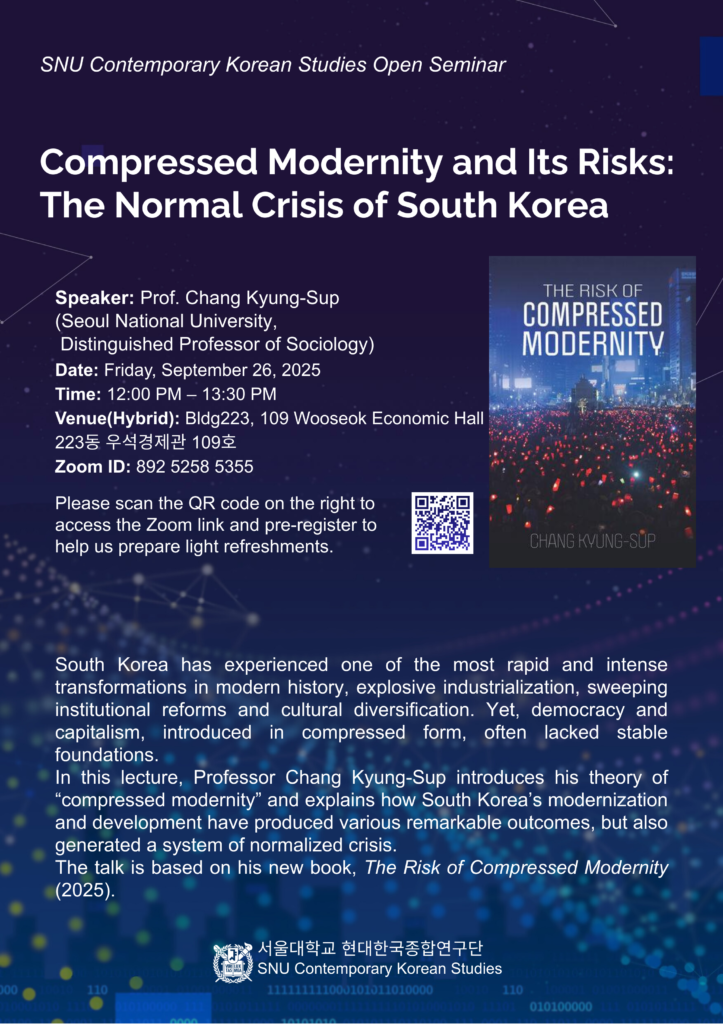
The presentation followed the main arguments of the book, diagnosing the institutional instability and social risks that emerged in the process by which capitalism and democracy were introduced to Korea in a compressed manner. Professor Chang emphasized that the crises facing Korean society today are not merely temporary phenomena, but path-dependent outcomes of compressed growth, thereby offering a new critical perspective for understanding contemporary Korean society.
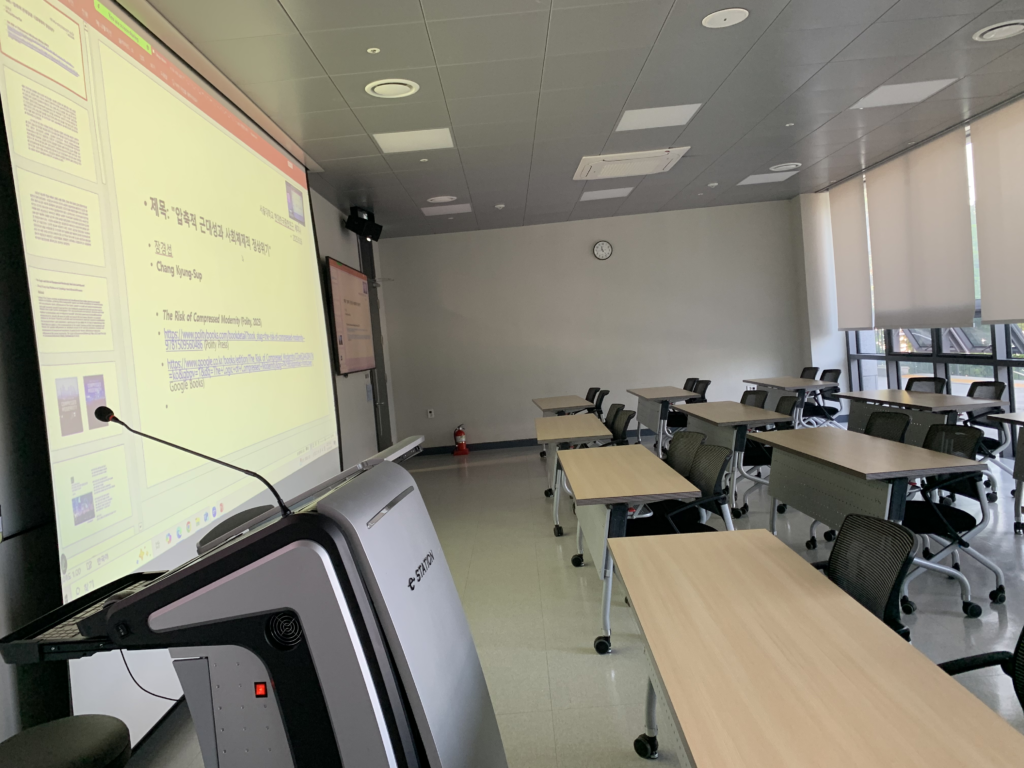
The seminar was held in a hybrid format, both online and offline. Researchers and students from various fields took part, engaging in a sophisticated academic discussion on the continuing relevance of compressed modernity theory and the sustainability of Korean society.