On the second day of the 3rd International Conference, held by the SNU Center for Contemporary Korean Studies on August 21 and 22 under the theme “Korea as Method,” the Values and Identity Team convened the open-call session “Finding Voice at the Margins: Religion, Citizenship, and the Struggle for Legitimacy in Korea” in Room 240 of the SNU Asia Center. Chaired by Esther Ghim (Seoul National University), the session featured four presentations.
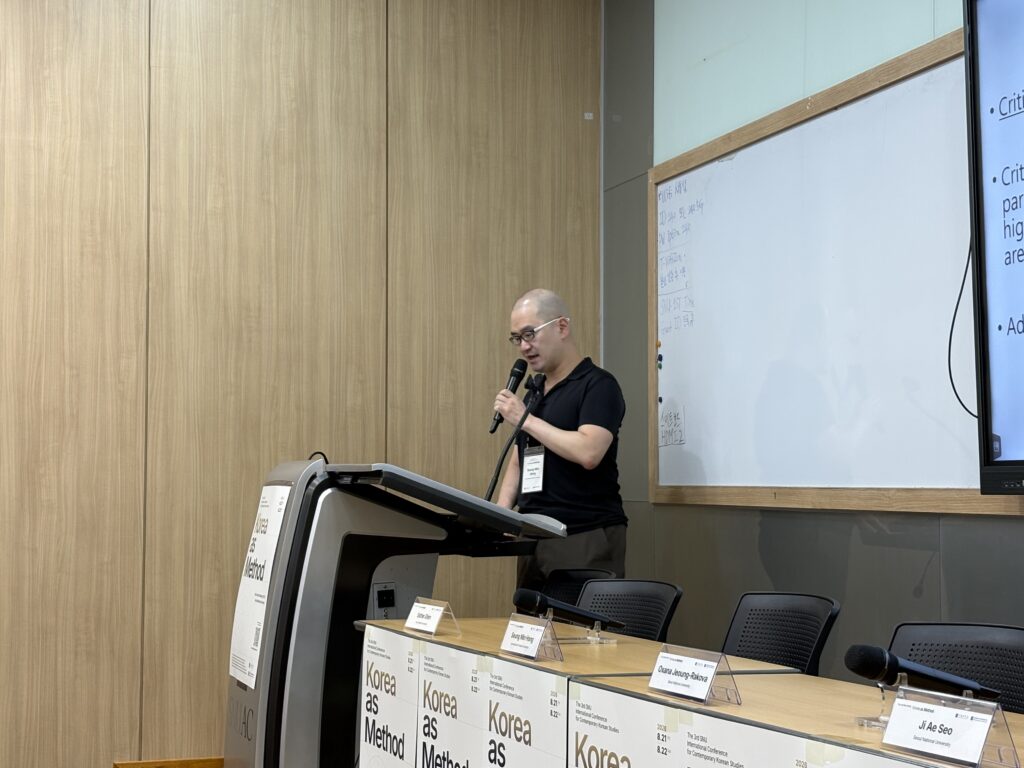
Seung Min Hong (International Christian University), in his presentation “Resistance in the Periphery of South Korean Protestantism: A Critical Examination of Critical Insider Movements,” examined the characteristics and limitations of “critical insider” movements that have challenged dominant teachings and practices from within South Korean Protestantism. A “critical insider” refers to a religious actor who remains committed to the fundamental tenets of their faith while maintaining a critical stance toward the dominant ways in which their own tradition is taught and practiced. Hong argued that this category adds a new dimension to the conventional insider/outsider distinction in the study of religion.
South Korean Protestantism has faced growing public criticism over its associations with authoritarian and far-right politics as well as practices such as hereditary succession within churches. Against this backdrop, organizations largely associated with the evangelical left have sought to expose scandals, challenge doctrinal claims, and provide theological education for laypeople, often relying heavily on new media. The CBS program Christian Now (2012–2014) represented one notable moment in which these actors converged. At the same time, Hong pointed to the limitations of these movements, including their male-dominated character and occasional reliance on excessively cynical rhetoric. He concluded by asking how critical insider movements might change amid the declining Protestant population and the proliferation of YouTube channels performing similar critical functions.
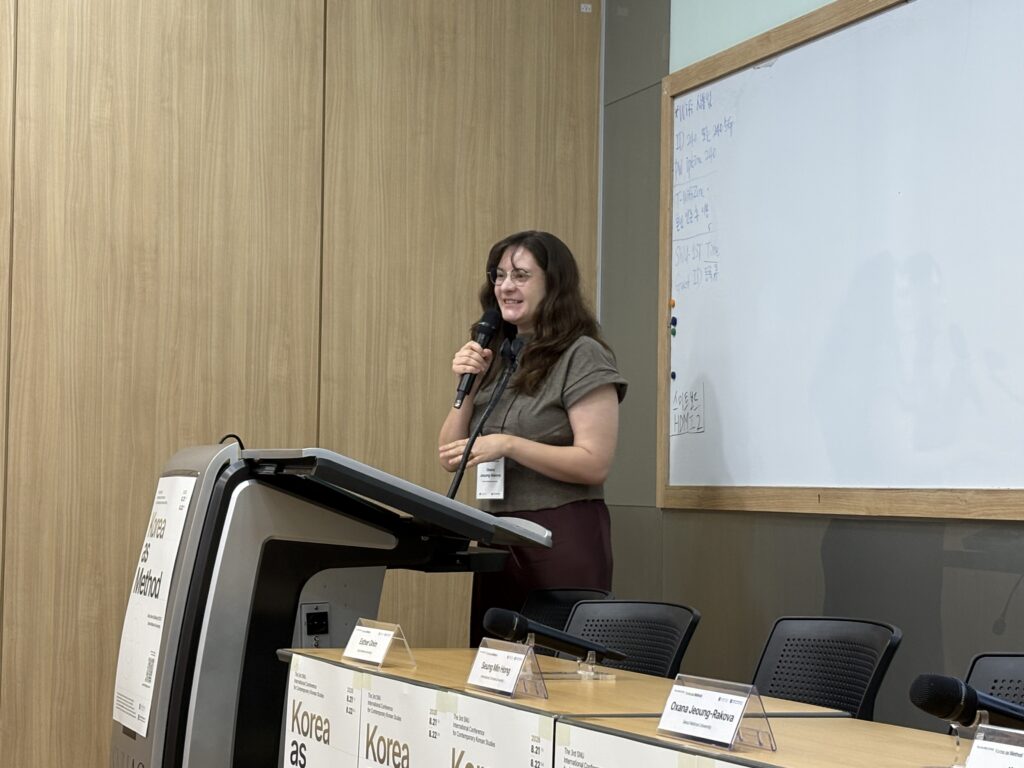
Oxana Jeoung-Rakova (Seoul National University), in “Korean Design as Method: Trajectories of Design as a Technology of Citizenship,” traced the historical trajectory of Korean design as a “technology of citizenship” through which relations between the state and its citizens have been organized. Drawing on participant observation of design projects in Seoul between 2018 and 2022, she identified three phases in the changing position assigned to citizens through design, while emphasizing that these phases did not simply replace one another but continue to overlap.
During the developmental-state period, design was understood primarily in terms of export competitiveness under the slogan of “art for export” (misul suchul, 美術輸出), with citizens largely absent from the picture. With the expansion of consumer markets and the rise of neoliberal urban governance, citizens became “almost present,” primarily in the role of consumers. Under the participatory governance of the 2010s, however, they became “over-present” as co-producers expected to define problems and participate in developing solutions.
Examples such as priority seats for pregnant women and “longevity chairs” installed near pedestrian crossings illustrate how design organizes expectations through material forms rather than through explicit prohibitions. Drawing on Barbara Cruikshank’s understanding of citizenship as something produced rather than simply given, Jeoung-Rakova argued that in contemporary Seoul, citizens are made, at least in part, through design.
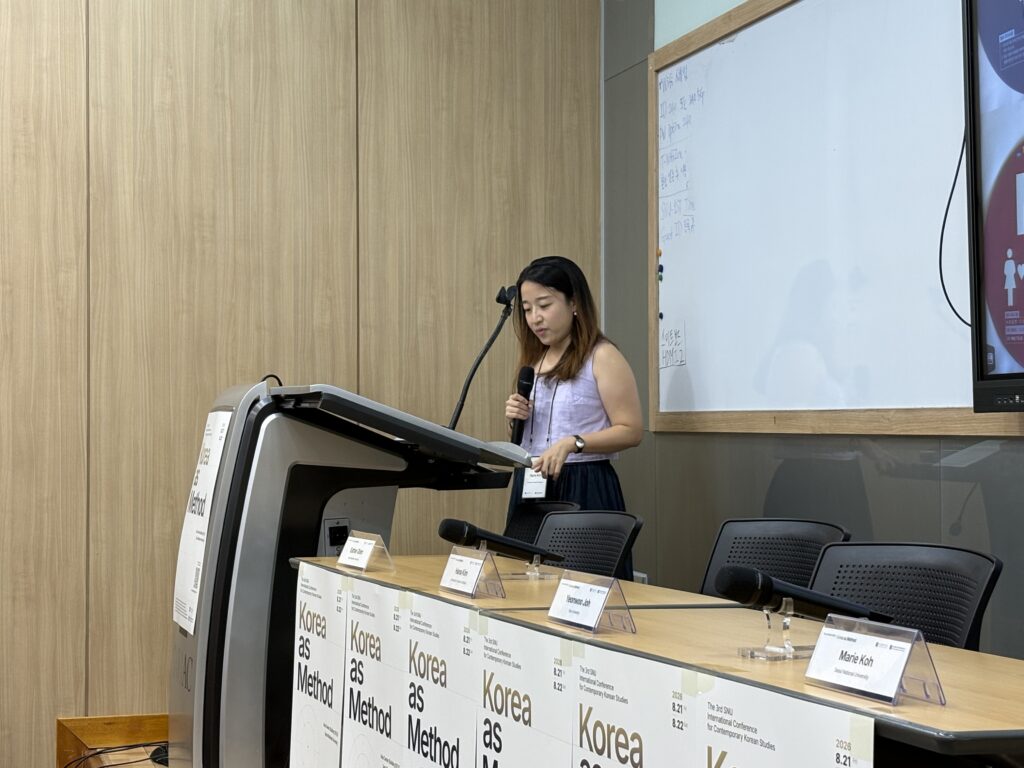
Hana Kim (University of Hawai‘i at Mānoa), in “When Gender Becomes Care: Anti-Gender Mobilization and the Reorganization of Citizenship in South Korea,” analyzed anti-gender mobilization in South Korea not as an importation of Western culture wars, but as the democratic rearticulation of authoritarian forms of gendered citizenship under neoliberal conditions. To explain why “gender” has become a central battleground of conservative Protestant politics in a society that did not experience a Western-style sexual revolution, Kim drew on Michel Foucault’s genealogy and governmentality as well as Judith Butler’s concept of the “gender phantasm.”
Empirically, the presentation examined two cases. The Christian Ethics Movement, founded in 1987, translated sexual conservatism into the language of consumer activism and parental activism, thereby constructing an infrastructure for subsequent culture wars as early as the 1990s. In sermons associated with the Holy Breakwater United National Movement and interviews with its participants, Kim found that the heterosexual family, national development, economic prosperity, and national security were woven together into a single moral narrative.
Drawing on Chang Kyung-Sup’s concept of “family liberalism,” Kim argued that what this narrative seeks to defend is not simply a set of traditional family values, but a political-economic order that has shifted responsibility for social reproduction onto the family. From this perspective, “gender” functions as a displaced signifier onto which heterogeneous anxieties—including crises of care and social reproduction—are condensed.
Yeonwoo Joh (Yale University), in “Practicing Secularism in Korean Popular Culture: Revisiting the Religious Critiques on Chu Homin’s Along with the Gods,” examined religious controversies surrounding the webtoon Along with the Gods as an instance in which secularism is practiced and negotiated in everyday Korean society. Joh demonstrated that the first installment, “The Afterlife,” draws extensively on Buddhist texts and iconography concerning the Ten Kings and Buddhist hells, and traced the conditions that allowed sacred objects and images enshrined in Buddhist temples to be reproduced within a commercial webtoon to their institutional classification as “cultural heritage.”
Once Buddhist artifacts are designated as national heritage, Johargued, they cease to be regarded solely as the property of a particular religious tradition and are repositioned as public assets shared by all Koreans. He further noted that Christian accusations of “idolatry” and the author’s defense of the work as merely an imaginative interpretation of tradition may appear opposed to one another but, in fact, operate within the same conceptual framework: a Christian model of religion premised on exclusive belonging and the possibility of religious contamination.
Buddhist elements, therefore, become safely consumable cultural products by being detached from the category of “religion” and reclassified as “tradition” and “culture.” Joh concluded that this very process of negotiation regulates the boundaries of what kinds of religious elements can appear in public culture without being perceived as threatening.
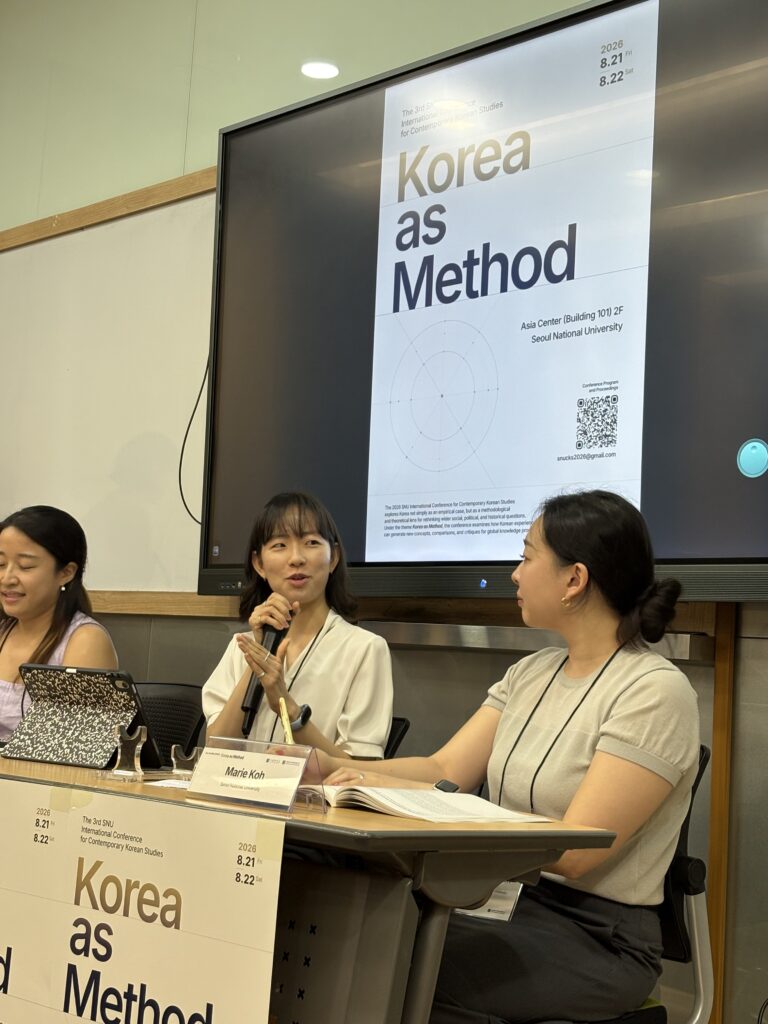
Following the four presentations, Ji Ae Seo (Seoul National University) and Marie Koh (Seoul National University) offered comments on the panel.
Taken together, the four presentations examined struggles for legitimacy from different locations at the margins of Korean society: critical movements within Protestantism, the production of citizens through design, anti-gender mobilization, and religious controversy in popular culture. Despite their different subjects, the presentations shared an interest in how actors, practices, and identities acquire recognition as legitimate—or are excluded from it—within changing configurations of religion, citizenship, and public life. By bringing these cases together, the session demonstrated that the boundaries of religion and citizenship in Korean society are not simply determined from an established center, but are continually contested, negotiated, and redrawn from the margins.