On the second day of the 3rd International Conference, held by the SNU Center for Contemporary Korean Studies on August 21 and 22 under the theme “Korea as Method,” the Values and Identity Team convened its final session, “Purifying the Sacred: Religion, State Power, and the Politics of Classification,” at Youngwon Hall (Room 210) of the SNU Asia Center. Chaired by Professor Haeyoung Seong (Seoul National University), the session featured three presentations.
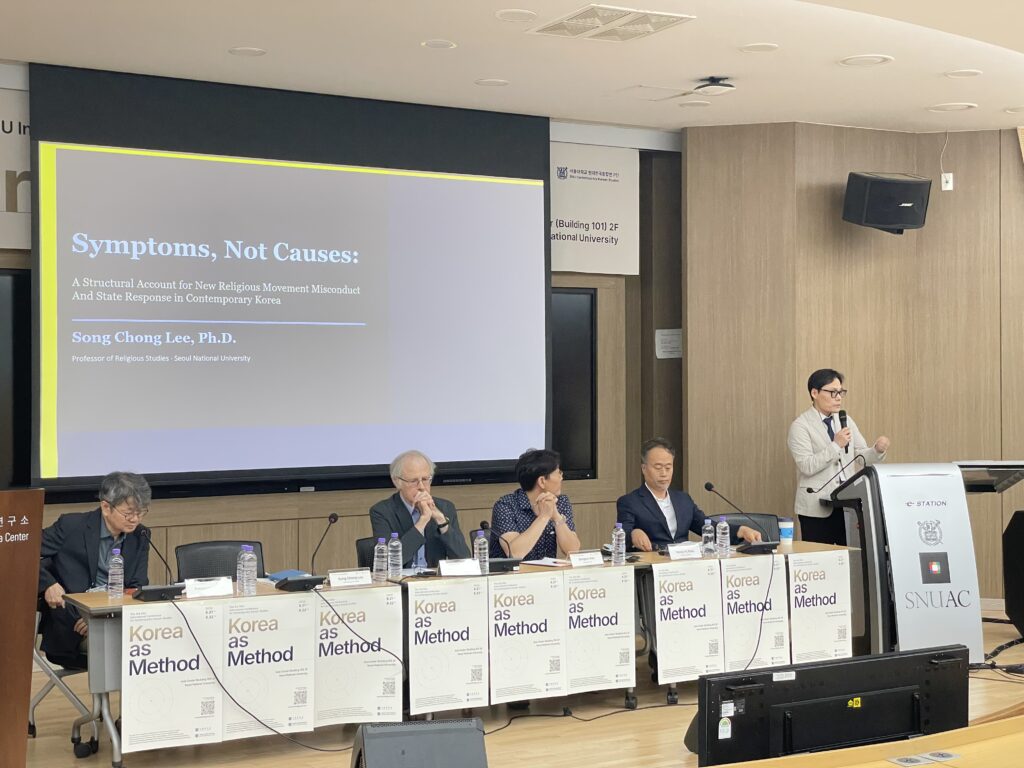
Professor Sung-Chung Lee (Seoul National University), in his presentation “Symptoms, Not Causes: A Structural Account of New Religious Movement Misconduct and State Response in Contemporary Korea,” analyzed recent regulatory measures targeting the Unification Church and Shincheonji not as exceptional responses to individual cases, but as symptoms of a broader structural pattern through which the Korean state has managed religious difference. He argued that the rhetoric of purity and pollution surrounding new religious movements tends to conflate individual wrongdoing with collective guilt, position the state as an arbiter of religious authenticity despite lacking the authority to do so, and expand the reach of civil law in ways that can justify outcomes tantamount to the dissolution of legally protected religious communities.
Underlying these processes, Lee argued, is a problem of symbolic classification. Sacred spaces, doctrinal innovation, and relations with political power become inherently suspect only when they appear outside the boundaries of established orthodoxy. Drawing further on the perspective of the “religious economy,” he suggested that this asymmetry is structural. While mainstream religions possess established channels through which their connections with political power can remain largely invisible, new religious movements are denied comparable access, pushed toward strategies operating in institutional gray zones, and subsequently criticized for relying on those very strategies. Lee concluded by proposing criteria through which responsibility for misconduct could be assigned without extending culpability to an entire community of faith.
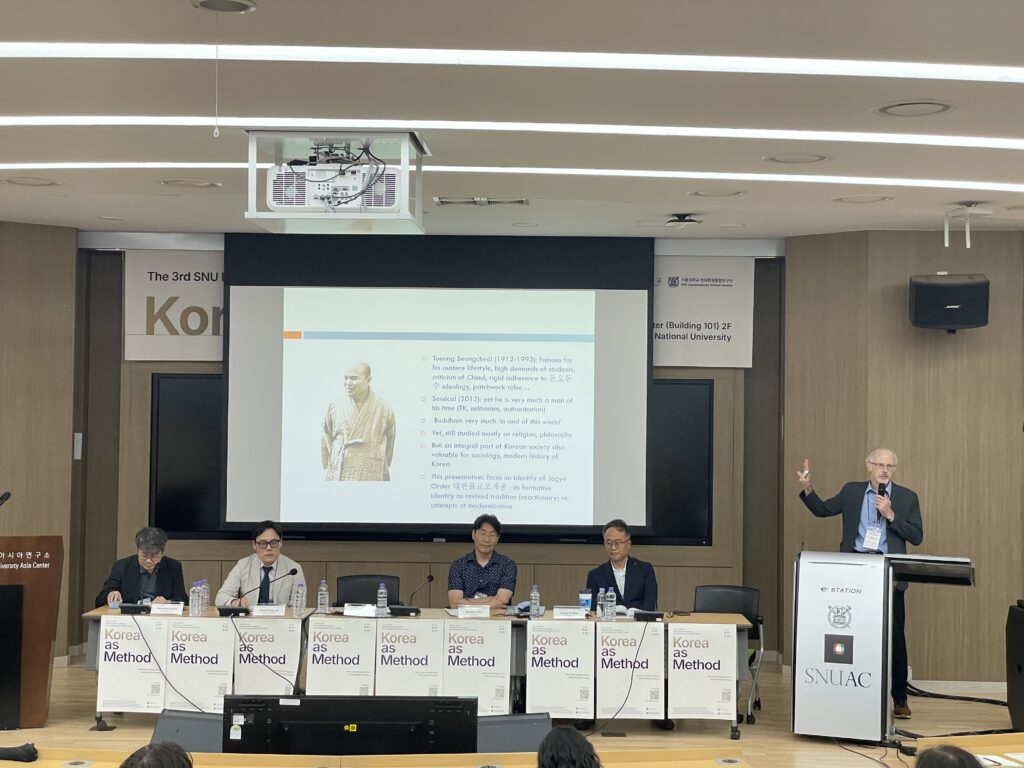
Professor Sem Vermeersch (Seoul National University), in “Towards a Sociology of Korean Buddhism: What Comes after Purification?,” examined the identity that mainstream Korean Buddhism, particularly the Jogye Order, has constructed around the idea of “purification” (jeonghwa, 淨化) since liberation, as well as the trajectory of that identity in recent years. While the Purification Movement from 1953 to around 1971 is commonly understood as an effort to exclude married monks, Vermeersch argued that it formed part of a broader project to restore what were perceived to have been lost during the colonial period: the celibate precepts, the purity of Dharma lineage, and the doctrinal purity of Ganhwa Seon meditation.
Yet a project that appeared successful through the authoritarian era and the strongly nationalist period of democratization has revealed its vulnerability over the past decade. The number of both lay followers and ordained practitioners has sharply declined, while younger generations increasingly perceive Buddhism as outdated and distant from their everyday lives. Vermeersch paid particular attention to the striking shift that became visible in 2023, when the Jogye Order embraced “NewJeansNim” as an approachable and popular public face of Buddhism. By examining the tension between this new outward-facing identity and the Order’s established self-understanding, he explored how Korean Buddhism is attempting to respond to broader transformations in Korean society.
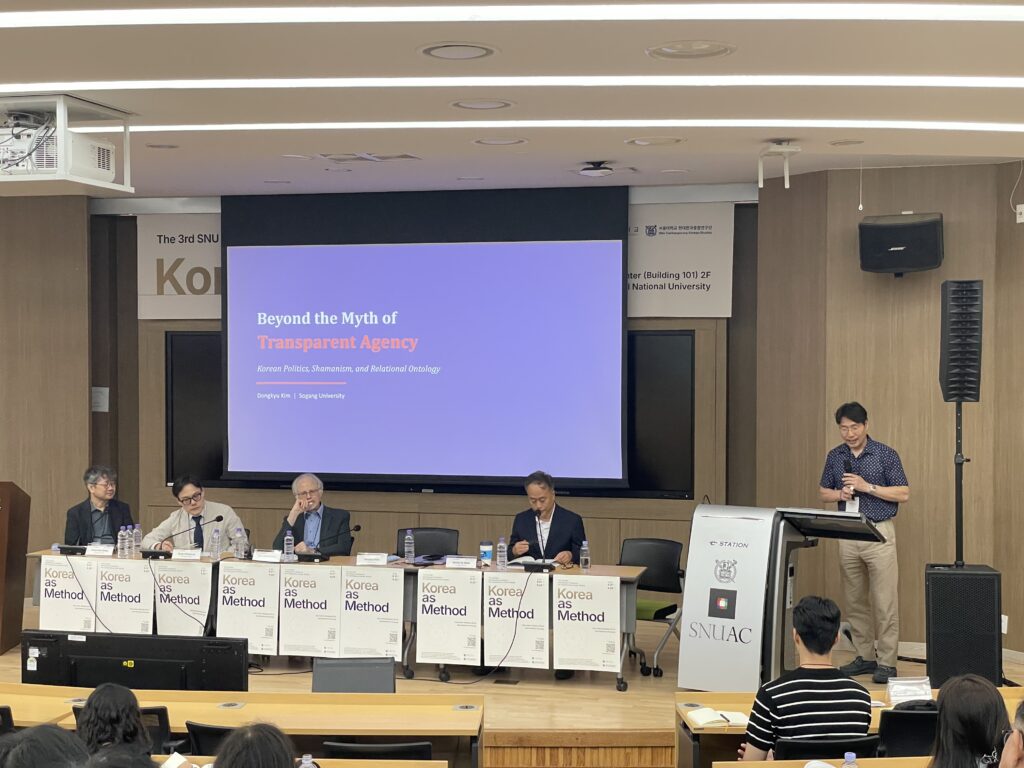
Professor Dong-kyu Kim (Sogang University), in “Beyond the Myth of Transparency: Korean Politics, Shamanism, and Relational Ontology,” explored why shamanism repeatedly resurfaces in Korean politics—and why each appearance tends to be consumed as a political scandal—despite modern norms of church-state separation and transparency. Tracing a genealogy from the Joseon-era category of eumsa (淫祀, “illicit rites”), through the modern designation of shamanism as “superstition,” to its later relocation within the category of “traditional culture,” Kim examined the historical process through which shamanism has been excluded from the domain of public reason.
Drawing on long-term fieldwork, he then highlighted the gap between “shamanism as represented scandal” and “shamanism as practiced.” In practice, he found, the principal clients of shamans were not high-ranking politicians but political staff members and aides coping with existential uncertainty amid elections and precarious employment. For them, shamanism functioned as a “relational technology” through which uncertainty could be managed and disrupted relationships reorganized.
Bringing together Bruno Latour’s concept of purification, Philippe Descola’s relational ontology, Tim Ingold’s notion of the meshwork, and his own model of “relational displacement” developed through research on byeonggut healing rituals, Kim reconceptualized Korean politics as an “ontological contact zone” in which modern demands for transparency encounter a relational cosmology.
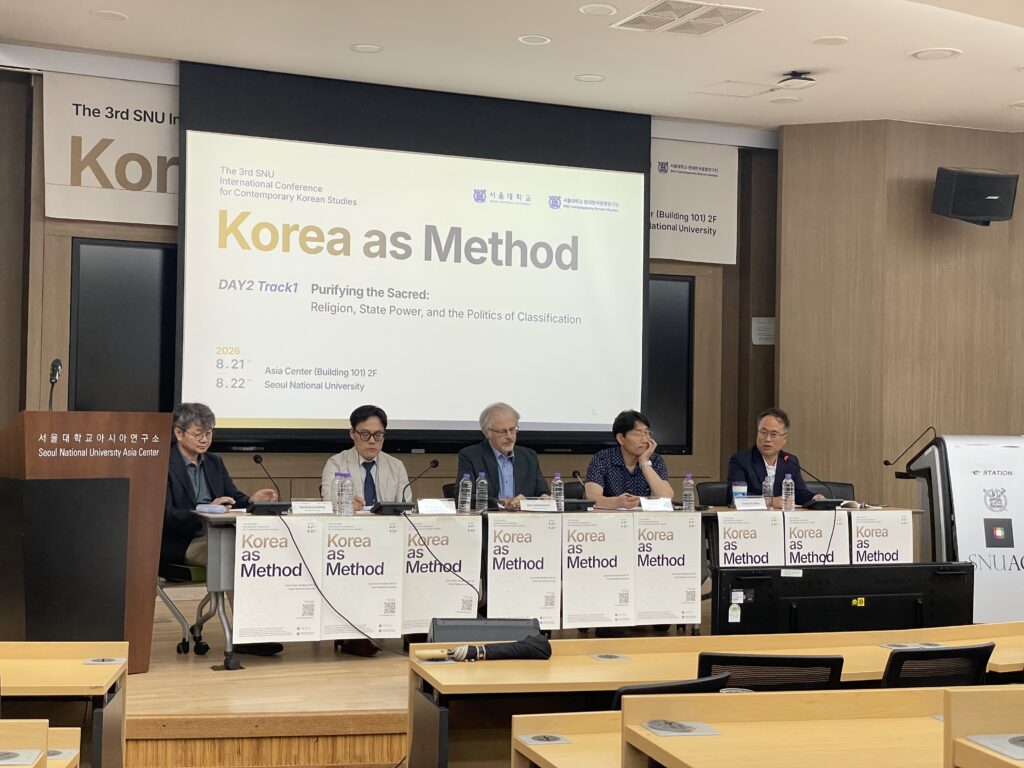
Following the three presentations, Professor Sung-gi Baek (Sahmyook University) offered comments on the panel.
Taken together, the three presentations were connected by the concepts of “purification” and “classification.” Through analyses of the regulation of new religious movements, the construction of Buddhist institutional identity, and the transformation of shamanism into political scandal, the speakers examined the processes through which the state and institutionalized religions have defined what counts as legitimate religion and excluded other forms as impure, improper, or suspect. In doing so, the session offered a multilayered perspective on the ways in which the boundaries of the sacred have been historically constructed and negotiated in relation to power in Korean society.