On the first day of the 3rd International Conference, held by the Seoul National University Contemporary Korea Research Group on August 21 and 22 under the theme “Korea as Method,” the session “Theorizing from South Korea, Beneath and Beyond Epistemological Binaries” took place in Room 230 of the SNU Asia Center. Chaired by Minyoung Kim (Yonsei University), the session featured three presentations. Addressing refugee mobility, cross-movement solidarity, and democratic erosion and resilience, the speakers explored how experiences from South Korea can challenge and move beyond some of the binaries and theoretical assumptions that have long structured the social sciences.
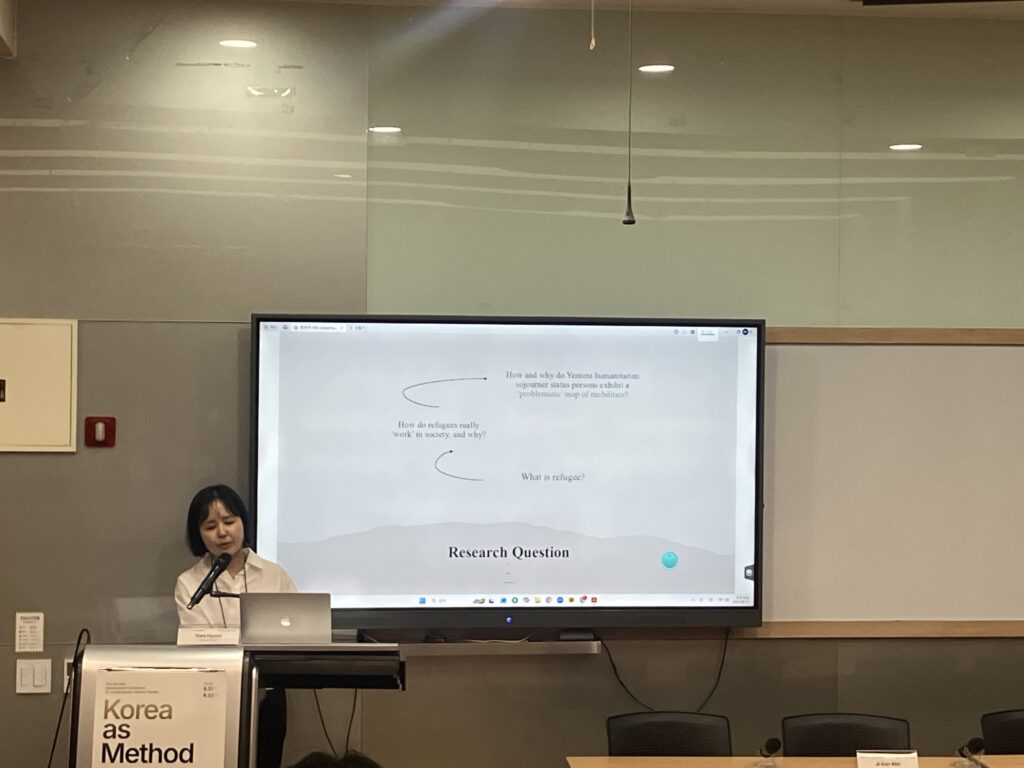
Yura Hyeon (University of Tokyo), in “Settling in Hypermobility: Yemeni Humanitarian Sojourner Status Persons Beyond the Framework of Displacement,” examined the experiences of Yemeni humanitarian sojourners living in South Korea. The arrival on Jeju Island of 561 Yemeni asylum seekers fleeing the civil war in 2018 made the refugee issue publicly visible in South Korea on an unprecedented scale. Their unexpected arrival generated intense backlash, with Yemenis stigmatized as “fake refugees” and, in particular, as potential sexual offenders who threatened Korean women.
Aligned with critical refugee scholarship, Hyeon challenged the conventional binary between forced displacement and voluntary migration by tracing the layered experiences of Yemenis who, more precisely than “refugees” in the legal sense, were granted humanitarian sojourner status in South Korea. Drawing on more than three years of ethnographic fieldwork conducted between 2019 and 2025, she demonstrated how Yemeni humanitarian sojourners actively mobilize across extensive geographical scales while, paradoxically, South Korea’s refugee regime “settles” them in a condition of hypermobility. Rather than simply immobilizing or displacing them, this mode of governmentality exploits their aspirations and capacities for movement, ultimately rendering them disposable labor. As the first longitudinal study of Yemeni refugees in South Korea, the research also presented a refugee-reception experience that cannot be adequately captured through the conventional Global North/Global South divide, opening a path toward transcending multiple binaries that structure the study of refugee migration.
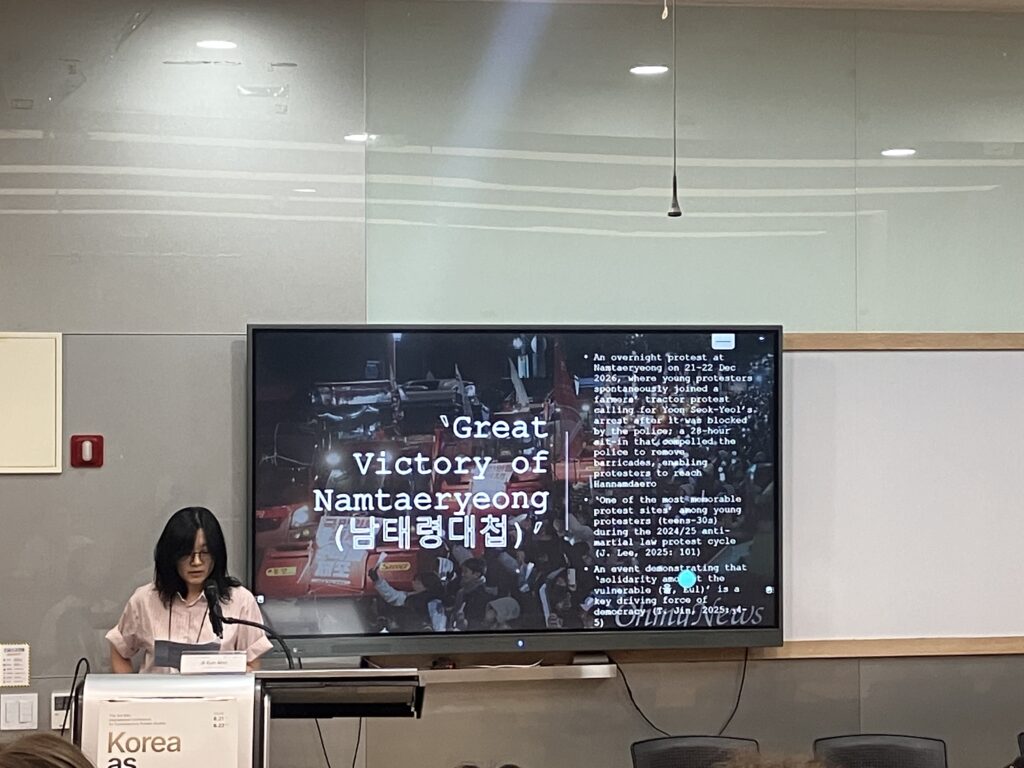
Next, Ji-Eun Ahn (University of Edinburgh) and Hyunjin Kim (Korea University), in “When Tractors Met Rainbows: Exploring a New Solidarity between Farmers and LGBTQ+ Communities in South Korea,” examined the Namtaeryeong protest during the 2024–2025 anti-martial law protest cycle as a moment in which a new cross-movement coalition emerged between the farmers’ movement and the LGBTQ+ rights movement.
At Namtaeryeong, farmers blocked by police barricades were joined by young female protesters in their twenties and thirties, who participated in an overnight sit-in and eventually broke through the blockade together. The protest created a kind of “free space” in which participants articulated identities and experiences marginalized within neoliberal, capitalist, patriarchal, and exclusionary structures in South Korean society, including those of farmers, workers, women, disabled people, and LGBTQ+ communities. While the Korean farmers’ movement has a long history of forging coalitions against authoritarian rule, the global capitalist food system, and neoliberalized markets, the presenters emphasized a particularly significant consequence of the Namtaeryeong experience: intense solidarity with younger protesters enabled elderly farmers to encounter sexual-minority activists and their agendas directly. This encounter subsequently led to farmers’ first collective participation in the 2025 Seoul Queer Parade.
The presenters placed this development in comparative perspective. At a time when far-right coalitions in parts of Europe have increasingly attracted farmers mobilized by grievances over climate-change mitigation and adaptation policies, the Namtaeryeong case points toward an alternative trajectory of agrarian mobilization—one grounded in inclusive cross-movement solidarity rather than exclusionary far-right politics.
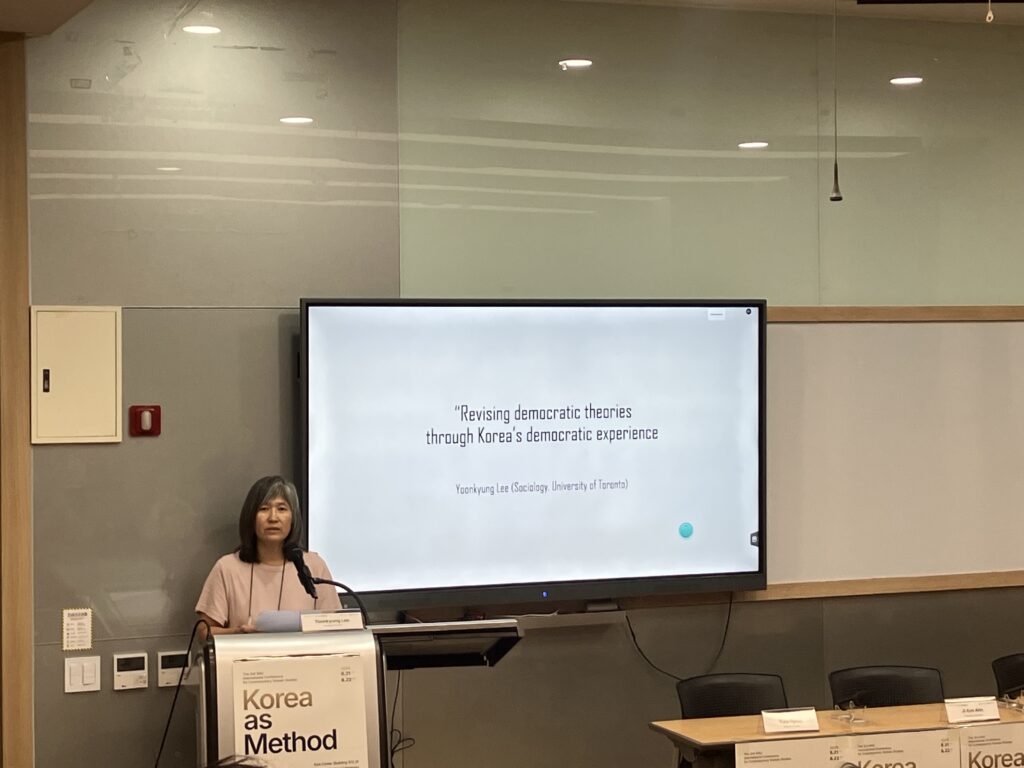
Finally, Yoonkyung Lee (University of Toronto), in “Revising Democratic Theories through the Korean Case of Democratic Erosion and Resilience,” revisited the assumptions of established democratic theories through South Korea’s political trajectory over the past four decades. South Korea has often been celebrated as an exemplary case of a war-torn, impoverished Third World dictatorship that transformed into both a major economic power and a vibrant democracy. Accordingly, scholars have treated Korea as a textbook case for theories ranging from modernization and democratic transition and consolidation to civil society and “people power,” as well as more recent debates on democratic reversal and resilience.
Lee argued, however, that the Korean case should not merely be used to validate existing theories but should instead serve as a basis for revising their underlying assumptions. She critically examined methodological nationalism, explanations that privilege endogenous domestic conditions, and the presumed sequential relationship in which capitalist development precedes democratization. In their place, she proposed an analytical framework that incorporates geopolitical context, the transnational connections of far-right forces and “bad civil society,” and the entanglements of wealth and religion in politics. Such an approach, she argued, can provide a more adequate basis for theorizing both the erosion and advancement of democracy in the twenty-first century.
Following the three presentations, Minyoung Kim (Yonsei University) offered comments on the panel.
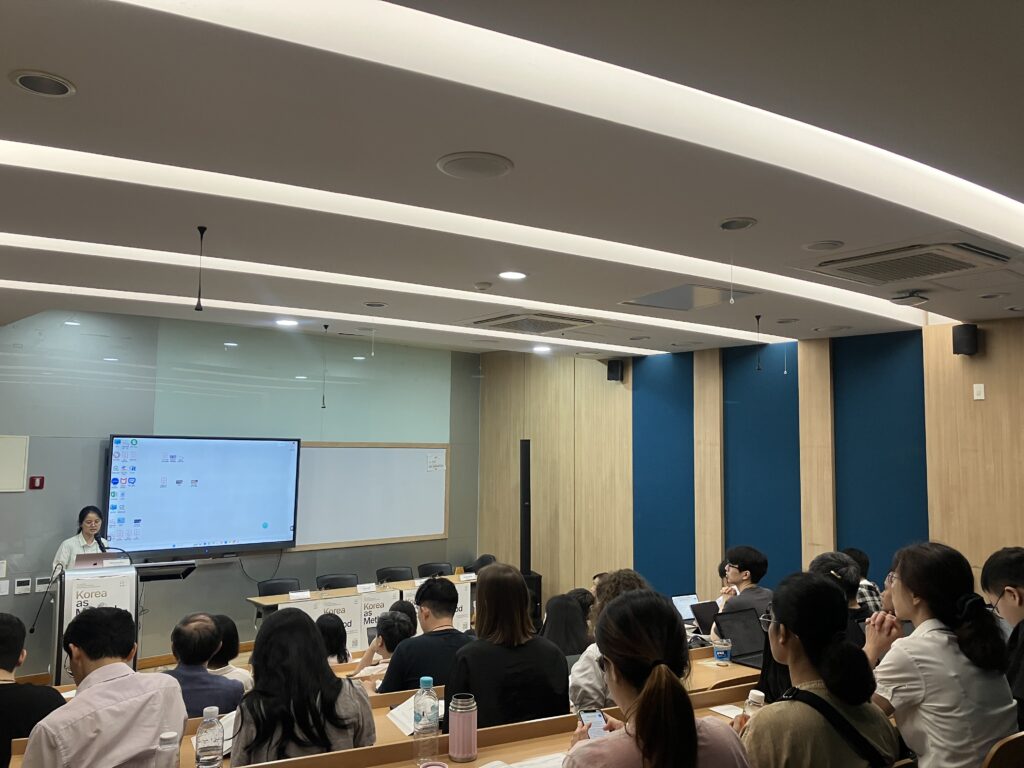
Taken together, the presentations addressed very different empirical fields—refugees, social movements, and democracy—yet shared a common theoretical ambition: rather than simply applying established universal theories to South Korea, they used Korean experiences to reconsider the assumptions and categories on which those theories are built. Familiar binaries such as forced versus voluntary migration, farmers versus sexual minorities, the Global North versus the Global South, and domestic versus transnational explanations proved insufficient for capturing the complexities of the cases examined. By focusing instead on mobility, solidarity, and political relations that emerge across and between these boundaries, the panel positioned South Korea not merely as an object to which theory is applied, but as a point of departure for generating new concepts and revising social theory itself. In this sense, the session exemplified the broader intellectual ambition of “Korea as Method”: to theorize the social sciences anew from the Korean experience.