The fourth session of the 1st International Conference for Contemporary Korean Studies, organized by the Seoul National University Contemporary Korea Research Group, was held under the title “K-Future.” The K-Future Team seeks to introduce a new temporal perspective into Korean Studies by approaching phenomena emerging in contemporary Korean society as “symptoms” that may indicate possible futures. Rather than treating the future simply as something yet to come, the team examines how future possibilities are already taking shape in present-day practices, affects, lifestyles, technologies, financial behavior, religion, and popular culture. This shared theoretical and methodological approach was presented through the concept of “symptomatology.”
Hong-Jung Kim (Seoul National University) proposed “survivalism” as a central psychosocial force shaping modern and contemporary Korean society. He argued that contemporary Koreans often embody seemingly contradictory values at once: developmentalist commitments to economic growth, democratic demands for individual rights, and highly competitive neoliberal attitudes in areas such as education. Rather than locating Koreanness in the content of any one of these values, Kim suggested that it lies in the form that allows such heterogeneous systems to be absorbed and managed with remarkable adaptability. He described survivalism as a kind of social “operating system” that places survival at the top of the hierarchy of values.
Kim situated this survivalism within a longer history of Korean modernity. He distinguished three successive survivalist regimes: one emerging around the late nineteenth century amid imperialist encroachment and the collapse of the old international order; a second shaped by the Cold War and the Korean War; and a third neoliberal form that took shape after the 1997 Asian Financial Crisis. Each transformation in the world order, he argued, reconfigured survival as a central problem of Korean society.
At the same time, Kim asked whether survivalism might take a different form in the twenty-first century. He pointed to practices such as veganism among younger generations as possible signs of an ethical shift beyond the mere reinforcement of one’s own existence toward forms of survival attentive to nonhuman life as well. He linked this possibility to a distinction between a survivalism of self-preservation and a survivalism of self-emptying, raising the question of whether the historical logic of survival in Korea might be transformed into new ways of living together.
Nathalie Luca (French National Centre for Scientific Research) followed with “What Is Optimism?,” distinguishing between what she called an “optimism of acting” and an optimism based primarily on positive thinking. For Luca, genuine optimism does not simply mean believing that the future will turn out well. It requires being fully situated in the present—connected to one’s time and place, to other people, and to one’s own desires and ideals—in order to recognize concrete opportunities through which a future can actually be built.
By contrast, optimism detached from concrete circumstances can become a form of positive thinking that prevents meaningful action. Drawing on examples ranging from Primo Levi’s account of Auschwitz and Simone Weil’s experience of factory labour to contemporary corporations and startup culture, Luca examined what happens when individuals lose meaningful connections to time, space, others, and their own sense of purpose. Under conditions of constant competition and insecurity, even highly qualified workers may experience burnout, depression, and a profound loss of meaning despite continuing to repeat optimistic narratives of success.
Luca connected this distinction to South Korea by asking whether the country’s postwar development had involved a gradual shift from an “optimism of acting,” grounded in responding to immediate circumstances, toward a neoliberal form of positive thinking centered on competition and self-management. She paid particular attention to the transformation of nunchi: what could once function as an embodied attentiveness to one’s surroundings may increasingly operate as a technique for avoiding exclusion in highly competitive environments. Her future research aims to examine how people seek to reconnect with time, place, others, and themselves amid processes of globalization, capitalization, digitalization, and dehumanization.
Following the two keynote presentations, members of the K-Future Team introduced their own projects in relation to the shared frameworks of symptomatology and survivalism. Jung Ha Kim (Seoul National University) focused on the affective dimensions of the contemporary “God-saeng” lifestyle, a popular term referring to an intensely disciplined life of productivity and self-improvement. She observed that some of the most ambitious and high-achieving young Koreans are also among the most exhausted, drawing attention to the uncanny coexistence of survivalism and exhaustion, optimism and depression, and the drives toward life and death. Through works such as Burning and My Liberation Notes, her project examines anger and exhaustion among young Korean precarians as affective symptoms of neoliberal survivalism.
Dongshin Yi (Seoul National University) approached the question of the future through the growing sense that it has become either impossible to realize or already predetermined. He identified Korea’s extremely low birth rate and high suicide rate as especially visible symptoms of this condition. Against an environment of constant digital stimulation, Yi turned to the concept of “profound boredom” as a potentially creative experience capable of disrupting the relationship between the present and an apparently predetermined future.
Yi connected this problem to the proliferation of “K-monsters” in contemporary Korean films and dramas. These monsters remain locked in constant struggle, yet their future often consists only of an endless continuation of the present. Their boredom, he suggested, comes not from inactivity but from the absence of a genuinely different future. By examining whether such boredom might deepen into a more transformative form of “profound boredom,” his project asks whether Korean cultural production can reveal possibilities for imagining futures that are not simply extensions of the present.
Seungcheol Lee (Seoul National University) then introduced research on young Korean cryptocurrency investors and investment-advisory YouTube channels, examining how the future is imagined and calculated in a financialized society. Modern capitalist temporality, he suggested, treats the future simultaneously as something calculable through probabilities, numbers, and data and as something uncertain and open to change. His research pays particular attention to the ways investment YouTubers combine supposedly objective figures and graphs with narrative constructions of what the market’s future will look like, raising broader questions about how financialization reshapes young people’s relationship to uncertainty, expectation, and the future.
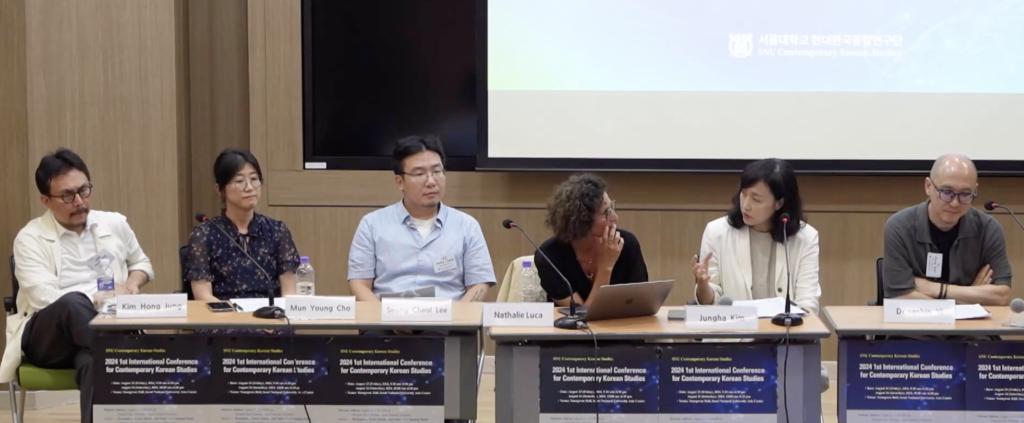
Taken together, the presentations approached contemporary Korean society through its relationship to the future. The historical prioritization of survival, the transformation of optimism into demands for constant self-improvement, the simultaneous pursuit of achievement and experience of exhaustion among young people, the sense that alternative futures have become difficult to imagine, and attempts to calculate uncertainty through financial practices were all treated as “symptoms” of how the future is being experienced in Korea today.
The K-Future session therefore presented the future not merely as an object of prediction, but as an analytical perspective through which the present can be reconsidered. By tracing possible futures already embedded in contemporary emotions, practices, cultural forms, and economic behavior, the session proposed a “symptomatology of the future” as a new way of asking what kinds of futures are becoming possible—or increasingly impossible—within contemporary Korean society.