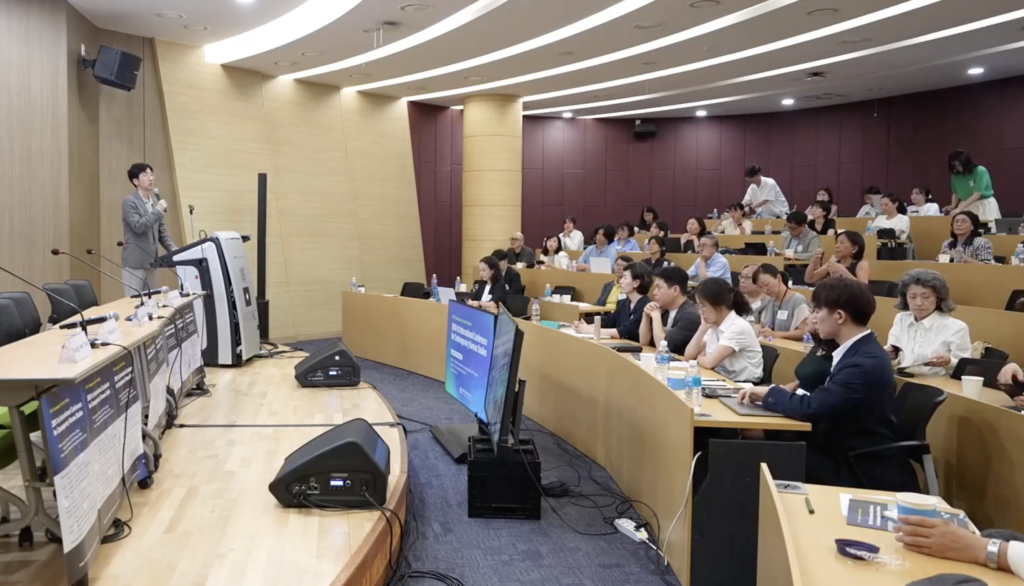
The third session of the 1st International Conference for Contemporary Korean Studies, organized by the Seoul National University Contemporary Korea Research Group, was held under the title “The Masterplots of K-Narrative.” Featuring presentations by Spencer Lee-Lenfield (Harvard University), Hannah Kim (University of Arizona), Hyoungchul Shin (Seoul National University), Youkyung Son (Seoul National University), Hyung-kook Song (KBS), and Kyunghee Yoon (Seoul National University), the session explored recurring narrative structures and their social meanings across a wide range of topics, including literary translation and diaspora, narrative form, meritocracy and retribution, K-Literature and K-Cinema, and memories of the Sewol ferry disaster.
Spencer Lee-Lenfield, in “How the Korean Diaspora Became the Dominant Force in Korean-English Literary Translation,” traced the historical process through which diasporic and transnational Koreans have come to occupy a central position in the English translation of Korean literature. Whereas earlier translations were often undertaken by Western Korean Studies scholars, Korean scholars of English, or collaborative translation teams, recent decades have seen the emergence of a growing cohort of diasporic translators with high levels of literacy in both Korean and English. Lee-Lenfield identified several conditions behind this shift, including the diversification of Korean literature following democratization, Korea’s economic growth and expanding ties with the diaspora, the growth of Korean Studies and Korean-language education in the Anglophone world, and increasing commercial opportunities for translated Korean literature.
This transformation, he argued, has produced translators who are able not only to work across two languages but also to navigate multiple literary communities, publishing environments, and cultural contexts. The future of Korean literature in English, therefore, is likely to pass substantially through the hands of diasporic and transnational Koreans. Understanding the global circulation of Korean literature consequently also requires attention to the literary activities and identities of the Korean diaspora.
Hannah Kim, in “The Unexpected Perils of Pervasive Story Telling,” critically examined the contemporary tendency to understand and communicate virtually everything through stories. Narratives make events easier to grasp by imposing causal connections and emotional coherence, yet these same qualities can also be misleading. Reality does not necessarily contain clear protagonists and villains, dramatic reversals, causal resolutions, or satisfying endings, but audiences accustomed to narrative forms may come to expect reality itself to conform to such structures.
Kim therefore emphasized that narrative is not simply a neutral vehicle for conveying content. Narrative forms themselves contain assumptions about what counts as meaningful, coherent, and satisfying. She suggested that certain features often found in Korean narratives—including genre hybridity, ambiguous endings, and characters who do not conform to conventional heroic models—may challenge established narrative expectations. Rather than locating the “K” of Korean culture solely in language, heritage, or recognizable cultural symbols, Kim proposed that new ways of organizing stories, and by extension new ways of imagining individual and collective lives, could themselves constitute a significant contribution of Korean cultural production.
Hyoungchul Shin, in “For a Fair Re(dis)tribution of Pain: Meritocracy and Vigilantism in K-Narrative,” explored the connections among meritocracy, retribution, and the distribution of suffering in contemporary Korean narratives. Within the broader research agenda of the K-Narrative Team, survivalism, meritocracy, and retributivism have been identified as recurring structures through which contemporary Korean literature and cultural production organize questions of success, failure, responsibility, and justice. From this perspective, narratives of vigilante justice raise broader questions about who is considered deserving of reward or punishment and how distrust in institutional justice may be transformed into desires for private retribution.
Youkyung Son, in “When Korean Literature Encounters ‘K’: Exploring the (Dis)Harmony between Korean and ‘K’ Literature,” examined the gap between “K-Literature” as it circulates globally and “Korean literature” as it has traditionally been studied within Korean literary scholarship. Her presentation drew attention to the ways in which K-Literature is selected, translated, published, and reconfigured through the international literary marketplace. The category of “K,” in this sense, does not simply designate literature produced in Korea. Rather, it points to a field whose boundaries are continually reconstructed through translation and global circulation, raising the question of how K-Literature as translated literature might be reconsidered from the perspective of Korean Studies.
Hyung-kook Song, in “(De)Globalization and Transformation of the Masterplot in K-Cinema,” considered how recurring narrative structures in Korean cinema have been formed and transformed amid changing processes of globalization and deglobalization. His presentation invited participants to view K-Cinema not simply in terms of the international success of particular films or genres, but in relation to the historical and social conditions of Korean society and shifts in the global cultural environment. This approach raises broader questions about how recurring narrative choices in Korean cinema register changing relationships between local experience and global cultural circulation.
Finally, Kyunghee Yoon, in “Accompanying the Specters: Fictional Narratives about the Sewol Ferry Disaster,” examined literary narratives surrounding the Sewol ferry disaster through questions of catastrophe, death, memory, and collective responsibility. Literary works dealing with Sewol do more than represent a tragic event from the past; they ask how the dead continue to remain present in the lives of survivors and how communities should relate to memories that cannot simply be brought to closure. In this sense, narratives of disaster become a means of reflecting on collective memory, national identity, and the ethical responsibilities of those who remain.
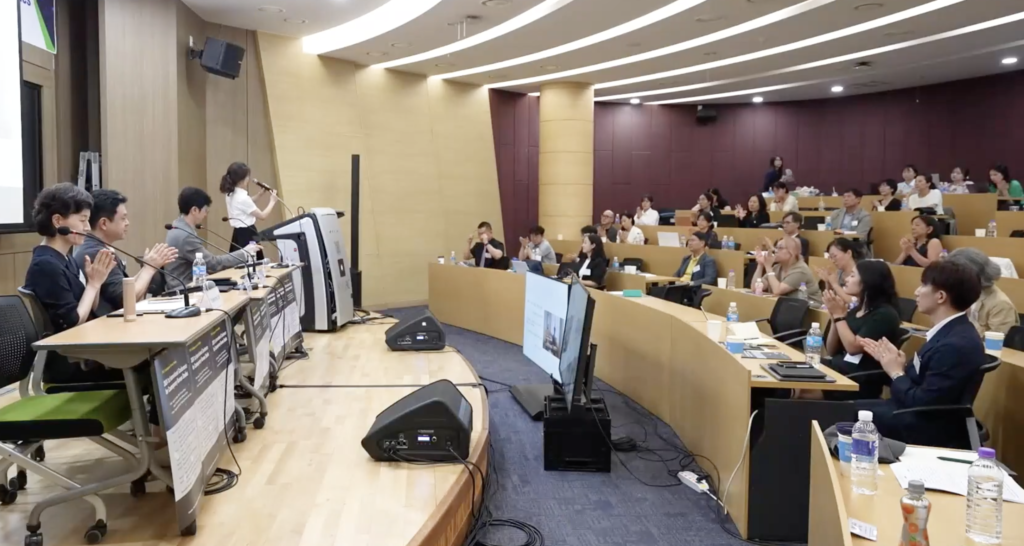
Although the six presentations approached very different objects and employed different disciplinary perspectives, they converged on a common question: what constitutes a “K-Narrative,” and are there recurring modes of storytelling through which Korean experiences are given meaning? The role of the diaspora in redefining the boundaries of Korean literature, challenges to conventional narrative forms centered on individual agency and success, recurring structures of meritocracy and retribution, the global construction of K-Literature and K-Cinema, and literary approaches to national tragedy all demonstrated that narratives do more than reflect reality—they also provide frameworks through which reality is interpreted.
The session therefore proposed the concept of the “masterplot” not as a means of identifying an immutable essence of Korean culture, but as an analytical tool for examining what kinds of lives contemporary Korean society considers valuable, how it explains suffering and failure, and what forms of memory it seeks to preserve. From this perspective, the global circulation of K-Narrative raises a question that goes beyond how widely Korean stories are consumed: how might narrative forms emerging from and transformed through Korean experiences challenge established ways of understanding the world and offer alternative ways of making meaning?