The session “Global Perspectives on Hallyu,” held as part of the 1st International Conference for Contemporary Korean Studies organized by the Seoul National University Contemporary Korea Research Group, examined Hallyu not simply as the global success of Korean popular culture, but as a phenomenon involving historical formation, transnational circulation, knowledge production, decolonization, cultural heritage, and identity. Chaired by Dal Yong Jin (Simon Fraser University), the session featured presentations by Suk-Young Hong (Seoul National University), Younghan Cho (Hankuk University of Foreign Studies), Haekyung Um (University of Liverpool), Sojeong Park (Seoul National University), and Sungmin Kim (Hokkaido University). The presentations addressed the theorization of Hallyu, decolonial knowledge production in Hallyu Studies, the heritagization of Hallyu, the postcolonial implications of K-beauty, and the recategorization of Korean popular music in Japan.
Suk-Young Hong, in “Introduction: Theorizing Hallyu,” outlined the relationship between Hallyu and a renewed field of Contemporary Korean Studies. Hallyu, she argued, should not be understood merely as the worldwide popularity of Korean popular culture. It has generated new demand for knowledge about the history, culture, industries, media systems, and social experiences that made such cultural production possible. By historicizing, theorizing, and decolonizing Hallyu, scholars can move beyond developmentalist narratives of Korea while also critically reconsidering knowledge-production systems that have long privileged Anglo-American and European frameworks.
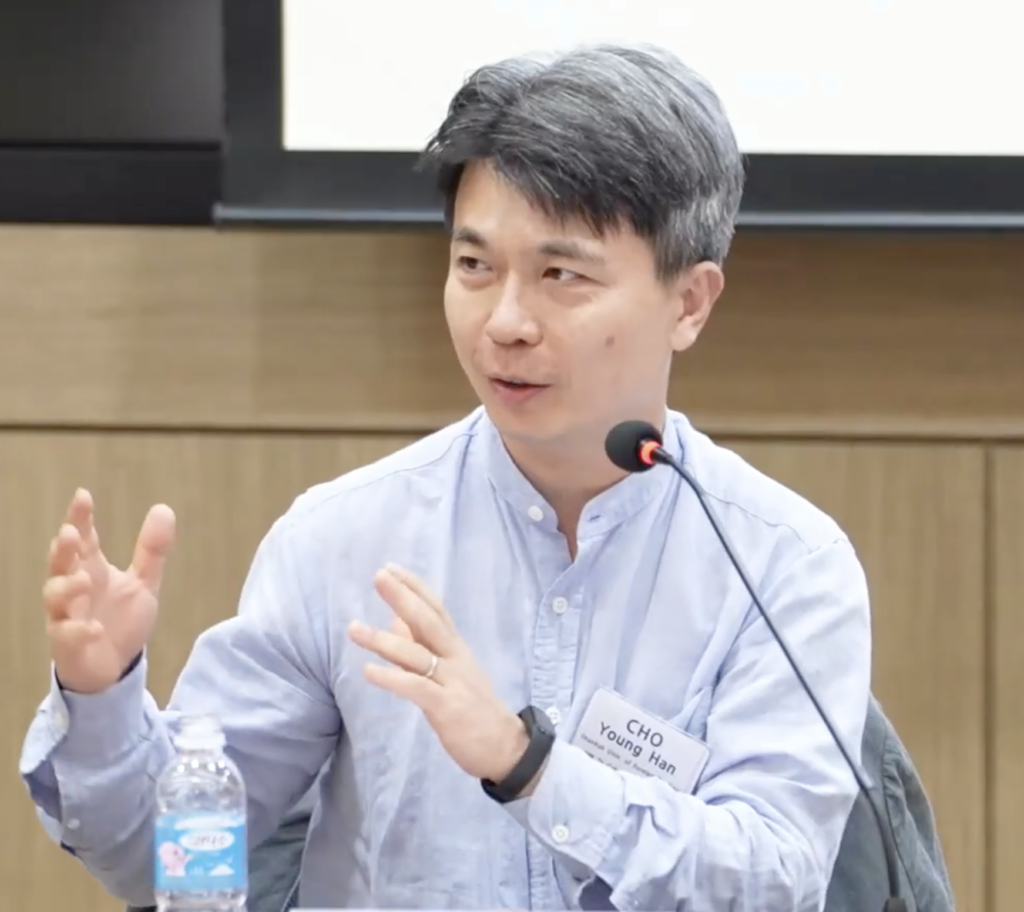
Younghan Cho, in “Institutionalizing Hallyu Studies: De-colonial Knowledge Production through the Historical Landscape of East Asian Pop Culture,” argued that Hallyu Studies should be situated within the longer history of East Asian popular culture. Hallyu was not an isolated Korean success, but emerged through regional processes of industrialization, urbanization, media development, and cultural exchange involving Japan, Hong Kong, Taiwan, and other parts of East Asia. Cho emphasized “Inter-Asia referencing” and the “geopolitics of knowledge,” calling for Asian scholars to engage more actively with one another’s experiences and research rather than treating Western theory as the sole point of reference. From this perspective, decolonizing Hallyu Studies does not mean excluding Western scholarship, but multiplying the sites from which theory and comparison can be generated.
Haekyung Um, in “When Does the Korean Wave Become Cultural Heritage?: Selective Canonization and Institutionalization of South Korean Popular Culture,” examined when and how Hallyu might become cultural heritage. Comparing exhibitions at the Victoria and Albert Museum in London, the National Museum of Korean Contemporary History, and a regional exhibition in Gwangju, she explored how museums select particular objects, narratives, and memories as worthy of preservation. While the V&A exhibition connected Korea’s twentieth-century nation-building process with its twenty-first-century global cultural success, exhibitions in Korea placed greater emphasis on the historical influences of the United States, Hong Kong, and Japan, as well as on local memories and experiences.
Um argued that once Hallyu enters the museum, it becomes subject to processes of selection, valuation, and canonization. Museums may function as sites of national and commercial soft power, but they can also open possibilities for bottom-up forms of heritage-making that incorporate private collections, audience memories, and local cultural histories. The discussion also raised the question of whether Hallyu, as an ongoing contemporary phenomenon, is too recent to be regarded as heritage. Um responded that cultural heritage need not necessarily be old, particularly in the context of digital and documentary heritage, and stressed the importance of rethinking what contemporary popular culture deserves to be archived and preserved.
Sojeong Park, in “Decolonizing Beauty?: A Postcolonial Perspective on K-Beauty,” examined K-beauty at the intersection of race, identity, digital technology, and global power relations. She argued that K-beauty may offer Asian women models of beauty and self-expression that differ from historically dominant Western standards and may complicate racialized representations of Asians. At the same time, she cautioned that this does not automatically make K-beauty decolonial. Korean beauty standards may themselves reproduce colorism, exclude darker skin tones, and generate new cultural hierarchies even as they challenge older Western ones.
Park also emphasized the central role of digital technology in the circulation of K-beauty. Digital retouching, social media, images of K-pop stars, and online beauty tutorials have made visual identities more fluid and open to modification. Yet these same processes remain closely tied to consumerism, neoliberal self-management, and unequal access to technology. K-beauty therefore needs to be understood as a complex postcolonial formation that may destabilize existing hierarchies while simultaneously producing new forms of inequality and domination.
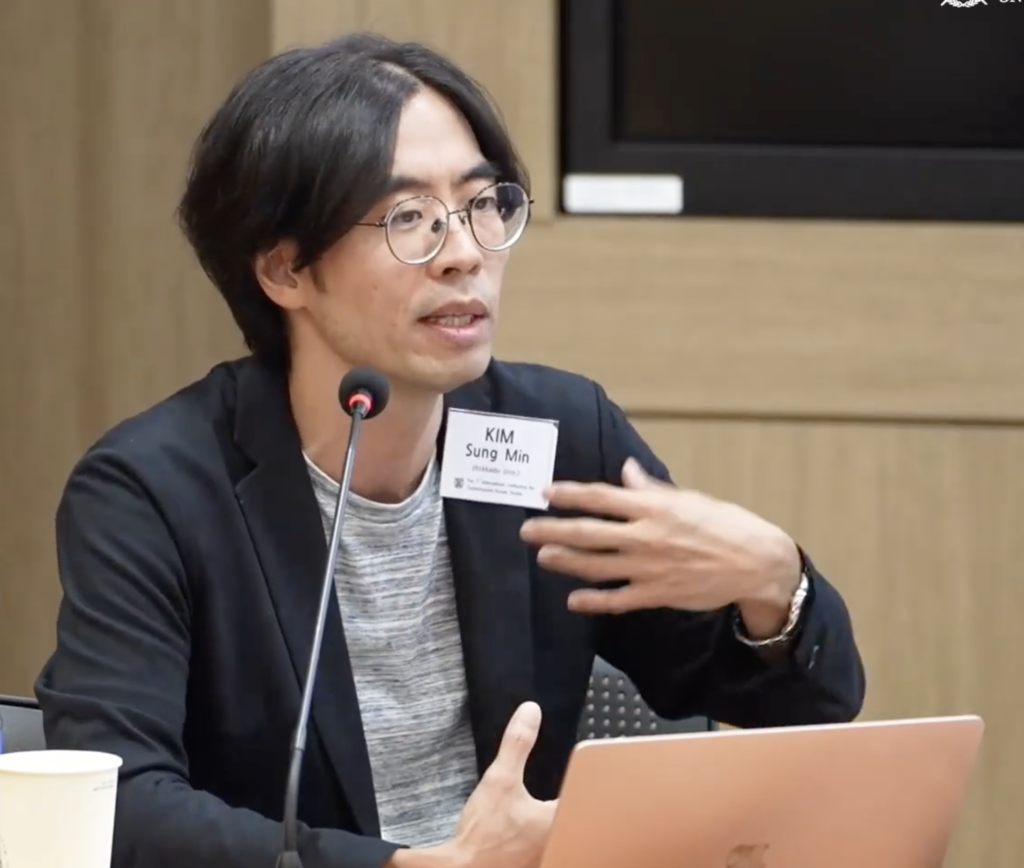
Sungmin Kim, in “Hallyu in Japan: Recategorizing Popular Music and Identities,” traced how Korean popular music has been classified and reclassified in Japan since the 1970s. Korean music was initially consumed largely through the category of “Korean enka,” but this framework weakened with the emergence of J-pop in the 1980s and 1990s. Following BoA’s debut in Japan in 2001 and the expansion of Hallyu through Winter Sonata and other cultural products, K-pop gradually emerged as a distinct musical, industrial, and cultural category separate from both J-pop and Western pop.
Kim argued that the rise of K-pop reshaped not only categories within the Japanese music industry, but also Japan’s perceptions of Korea, Asia, and its own place in the world. Even as political relations between Korea and Japan deteriorated after 2012, the K-pop market continued to expand, suggesting a partial decoupling of cultural exchange from interstate relations. At the same time, anti-Hallyu and anti-Korean discourses became increasingly visible as Hallyu itself grew. More recently, Japanese performers and companies have begun to use the K-pop production system and market as platforms for global expansion, making the boundary between K-pop and J-pop increasingly fluid.
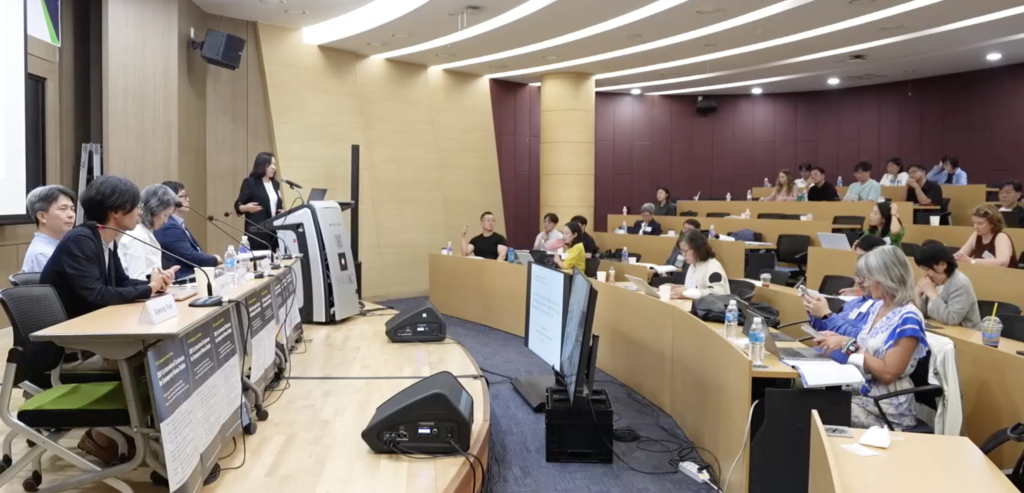
The discussion that followed addressed whether an East Asian perspective remains relevant now that Hallyu has become global, who has the authority to select and preserve Hallyu as cultural heritage, how concepts such as “the West” and “whiteness” should be defined in postcolonial analyses of K-beauty, and how Hallyu has transformed Japan’s music market and national self-understanding. Participants argued that the globalization of Hallyu does not make East Asia less important as an analytical frame. Rather, it increases the need to move beyond both Korea-centered and West-centered perspectives by bringing multiple regional experiences into comparison.
The final discussion raised a further institutional question. While Korean popular culture may now have secured a durable global presence, the institutional foundations of Korean Studies at universities outside Korea remain uneven. Participants therefore asked how growing popular interest in Korean culture might be translated into lasting infrastructures for teaching, research, and scholarly networks. Hallyu was presented as an important force capable of broadening Korean Studies beyond its traditional emphasis on language and history toward the study of contemporary culture, media, politics, and social transformation.
Taken together, the presentations shared a common refusal to understand Hallyu simply as a collection of cultural products “exported” from Korea to the world. Hallyu emerged instead as a historical process formed through interactions among Korea, East Asia, and the wider world; as a space in which the meaning of “Koreanness” is continually reconstructed; and as a phenomenon that challenges established cultural and academic hierarchies. From this perspective, Hallyu Studies becomes an important site within Contemporary Korean Studies for examining how modern Korea is constituted and understood globally, and how existing relationships between centers and peripheries of culture and knowledge are being transformed.