The music session of the 1st International Conference for Contemporary Korean Studies, organized by the Seoul National University Contemporary Korea Research Group, was held under the title “Exploring Contemporary Korean Music: From Traditional to Classical to K-Pop and Everything in Between.” The session opened with an introduction to the Contemporary Korean Music research network by Anna Yates-Lu (Seoul National University), followed by presentations by Keith Howard (University of London) and Nancy Yunhwa Rao (Rutgers University) on the history and methodology of kugak research and intercultural collaboration in contemporary East Asian music. Rather than treating traditional, classical, and popular music as separate domains, the session crossed these boundaries to reconsider the scope and meaning of “Korean music” today.
Anna Yates-Lu introduced the Contemporary Korean Music research project by observing that, despite a long history of scholarship on Korean music, research on traditional music, Western classical music, and popular music has often developed within relatively separate disciplinary spheres. The project therefore seeks to build an interdisciplinary network connecting approaches from musicology, ethnomusicology, anthropology, and practice-based research while incorporating the perspectives of performers and other practitioners alongside those of academic researchers.
A central premise of the project is that Korean music can no longer be defined solely as music created within the territorial boundaries of Korea or exclusively by Koreans. Diasporic communities, international performers, and musical scenes in the United States, the United Kingdom, and continental Europe have all become important sites in which Korean music is produced, performed, and reinterpreted. The project consequently examines not only methodological but also geographical expansions of Korean music research, as well as questions of interculturality, transnationalism, and cultural policy. These changing conditions ultimately raise a broader question about how “Koreanness” itself should be understood through music.
Keith Howard, in “Shifts and Stasis in the Promotion of Kugak: Observing and Interacting with Korean Music, 1979–2024,” reflected on more than four decades of research on Korean traditional music to examine changes in both the boundaries of kugak and the methodologies used to study it. Korean kugak scholarship was initially institutionalized around court music and historical sources, supported by institutions including Seoul National University, the National Gugak Center, and the national intangible cultural heritage system. Over time, its scope expanded considerably to encompass folk songs, sanjo, pansori, samulnori, and various forms of fusion and newly created traditional music.
Howard argued, however, that while the objects of kugak scholarship have expanded substantially, many of its core methodological structures have remained comparatively stable. During the same period, international musicology and ethnomusicology increasingly turned toward the social, cultural, political, and geographical contexts of music-making. This divergence has created a methodological distance between Korean kugak scholarship and international ethnomusicology, with practical implications for younger scholars seeking to publish, participate in international conferences, or move between Korean and overseas academic institutions.
Howard therefore returned to the question of what should count as kugak. If its boundaries have already expanded from court music to folk, newly composed, and fusion music, should scholarship on religion and music, colonial-era musical circulation, digital culture, the internet, or artificial intelligence also fall within the field? And should kugak continue to be studied separately from other forms of Korean music and from ethnomusicological research elsewhere in the world? Rather than offering a fixed answer, Howard argued that the vitality of kugak in Korea and abroad will depend on continued reflection on the relationship between preservation, research methodology, and contemporary musical practice.
Nancy Yunhwa Rao, in “Classicism and Inter-Asian Collaboration in Contemporary Music,” examined how collaboration among musicians from different East Asian traditions can generate new possibilities in contemporary concert music. She approached culture not as a collection of fixed and isolated entities but as something continuously transformed through movement, exchange, and interaction. From this perspective, intercultural collaboration should not automatically be reduced to the language of “cultural appropriation.” When musicians seriously engage with one another’s aesthetic values, practices, and cultural memories, collaboration can instead become a process through which different traditions are mutually transformed and new artistic practices emerge.
Rao used the concept of “Inter-Asia” not to suggest a unified Asian cultural identity, but to analyze exchanges among societies that share certain historical experiences while retaining distinct cultural trajectories. The condition of being “familiar yet different,” she argued, can provide musicians with both common ground and productive difference, becoming an important source of artistic creativity.
She illustrated this argument through two cases of inter-Asian musical collaboration. The first involved Chinese American composer Chou Wen-chung and Korean gayageum musician Yi Jiyoung, whose collaboration contributed to the creation of Eternal Pine. The second concerned Korean composer Unsuk Chin and Chinese sheng virtuoso Wu Wei. Chin had long avoided using Asian traditional instruments because she resisted having her music interpreted through stereotypes of an “East Asian composer,” but her encounter with Wu Wei revealed new sonic possibilities in the sheng and led to the composition of Šu. In both cases, collaboration with a different but culturally proximate East Asian musical tradition opened possibilities that had remained inaccessible within the composers’ previous practices.
Rao connected these collaborations to the concept of “classicism.” Rather than simply reproducing the past, classicism involves reimagining and recreating inherited traditions through the aesthetic concerns of the present. She therefore proposed that contemporary East Asian composers’ engagement with cultural memory should not be understood only through questions of national authenticity, nationalism, Orientalism, or postcolonialism. Inter-Asian collaboration can instead illuminate how musicians actively reinterpret the classical past through contemporary musical languages, allowing different traditions to shed light on and transform one another.
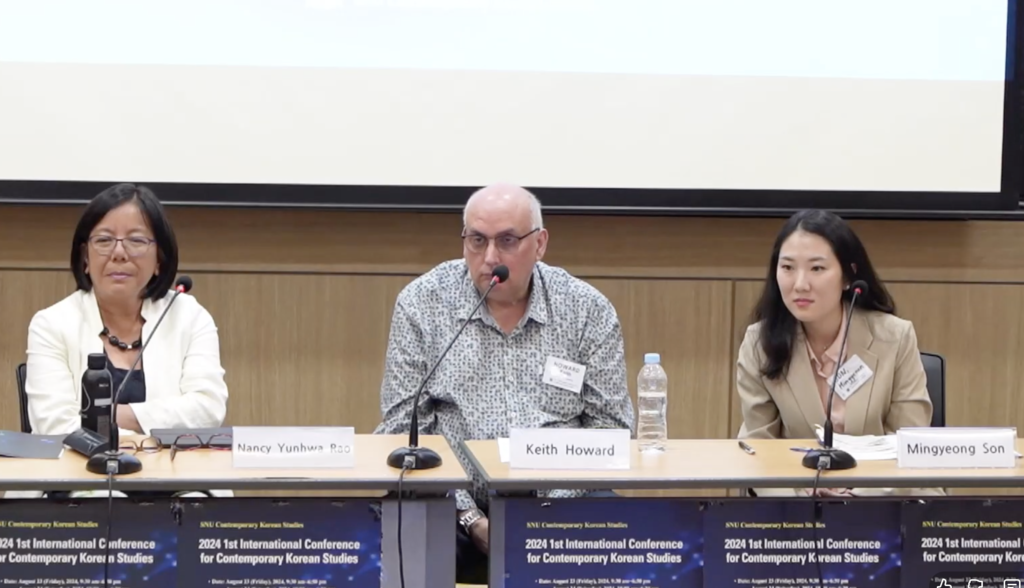
The discussion that followed brought the two presentations into dialogue around questions of musical identity, tradition, and collaboration. Participants considered how scholarship on traditional Korean music might engage more effectively with international academic debates without abandoning its own intellectual history, how musical practices that have been lost or transformed might be recovered, and how much “fusion” is necessary for a collaboration to become genuinely intercultural.
Howard emphasized that it was not the role of an outside scholar to prescribe how Korean kugak scholarship should change, while noting that difficulties in communicating with international journals and conferences remain a real concern. He also stressed that the tension between preservation and transformation is not unique to Korea: similar debates over the recording, standardization, loss, and revival of traditional music and dance have occurred around the world. The continued vitality of kugak in Korea and its growing recognition abroad should therefore itself be regarded as a significant achievement.
The discussion of intercultural collaboration likewise emphasized that there is no single ideal form of musical synthesis. In some collaborations, distinct traditions may remain clearly recognizable alongside one another; in others, they may generate a new musical language in which the boundaries are much harder to distinguish. Participants therefore highlighted the importance of examining not only composers and performers but also relations of trust and hierarchy, different degrees of collaboration, and the ways audiences from different cultural backgrounds perceive the resulting music.
Taken together, the session presented “Korean music” not as a field defined by fixed boundaries between tradition and modernity, Korea and the world, or kugak, classical, and popular music, but as an evolving domain continuously reshaped through encounters among different musical traditions, research methodologies, people, and places. The changing history of kugak and contemporary inter-Asian collaboration may appear to represent very different musical worlds, yet both ultimately raise the same questions: what can be called Korean music, and how can cultural identity be understood through musical practice?
From this perspective, the study of contemporary Korean music becomes more than the study of a specialized cultural field. It provides an important site for Contemporary Korean Studies in which tradition and modernity, national and transnational movement, cultural memory, institutional practice, and changing forms of identity intersect.