On January 30, at 2:00 p.m., the second lecture in the doctoral dissertation lecture series organized by the Modernity and Development Team of the SNU Contemporary Korean Studies (서울대학교 현대한국종합연구단 ‘근대성과 발전사팀’) was held.
This seminar, held under the theme “The Cold War and Development in East Asia: Across Militarism, Science and Technology, and Local Society,” brought together recent doctoral dissertation research from various fields of modern Korean history—including militarism, science and technology, and local society—to present findings and discuss the issues they raise.
The second presentation was given by Dr. Lim, Gwangsoon (임광순) of the Research Institute of Korean Studies at Korea University, under the title “The Implementation and Character of Population Dispersal Policy during the Park Chung-hee Regime (박정희 정권기 인구분산정책의 추진과 성격).” A wide-ranging discussion unfolded on population movement and dispersal policy during the Park Chung-hee regime of the 1960s–70s, a major issue in modern Korean history. In particular, the presentation focused on how the two logics of economic development and national security were mobilized in the population dispersal policy of this period.
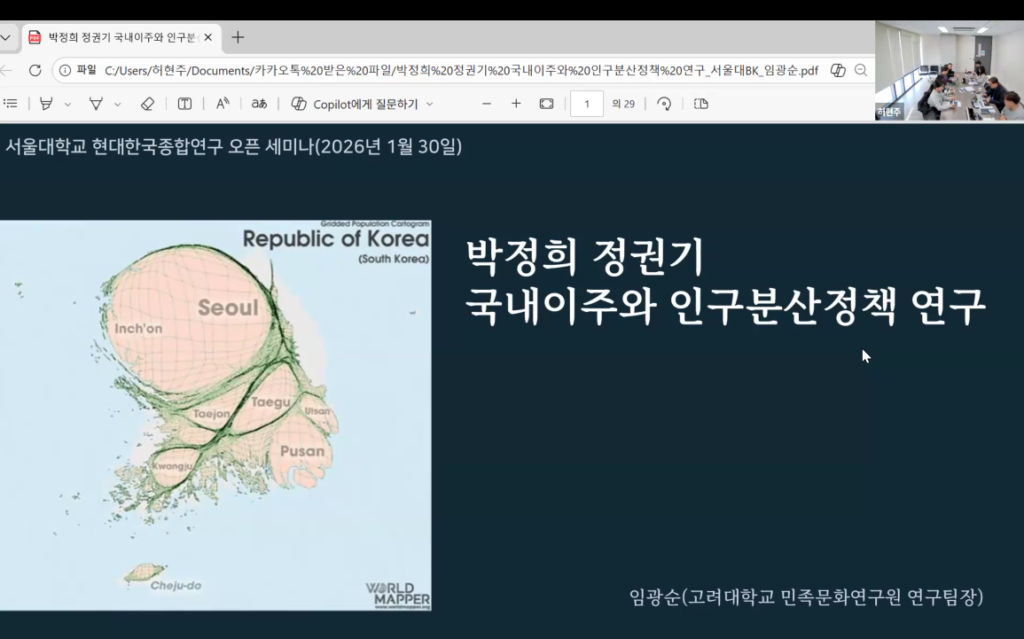
In the discussion that followed, held simultaneously in the in-person classroom and online, early-career researchers—including graduate students from the Department of Korean History at Seoul National University—led a lively question-and-answer session. The discussion expanded into topics such as other facets of population movement, housing issues in Korean society, regional imbalances in development, and dimensions of transportation and logistics.