On March 13, at 2:00 p.m., the final lecture in the doctoral dissertation lecture series organized by the Modernity and Development Team of the SNU Contemporary Korean Studies (서울대학교 현대한국종합연구단 ‘근대성과 발전사팀’) was held.
This seminar, held under the theme “The Cold War and Development in East Asia: Across Militarism, Science and Technology, and Local Society,” brought together recent doctoral dissertation research from various fields of modern Korean history—including militarism, science and technology, and local society—to present findings and discuss the issues they raise.
The sixth presentation was given by Dr. Seo, Hong-Seok (서홍석) of the Korea University Center for Korean History, under the title “The Korean People’s Army’s Participation in Socialist Rural Construction and the Formation of a ‘Unity of Military and People (軍民一致)’ Society (1945–1972) (조선인민군의 사회주의 농촌건설 참여와 ‘군민일치(軍民一致)’ 사회 형성(1945~1972)).” Taking up a cutting-edge topic in North Korean history, the presentation examined—from a long-term perspective—the role of the military in development and postwar reconstruction, including the agricultural collectivization of North Korea, from immediately after Liberation through the postwar 1960s–70s.
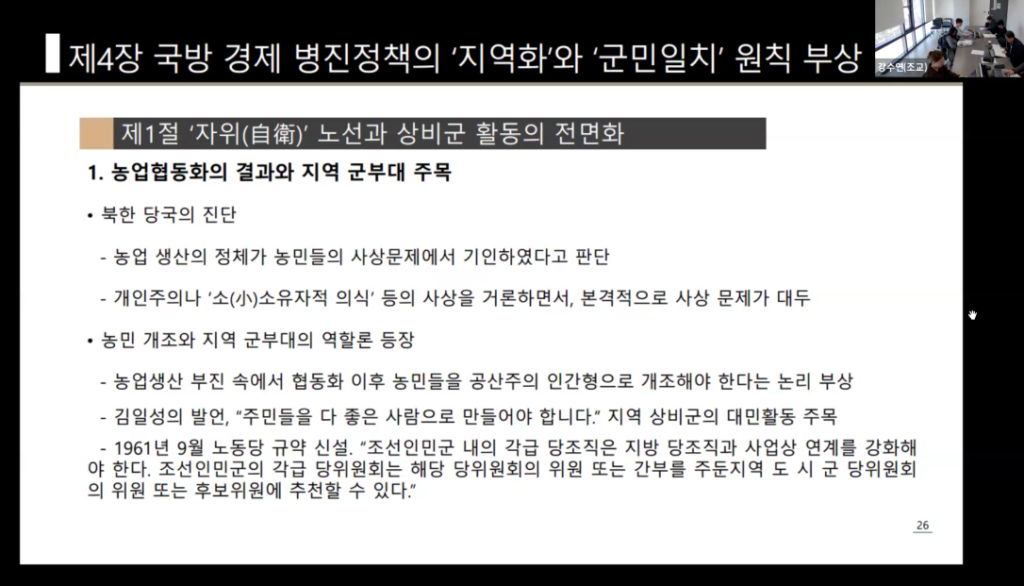
In the discussion that followed, held simultaneously in the in-person classroom and online, early-career researchers—including graduate students from the Department of Korean History at Seoul National University—led a lively question-and-answer session. From a comparative North–South Korean perspective, the discussion ranged broadly over the social role of the military, the character of policy in socialist-bloc states, and the distinctive features, limitations, and significance of North Korean historical studies within modern Korean history.