On April 3 at 4:00 p.m., the 11th Values and Identity Team Colloquium was held in Room 214, Building 5, at Seoul National University. The event was organized by the Values and Identity Team of the Center for Contemporary Korean Studies.
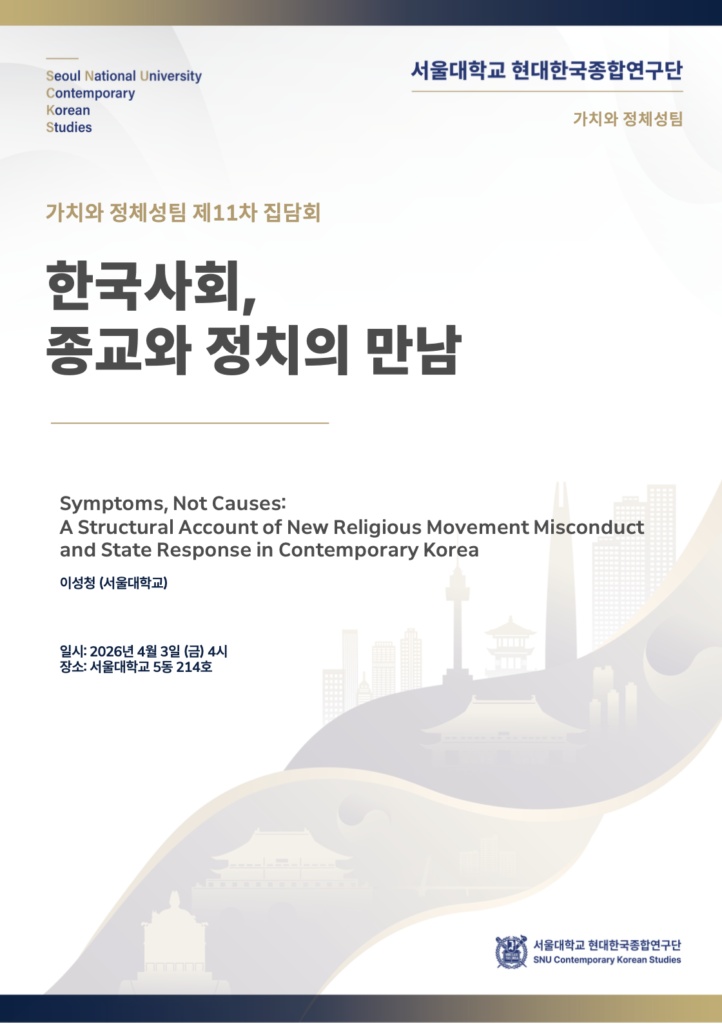
The colloquium was held with the aim of exploring the values and identities of Koreans living in 2026 by examining various phenomena in contemporary Korea, while also considering future prospects.
Professor Lee Sung-chung of the Department of Religious Studies at Seoul National University delivered a presentation titled “Symptoms, Not Causes: A Structural Account of New Religious Movement Misconduct and State Response in Contemporary Korea.”
In his presentation, Professor Lee critically analyzed the firm attitudes and remarks recently expressed by senior government officials toward new religious movements. He suggested that the current situation should be understood as a symptom produced by structural asymmetries in Korea’s religious market. Professor Lee examined the problems in the government’s response across three dimensions, calling for individual new religions to be assessed on the basis of their actual outcomes and for greater attention to be paid to the structural asymmetries of Korea’s religious market.
In the Q&A session that followed, researchers from the Values and Identity Team exchanged a range of views. Professor Jung Hyun-joo of the Department of Urban Planning at Seoul National University expressed general agreement with the argument of the presentation, while noting that the discussion could be further enriched if it also addressed possible alternative views from the perspective of public perception. Professor Sung Hae-young of the Department of Religious Studies at Seoul National University noted that the presentation was significant in that it dealt with a highly timely topic, adding that the research would become even more interesting if the discussion were expanded to examine the dynamics jointly produced by established religions and the government.