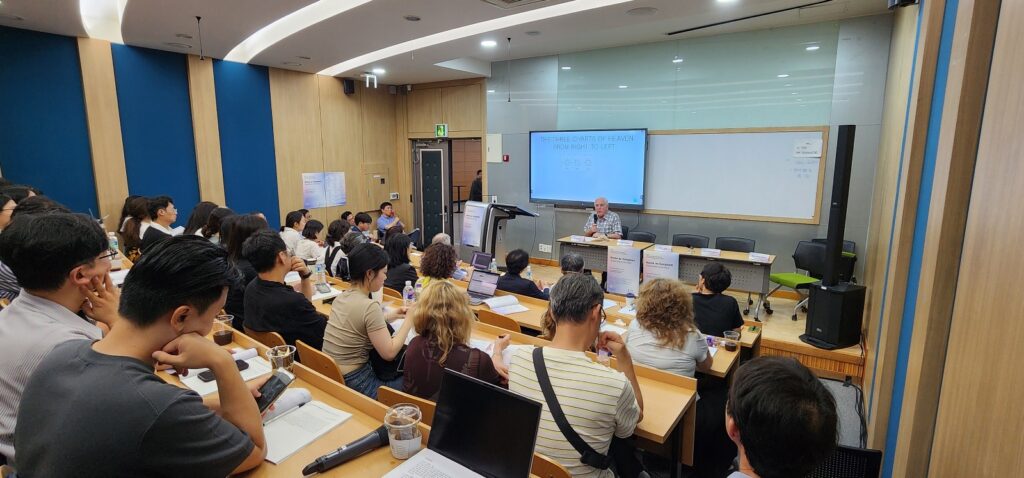
Seoul National University’s Center for Contemporary Korean Studies held an international conference titled “Korea as Symptom” over two days, on August 22 and 23. As the second session of the conference, the Values and Identity Team organized a session titled “Religion, Culture, and Political Identity in Korea I” in Room 230, Building 101, at Seoul National University. Chaired by Professor Sem Vermeersch of Seoul National University, the session featured the following three presentations.
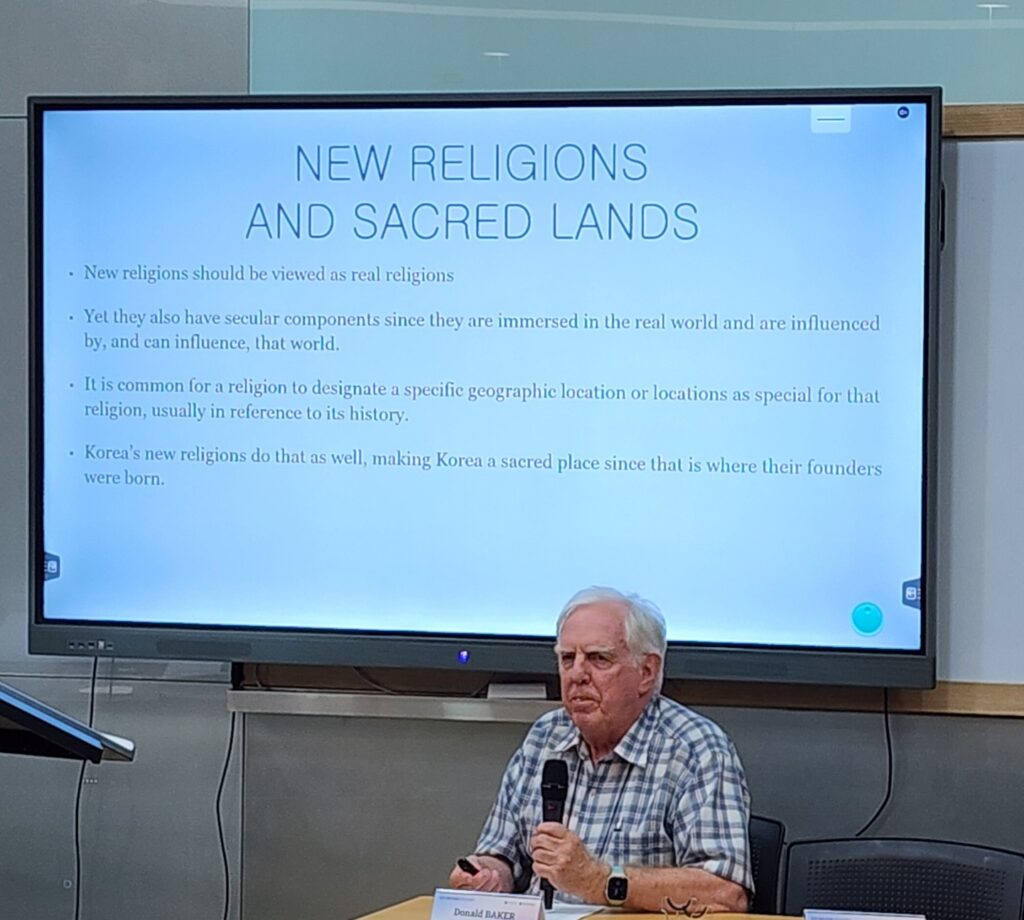
The first presenter was Professor Donald Baker of the University of British Columbia, who delivered a presentation titled “Sacralizing the Nation: New Religions and Korea’s Place in the World.” Focusing on Korean new religions that have received relatively little scholarly attention, Professor Baker analyzed religious nationalism in Korea as expressed through these movements. In particular, by examining cases such as Donghak/Cheondogyo, Won Buddhism, and Daejonggyo, he highlighted the ways in which Korean new religions intersected with modern Korean history.
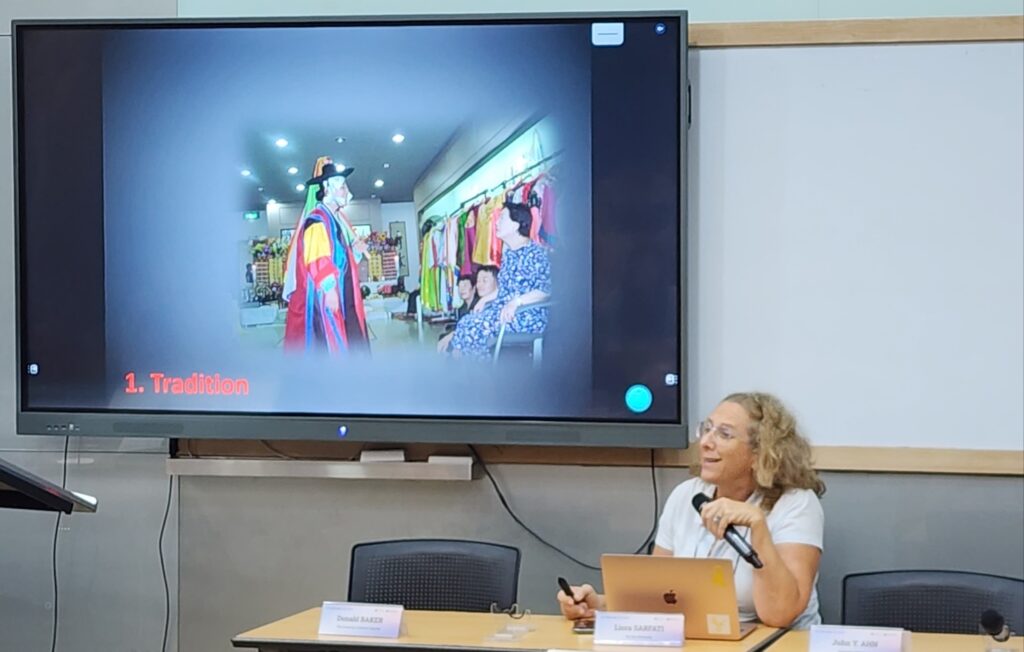
The second presentation was delivered by Professor Liora Sarfati of Tel Aviv University, titled “Evolving Representation of Mudang in Korean Television.” In Korea, mudang, or shamans, have long been regarded as irrational and outdated superstition. Since the 2000s, however, mudang have increasingly been represented in the media as helpers or problem-solvers in television dramas. Professor Sarfati pointed out that this shift reflects a broader tendency to view shamanism as a distinctive cultural asset of Korea.
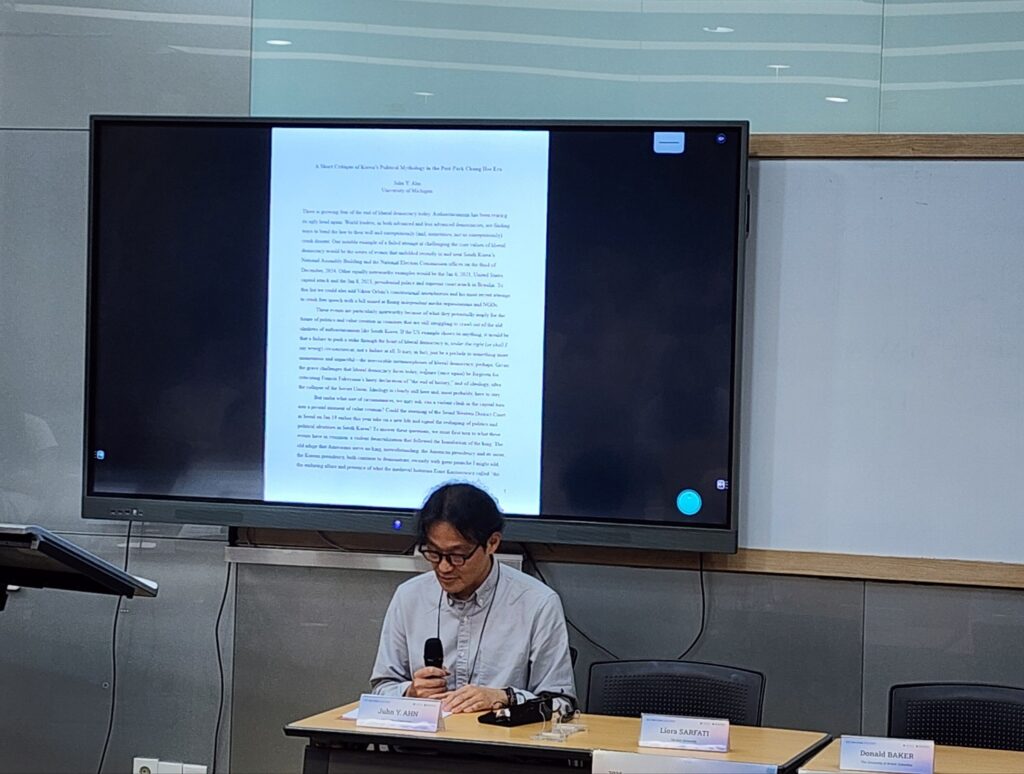
The final presentation was given by Professor Ahn Junyoung of the University of Michigan, titled “A Short Critique of Korea’s Political Mythology in the Post-Park Chung Hee Era.” He showed that political mythology has continued to operate in Korean society after Park Chung Hee’s death, interpreting this phenomenon through the concept of “the king’s two bodies.” In particular, he explained that even after democratization, politicians have tended to reinforce their authority and legitimacy through associations with religion or superstition.
By analyzing the intersections of religion, culture, and politics in Korean society from the perspectives of religious nationalism, media representation, and political mythology, this session provided an opportunity to examine the complex dimensions of Korean identity in a multilayered way.