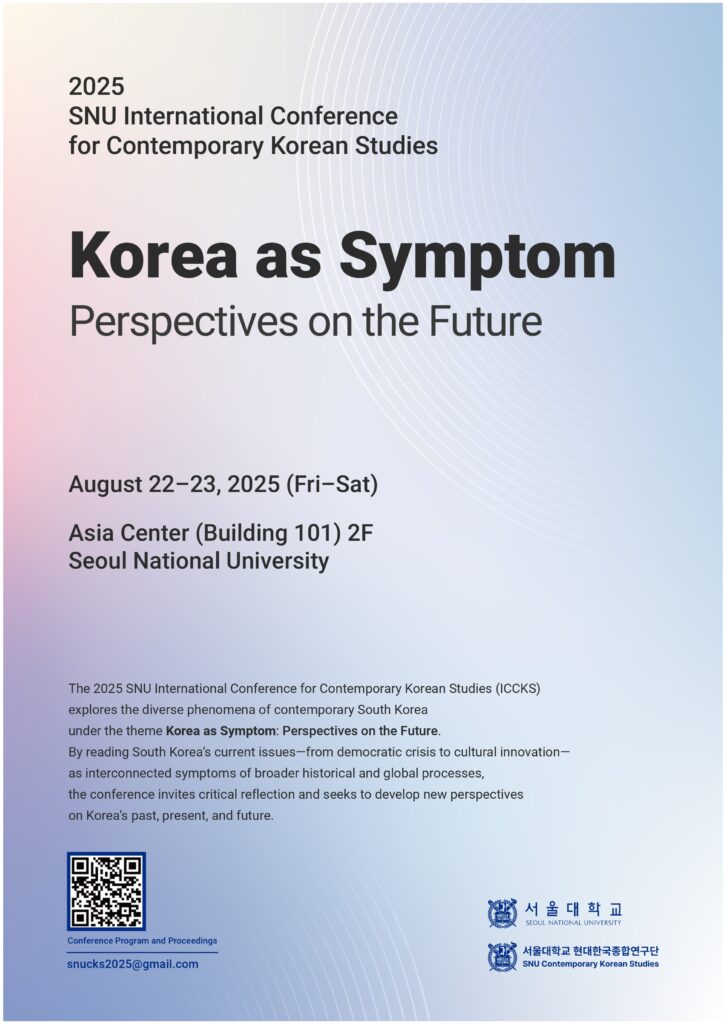
The SNU Center for Contemporary Korean Studies will host the 2025 SNU International Conference for Contemporary Korean Studies over two days, from Friday, August 22 to Saturday, August 23, 2025, on the second floor of the SNU Asia Center (Building 101). Following its inaugural conference last year, this second annual gathering will be held under the theme “Korea as Symptom: Perspectives on the Future.” The conference seeks to interpret a wide range of contemporary phenomena in Korean society—from the crisis of democracy to the global expansion of K-pop—within broader historical and global transformations.
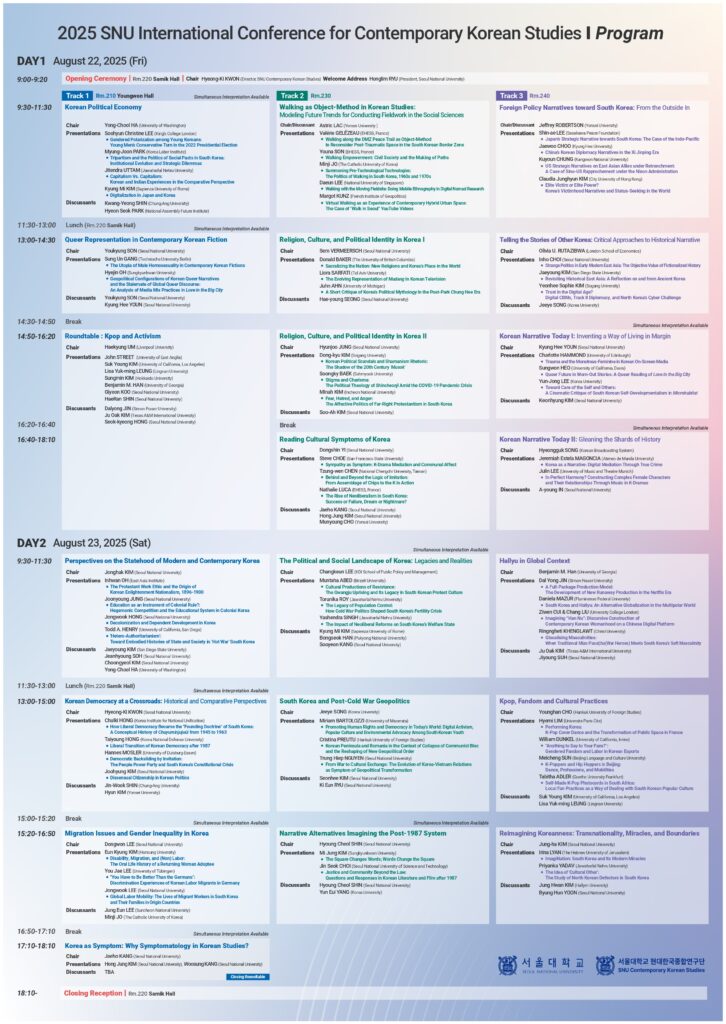
Bringing together scholars of Korea from around the world, including researchers from South Korea, China, Taiwan, Hong Kong, Japan, India, the Philippines, Israel, the United States, Canada, the United Kingdom, Germany, France, and Italy, the conference will begin with welcoming remarks by SNU President Hong Lim Ryu and continue with an intensive two-day program. In addition to established research agendas such as the political economy of Korea, the global circulation of Korean culture, and statehood and democracy in contemporary Korea, the conference will feature in-depth discussions of emerging topics including gender and migration, K-pop and social movements, queer narratives in Korean literature, and religion and political identity. On the second day, the conference will conclude with a roundtable discussion involving all presenters and discussants, bringing together the key insights from the preceding sessions and identifying future research agendas for Korean Studies.
Major sessions of the conference will be livestreamed on YouTube, allowing interested scholars and members of the public around the world to participate remotely. Simultaneous interpretation will also be provided for selected sessions to facilitate communication among participants.
The SNU Center for Contemporary Korean Studies was established in 2023 with the goal of building a research-oriented global hub with strong global visibility. The Center seeks to advance scholarly understanding of social transformation and cultural practices in contemporary Korea while promoting interdisciplinary collaboration among researchers in Korea and abroad. Currently, more than 50 researchers and research assistants are conducting collaborative research with scholars around the world, and major research outcomes of the Center are being published as part of a Korean Studies monograph series with Palgrave Macmillan.
Beginning with this second international conference, the event is expected to become an annual academic gathering. Future conferences will continue to explore new ways of understanding contemporary Korea: the 2026 conference will be held under the theme “Korea as Method,” followed by “Korea as Alternative” in 2027, extending the conversation toward new methodologies and alternative perspectives for thinking about contemporary Korea.
Event Information
- Event: 2025 SNU International Conference for Contemporary Korean Studies
- Date & Time: August 22 (Fri)–23 (Sat), 2025, 09:00–18:30
- Venue: 2F, SNU Asia Center (Building 101), Seoul National University
- Organizer: SNU Center for Contemporary Korean Studies
- Format: In person and livestreamed on YouTube
https://www.youtube.com/@SNUCKS2025
Please refer to the attached conference materials for further details.
The 2nd International Conference: Overview
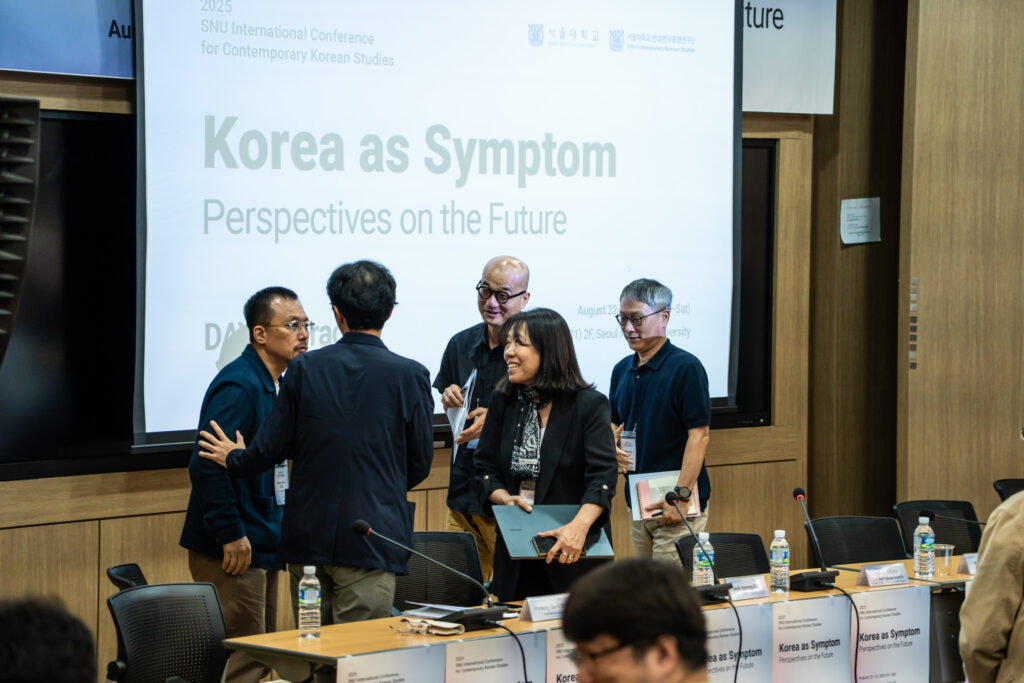
The 2nd International Conference, held under the theme “Korea as Symptom: Perspectives on the Future,” approached the diverse phenomena emerging in contemporary Korean society not simply as outcomes of a single fixed structure or developmental trajectory, but as “symptoms” through which deeper social transformations might be read. Korea’s compressed growth and democratization, political conflict and social insecurity, the global expansion of popular culture, and changing forms of religion and identity were examined as different manifestations of broader and often contradictory transformations. In doing so, the conference sought to move beyond familiar binaries such as success and crisis, tradition and modernity, or the domestic and the global, and to explore how the present condition of Korean society might be interpreted in relation to possible futures.
Across two days of presentations and discussions, participants examined a wide range of issues, including transformations in political economy surrounding gender, labour, and digitalization; the history and possible erosion of Korean democracy; religion and political identity; state formation and foreign-policy narratives; post–Cold War geopolitics; the intersection of migration, disability, and gender; queer and marginalized identities; and narratives in Korean literature and popular culture. The conference also explored the global circulation and local reconfiguration of Hallyu, the relationship between K-pop fandom and political or social activism, and experimental approaches to fieldwork that treated “walking” as both an object and a method of research. Across these discussions, Korea emerged not as a space that could be reduced to a single identity or developmental model, but as a complex site in which democratization and political crisis, global cultural influence and local reinterpretation, economic development and social insecurity, and national boundaries and transnational mobility coexist and intersect.
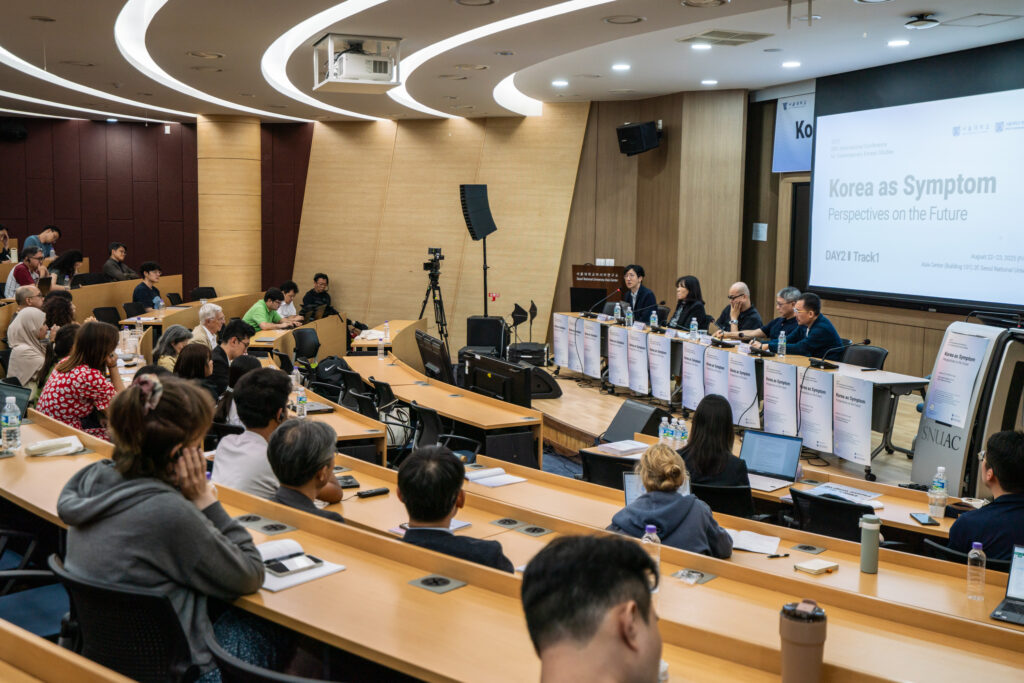
The concluding discussions brought these diverse cases together through the shared framework of “symptomatology.” Here, a “symptom” did not simply refer to a social problem in need of correction. Rather, it referred to a visible event or phenomenon through which less visible structures and transformations operating beneath the surface could be interpreted. The 2nd International Conference therefore developed an interdisciplinary approach that sought to understand contemporary Korea by attending closely to fragmented, heterogeneous, and sometimes contradictory phenomena rather than subsuming them under a single universal theory. In this sense, the conference also laid the intellectual groundwork for the next stage of the Research Group’s agenda, “Korea as Method,” by moving from the task of identifying and interpreting Korean “symptoms” toward questioning the concepts and methods through which Korea itself is studied.