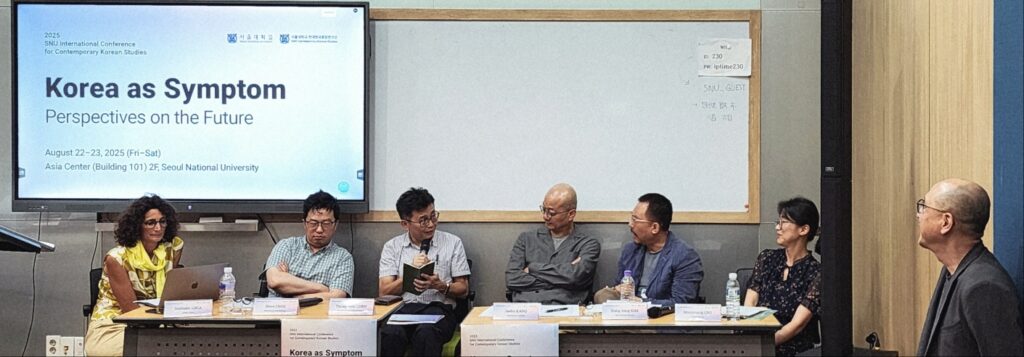
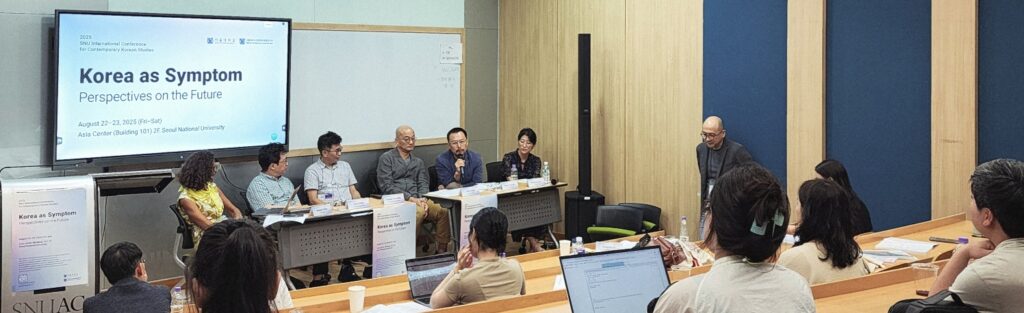
SNU Contemporary Korean Studies held an international conference under the theme “Korea as Symptom” on August 22 and 23. On the final session of the first day, the K-Future Team presented a panel titled “Reading Cultural Symptoms of Korea.” Chaired by Dongshin Lee (Seoul National University), the session brought together three speakers who approached Korea’s cultural symptoms through popular culture, technology, and religion.
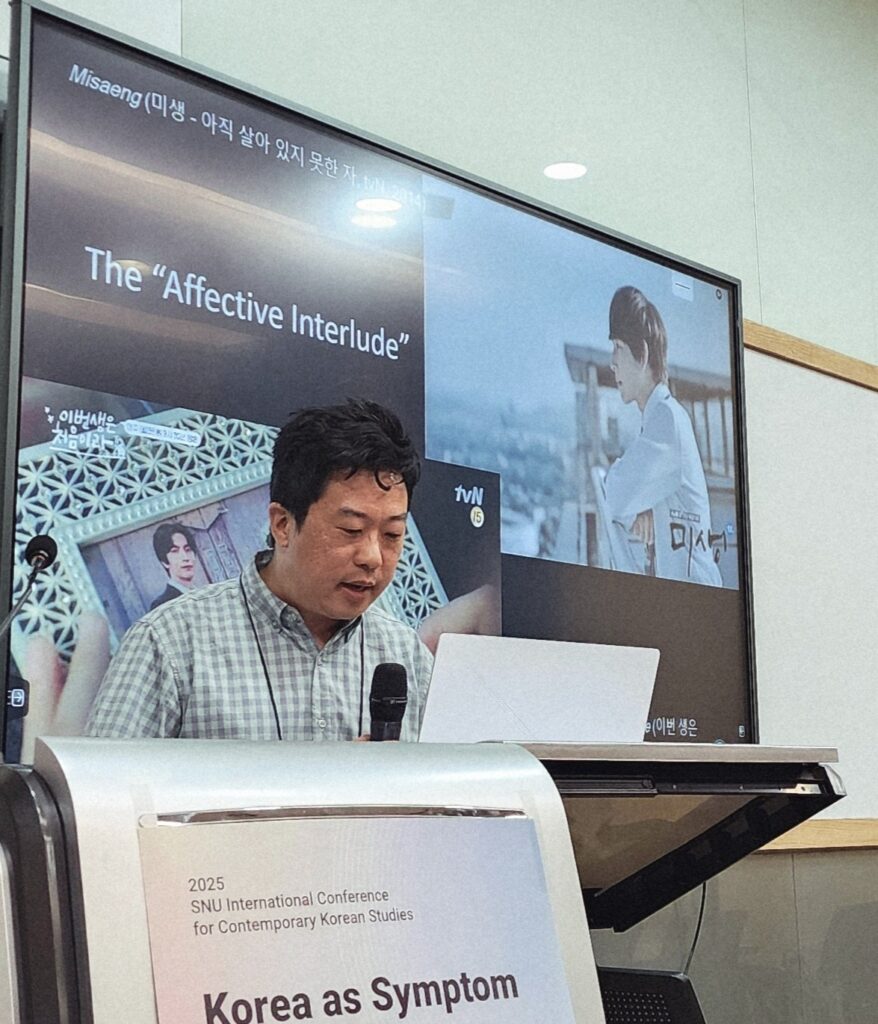
Steve Choe (San Francisco State University) presented “Sympathy as Symptom,” examining the expression of emotion in K-dramas. Focusing on “feeling”, a term often invoked but rarely theorized in discussions of K-drama, Choe proposed the concept of the “affective interlude” to describe scenes placed between dialogue and action. These interludes stage “true feeling” as spectacle, organizing viewers’ responses such as sympathy, anger, tears, or discomfort. His presentation invited a critical reflection on the forms of morality and virtue that K-dramas produce and circulate within the Korean cultural context.
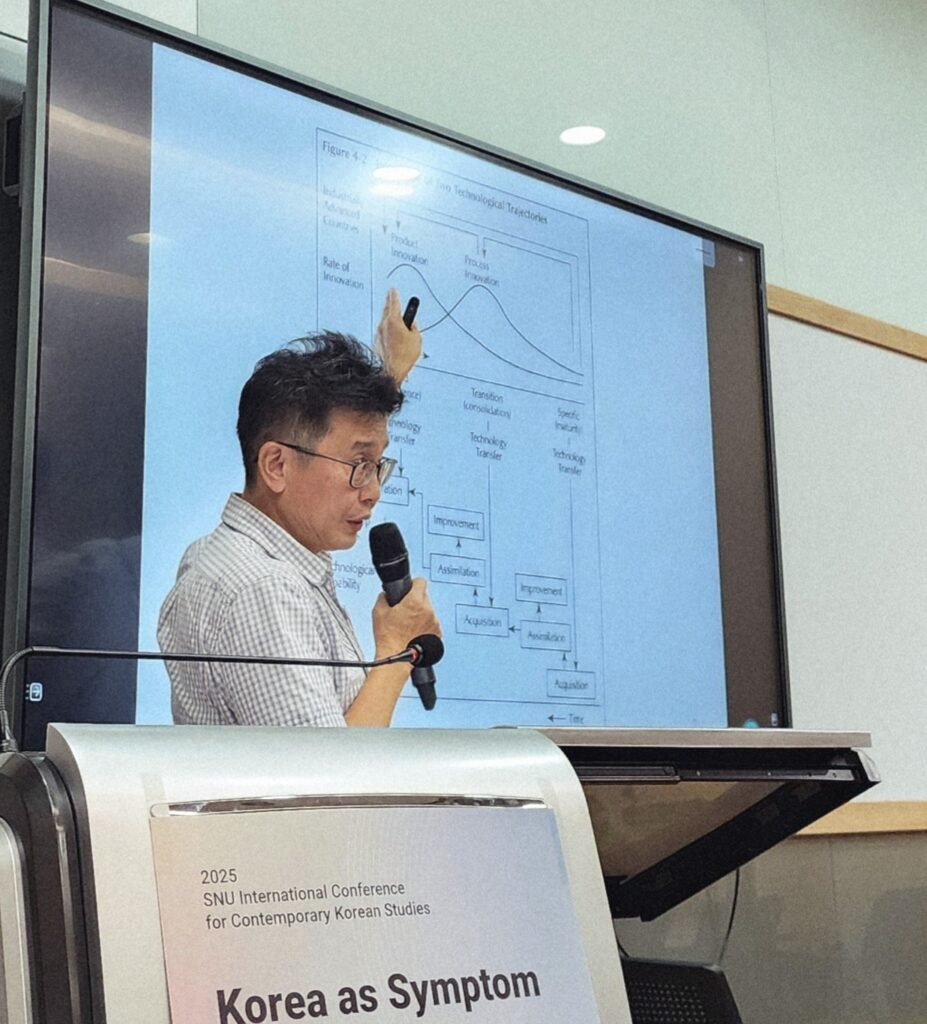
Tzung-wen Chen (National Chengchi University) presented “Behind and Beyond the Logic of Imitation,” reconsidering the familiar narrative of Korean technological development as a transition “from imitation to innovation.” Focusing on the early development of the semiconductor industry, Chen argued that technological change in Korea cannot be reduced to a binary movement from copying to invention. Rather, it should be understood as a process of assemblage and instauration, in which forms, concepts, values, devices, and organizations were combined across multiple levels. From this perspective, Korea’s technological development appears as an emergent process of rearranging heterogeneous elements under specific Korean conditions. Chen further suggested that similar dynamics can also be observed in K-pop and the Korean food industry.
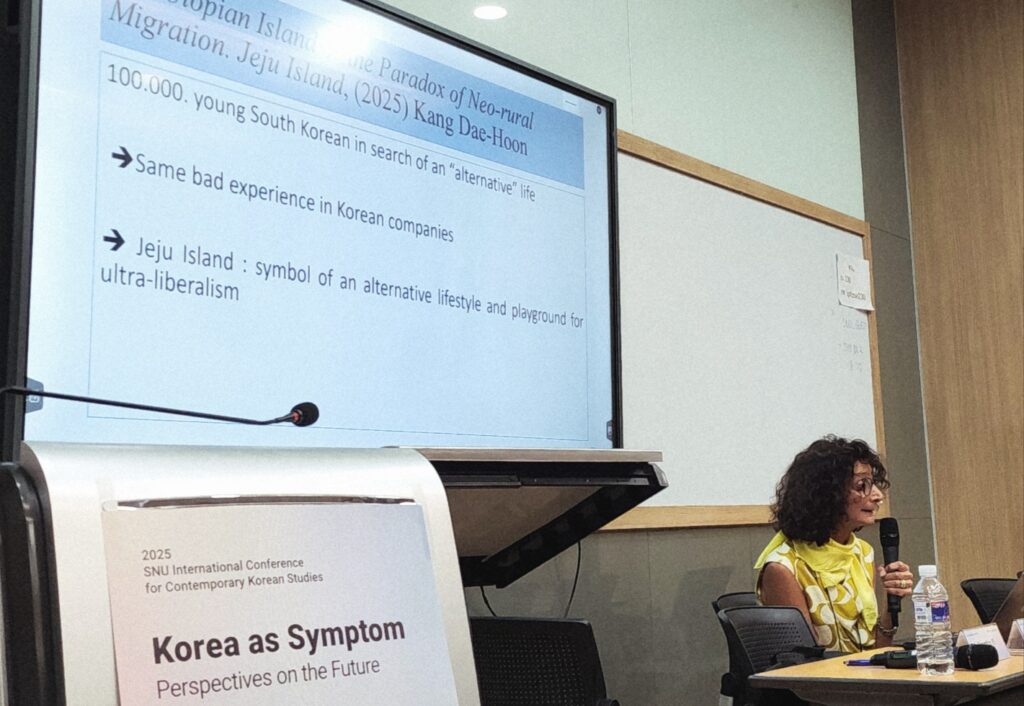
Nathalie Luca (EHESS) presented “The Rise of Neoliberalism in South Korea: Success or Failure, Dream or Nightmare?” analyzing how selected religious groups in Korea have combined religious values with neoliberal norms since the 1980s. Luca showed that, under neoliberalism, religion no longer stands outside the market. Instead, religious institutions and spiritual leaders have adjusted doctrines and practices in response to market logics and demands. Her presentation illuminated how religion neither simply accepts nor rejects neoliberalism, but reorganizes itself within its conditions. This analysis also resonates with Boltanski and Chiapello’s account of how capitalism renews itself by absorbing critique.
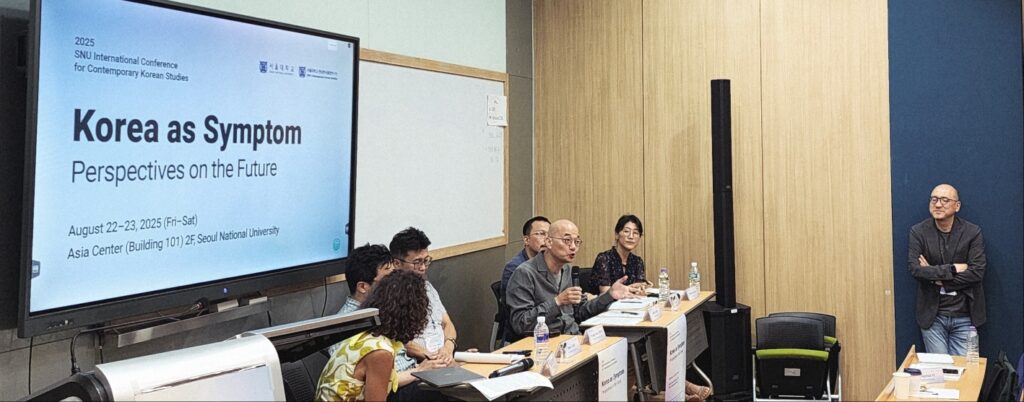
Across the session, the K-Future Team read Korea’s cultural symptoms through three lenses: affect, assemblage, and neoliberal adaptation. Although the presentations differed in object and method, they shared a common concern with how contemporary Korea is being shaped through changing forms of feeling, technology, and belief. In this way, the session translated the conference theme “Korea as Symptom” into a concrete practice of reading cultural symptoms.