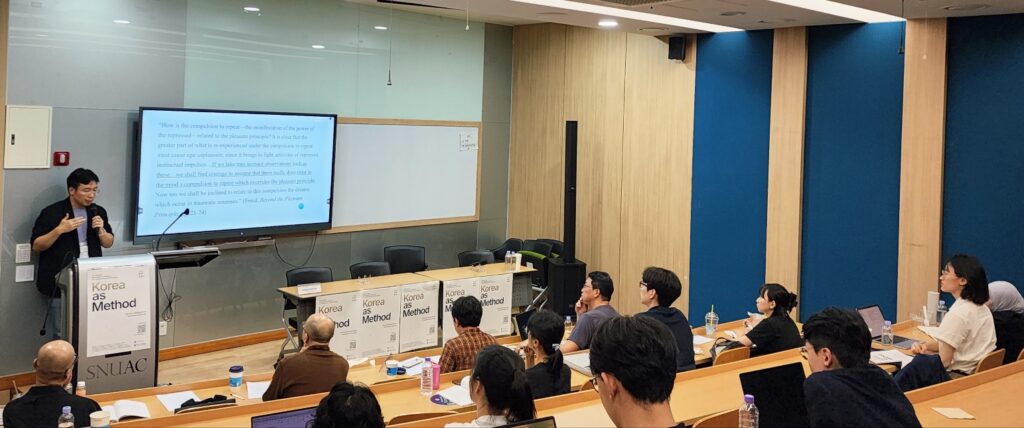
On August 21 and 22, SNU Contemporary Korean Studies hosted an international conference under the overarching theme of “Korea as Method.” During the session titled “A Thanatology of Contemporary Korean Society,” the K-Future Team illuminated the concept of ‘death’ in contemporary Korea through three distinct lenses: state mourning, post-apocalyptic imagination, and the temporality of ppalli-ppalli (hurry-hurry). As noted by the session chair, Professor Jaeho Kang (Department of Communication, SNU), the three presentations offered a multidimensional exploration of death across varying subjects and theoretical frameworks.
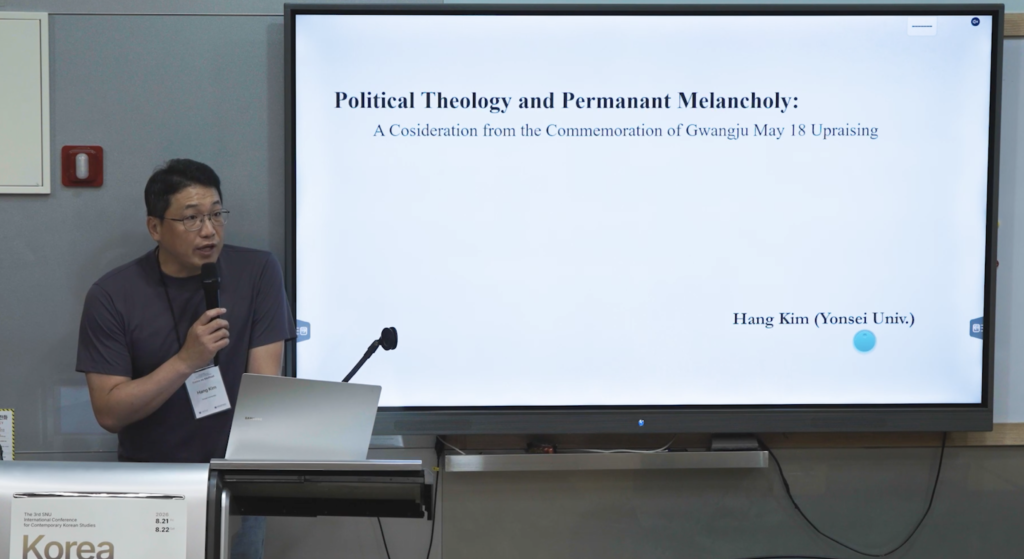
Political Theology and Permanent Melancholy
The architecture of the modern state is built upon the separation of church and state, a principle forged by overcoming bloody religious civil wars. Consequently, Christian political theology concerning salvation and eternal life was thoroughly depoliticized within secular politics. How, then, does the state mourn death in the absence of religious rituals? Professor Hang Kim (Cultural Anthropology, Yonsei University) posed this profound question by examining the state-led commemoration of the victims of the May 18 Gwangju Democratization Movement. He highlighted the unique Korean context, where Christian political theology was absent during the formation of the modern state. Kim incisively argued that the nation’s state-led mourning fails to achieve successful “mourning work” (Trauerarbeit), instead lingering in what Freud termed “permanent melancholy.”
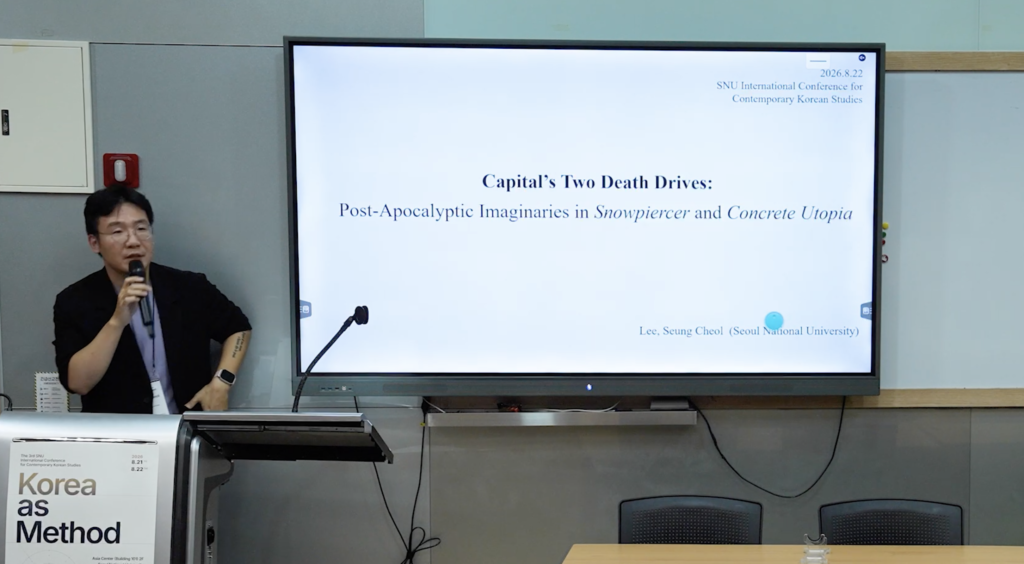
Capital’s Two Death Drives
If imagining the end of the world has become synonymous with imagining capitalism itself, what do on-screen catastrophes warn us about today? Professor Seung Cheol Lee (Anthropology, SNU) analyzed the distinct yet entangled death drives of capital by comparing the disaster films Snowpiercer (2013) and Concrete Utopia (2023). While the perpetually moving train in Snowpiercer – driven by recurring crises and managed revolts – illustrates Freud’s “repetition compulsion” and capitalist exploitation, the apartment complex in Concrete Utopia – depleting external resources to regress to a past state of stasis – symbolizes expropriation in an era of rent-seeking capitalism and neo-feudalism. By meticulously contrasting these two regimes, the presentation cautiously explored the fleeting possibility of political rupture beyond perpetual repetition and fortified stasis.
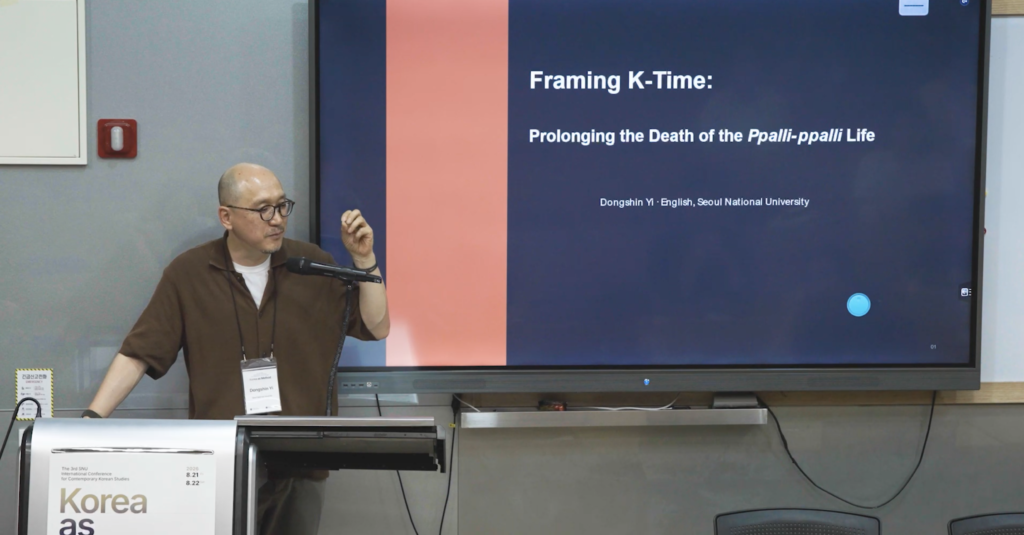
Framing K-Time: Prolonging the Death of the Ppalli-ppalli Life
Is the ppalli-ppalli (hurry-hurry) culture, which has driven South Korea’s intense growth since the 1960s, still viable in the twenty-first century? Professor Dongshin Yi (English Language and Literature, SNU) posed this fundamental question in his presentation, “Framing K-Time,” diagnosing the imminent death of ppalli-ppalli as a form of human life in the face of the overwhelming, inhuman speed of digital technologies. In this context, the presentation offers a novel reading of the time-slip and retro narratives currently permeating Korean popular media. Specifically, the nostalgic throwbacks of the Reply series and the time-slip tropes in shows like Lovely Runner and Mr. Queen were illuminated not merely as passing entertainment trends, but as a collective, yet ultimately futile, attempt to prolong the lifespan of the dying ppalli-ppalli life. Finally, drawing upon Heidegger’s proposition that human beings discover their own temporality and being only by experiencing death as such, Professor Yi meticulously examined the existential problem that the impending demise of the ppalli-ppalli culture poses for contemporary Koreans in the twenty-first century.
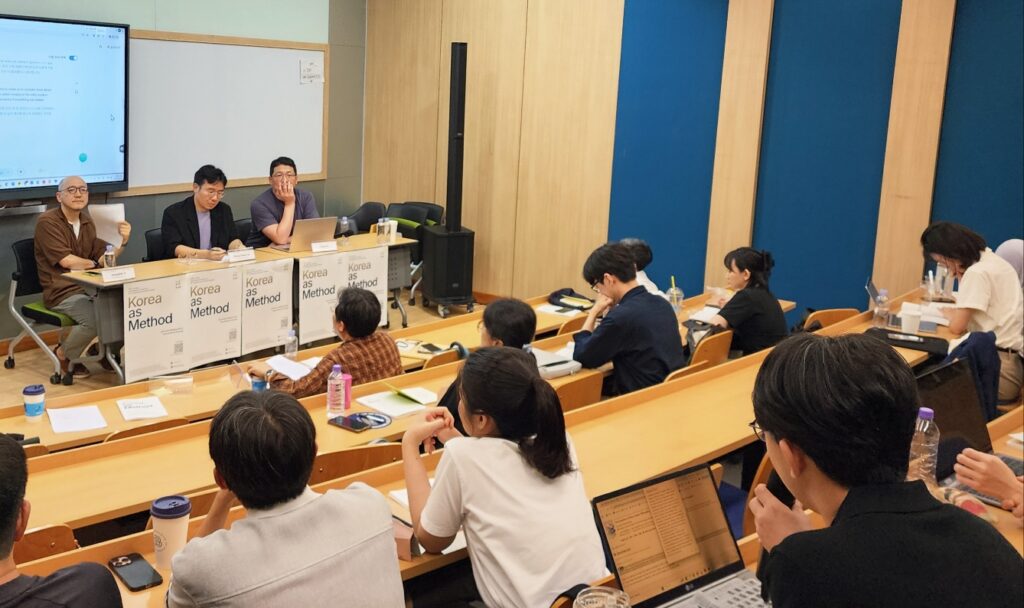
Taken together, the three presentations revealed death not simply as the end of life, but as a force that continues to organize collective life. The dead remain present through unfinished mourning; capitalism survives by repeating crisis and consuming its own conditions of existence; and a way of life approaching its end is prolonged through nostalgia and temporal return. Seen from these different angles, death emerges as something that is remembered, repeated, and deferred rather than simply concluded. The session thus invited us to ask not only how death is experienced in contemporary Korea, but how Korean society continues to live with, through, and against it.