Activities

K-Narratives

SNU Contemporary Korean Studies conducts interdisciplinary collaboration and international research exchange in the politics, economics, technology, and culture of contemporary Korea.

Research Teams

2026 SNU ICCK Session – “Korean Masculinity: Problems and Solutions” (Narrative, DAY1, Track3, Session 3)

2026-08-25

On August 21, 2026, a lecture hosted by the K-Narrative Team of the SNU Contemporary Korean Studies was held in Room 240 of the Seoul National University Asia Center(Building 101). The event was held under the theme “Korean Masculinity: Problems and Solutions”
2026 SNU ICCK Session – “Korean Masculinity: Problems and Solutions” (Narrative, DAY1, Track3, Session 3)

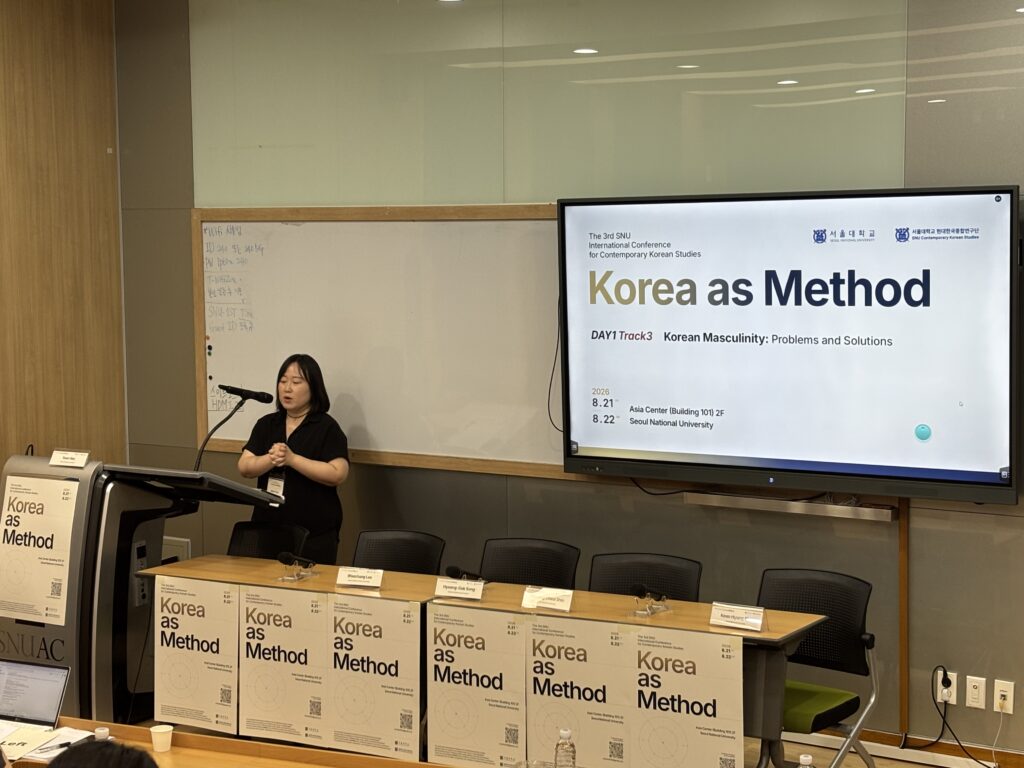
Yoon Heo(Ewha Womans University), in her presentation titled “(Un)mournable Masculinity and Misogyny as a Symptom” sought to historicize and gender the problems of Korean society by examining misogyny and antifeminist backlash as symptoms produced by the impossibility of achieving hegemonic masculinity. The presentation pointed out that, through the experiences of colonialism, the Korean War, militarism, and industrialization, Korean men have continually been required to conform to the norm of the “strong man,” while in reality they have repeatedly experienced a sense of loss and anxiety without ever securely attaining such masculinity. This anxiety has manifested itself in hatred toward social minorities, including women, sexual minorities, and migrants, as well as in discourses of “reverse discrimination,” and the recent conservative turn and far-right radicalization among young men must likewise be examined within this historical context. Furthermore, Heo emphasized that the present condition in which men perceive themselves as “the disadvantaged” should be transformed from a basis for exclusion and hatred into an opportunity for empathy and solidarity with other socially marginalized groups, and that Korean masculinity now stands at a critical crossroads: whether it will “stand on the side of care and consideration, or on the side of narcissism.”
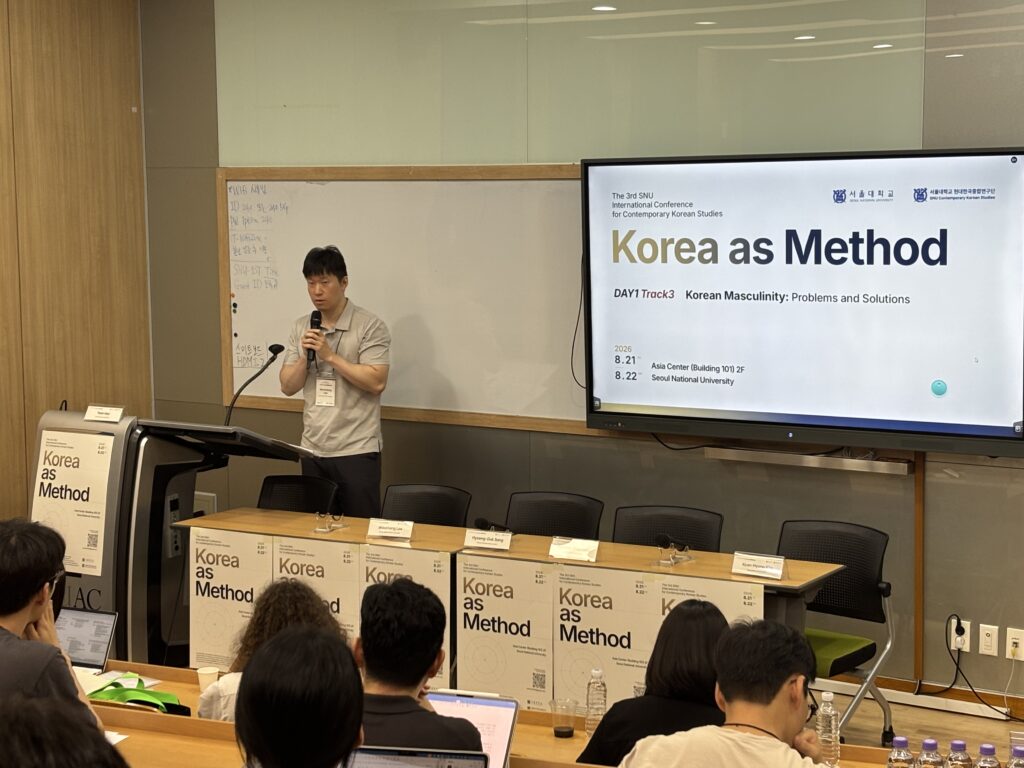
Woochang Lee(Korea National Open University), in his presentation titled “How Do South Korean Anti-feminists ‘Historicize’ Feminism?” analyzed the “historical narratives” of anti-feminism that have been formed and circulated primarily within male-dominated online communities over the past decade. Through such cases as the controversy over “gender equalism”(seong pyeongdeungjuui) on Namuwiki, discourses of reverse discrimination among young men in the late 2010s, and the so-called “decline of Japanese feminism” the presentation examined how Korean anti-feminists have constructed narratives that define feminism as female supremacism and as the oppression of men, while positioning young men as its victims. In particular, these narratives have combined with the existing discourse of “Hell Joseon” to extend conflicts between older and younger generations into the realm of gender politics, while also producing a vision of the future in which feminism transforms society and masculinity only to eventually collapse. Focusing on the way young men are represented within such narratives as “pure victims” freed from agency and responsibility, Lee argued that, in order to move beyond this negative form of masculinity and explore the possibility of new masculinities, it is necessary to construct a different kind of historical narrative.
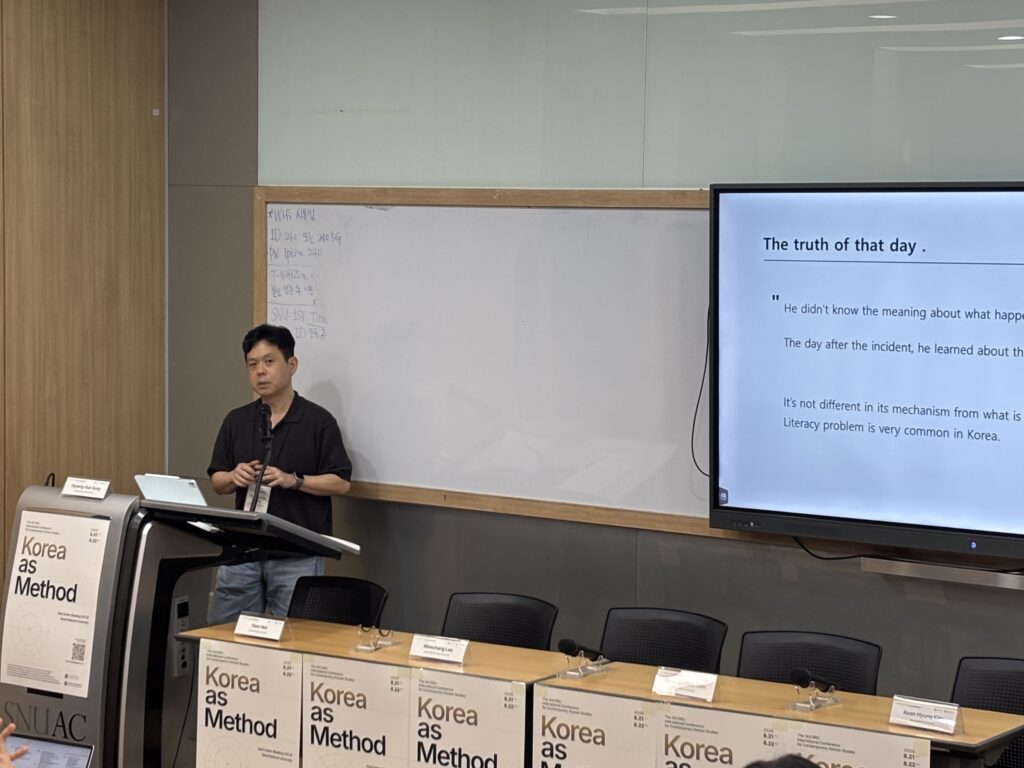
Hyeong-guk Song(KBS), in his presentation titled “Born Sons, Becoming Men: Masculinity in AI Media Environment” drew attention to the fact that the problems of masculinity in contemporary Korean society do not suddenly emerge in young adulthood, but are formed from before the teenage years within digital media environments and peer cultures. Drawing on cases such as the Paechai High School baseball team cheering incident and exposure to far-right YouTube content, he pointed out that repeatedly consuming memes and forms of entertainment without fully understanding the contexts of hatred embedded in them can dull one’s sensitivity to hatred, while recommendation algorithms can naturally connect content related to combat sports, games, success, and gender with extremist discourse. In particular, the developmental characteristics of adolescence, the desire for recognition within peer groups, the recommendation algorithms of big tech companies, and the choices of content producers and users interact to form a “feedback loop” that reinforces particular forms of masculinity, while the spread of AI may likewise exert new influences on the formation of adolescents’ values. To address these problems, Song argued that rather than reducing them to individual adolescents’ lack of knowledge or deviant behavior, a structural approach is needed that examines what they see and hear, how they form relationships, and the environments in which they grow up; he also stressed the importance of new forms of problem-solving education and research that, through literature, education, and social dialogue, move beyond hasty hatred of others and binary modes of judgment.
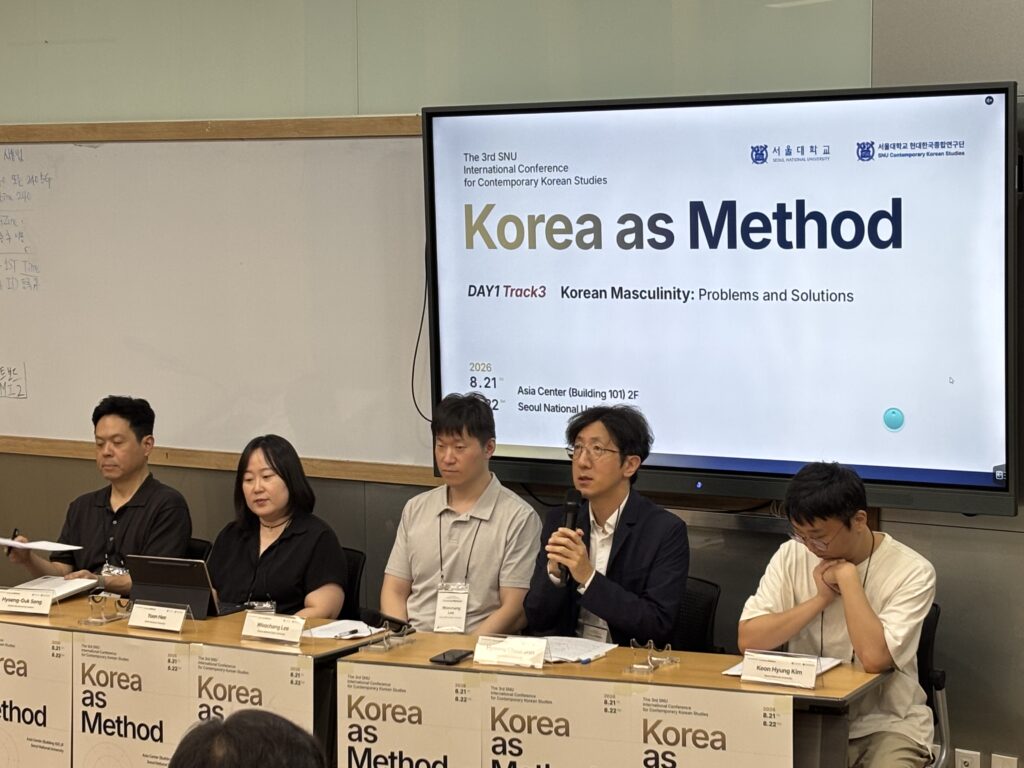
In the discussion that followed, lively debate on contemporary Korean masculinity took place, led by the designated discussants Hyoung Cheol Shin(Seoul National University) and Keon Hyung Kim(Seoul National University). Among the issues discussed was the need to begin by acknowledging the emotions that contemporary Korean men themselves experience in order to understand contemporary Korean masculinity, along with a range of other social and cultural issues surrounding masculinity today.

2026 SNU ICCK Session – “Korean Masculinity: Problems and Solutions” (Narrative, DAY1, Track3, Session 3)

2026-08-25

On August 21, 2026, a lecture hosted by the K-Narrative Team of the SNU Contemporary Korean Studies was held in Room 240 of the Seoul National University Asia Center(Building 101). The event was held under the theme “Korean Masculinity: Problems and Solutions”

2026 SNU ICCK Session – “Korean Masculinity: Problems and Solutions” (Narrative, DAY1, Track3, Session 3)

Yoon Heo(Ewha Womans University), in her presentation titled “(Un)mournable Masculinity and Misogyny as a Symptom” sought to historicize and gender the problems of Korean society by examining misogyny and antifeminist backlash as symptoms produced by the impossibility of achieving hegemonic masculinity. The presentation pointed out that, through the experiences of colonialism, the Korean War, militarism, and industrialization, Korean men have continually been required to conform to the norm of the “strong man,” while in reality they have repeatedly experienced a sense of loss and anxiety without ever securely attaining such masculinity. This anxiety has manifested itself in hatred toward social minorities, including women, sexual minorities, and migrants, as well as in discourses of “reverse discrimination,” and the recent conservative turn and far-right radicalization among young men must likewise be examined within this historical context. Furthermore, Heo emphasized that the present condition in which men perceive themselves as “the disadvantaged” should be transformed from a basis for exclusion and hatred into an opportunity for empathy and solidarity with other socially marginalized groups, and that Korean masculinity now stands at a critical crossroads: whether it will “stand on the side of care and consideration, or on the side of narcissism.”

Woochang Lee(Korea National Open University), in his presentation titled “How Do South Korean Anti-feminists ‘Historicize’ Feminism?” analyzed the “historical narratives” of anti-feminism that have been formed and circulated primarily within male-dominated online communities over the past decade. Through such cases as the controversy over “gender equalism”(seong pyeongdeungjuui) on Namuwiki, discourses of reverse discrimination among young men in the late 2010s, and the so-called “decline of Japanese feminism” the presentation examined how Korean anti-feminists have constructed narratives that define feminism as female supremacism and as the oppression of men, while positioning young men as its victims. In particular, these narratives have combined with the existing discourse of “Hell Joseon” to extend conflicts between older and younger generations into the realm of gender politics, while also producing a vision of the future in which feminism transforms society and masculinity only to eventually collapse. Focusing on the way young men are represented within such narratives as “pure victims” freed from agency and responsibility, Lee argued that, in order to move beyond this negative form of masculinity and explore the possibility of new masculinities, it is necessary to construct a different kind of historical narrative.

Hyeong-guk Song(KBS), in his presentation titled “Born Sons, Becoming Men: Masculinity in AI Media Environment” drew attention to the fact that the problems of masculinity in contemporary Korean society do not suddenly emerge in young adulthood, but are formed from before the teenage years within digital media environments and peer cultures. Drawing on cases such as the Paechai High School baseball team cheering incident and exposure to far-right YouTube content, he pointed out that repeatedly consuming memes and forms of entertainment without fully understanding the contexts of hatred embedded in them can dull one’s sensitivity to hatred, while recommendation algorithms can naturally connect content related to combat sports, games, success, and gender with extremist discourse. In particular, the developmental characteristics of adolescence, the desire for recognition within peer groups, the recommendation algorithms of big tech companies, and the choices of content producers and users interact to form a “feedback loop” that reinforces particular forms of masculinity, while the spread of AI may likewise exert new influences on the formation of adolescents’ values. To address these problems, Song argued that rather than reducing them to individual adolescents’ lack of knowledge or deviant behavior, a structural approach is needed that examines what they see and hear, how they form relationships, and the environments in which they grow up; he also stressed the importance of new forms of problem-solving education and research that, through literature, education, and social dialogue, move beyond hasty hatred of others and binary modes of judgment.

In the discussion that followed, lively debate on contemporary Korean masculinity took place, led by the designated discussants Hyoung Cheol Shin(Seoul National University) and Keon Hyung Kim(Seoul National University). Among the issues discussed was the need to begin by acknowledging the emotions that contemporary Korean men themselves experience in order to understand contemporary Korean masculinity, along with a range of other social and cultural issues surrounding masculinity today.