Activities

Statehood

SNU Contemporary Korean Studies conducts interdisciplinary collaboration and international research exchange in the politics, economics, technology, and culture of contemporary Korea.

Research Teams

2026 SNU ICCK Session – What Can K-Philosophy Be? Innovative and Decolonial Approaches to Conceptualizing Korean Philosophy as an Epistemic Resource for Global Debate

2026-08-27

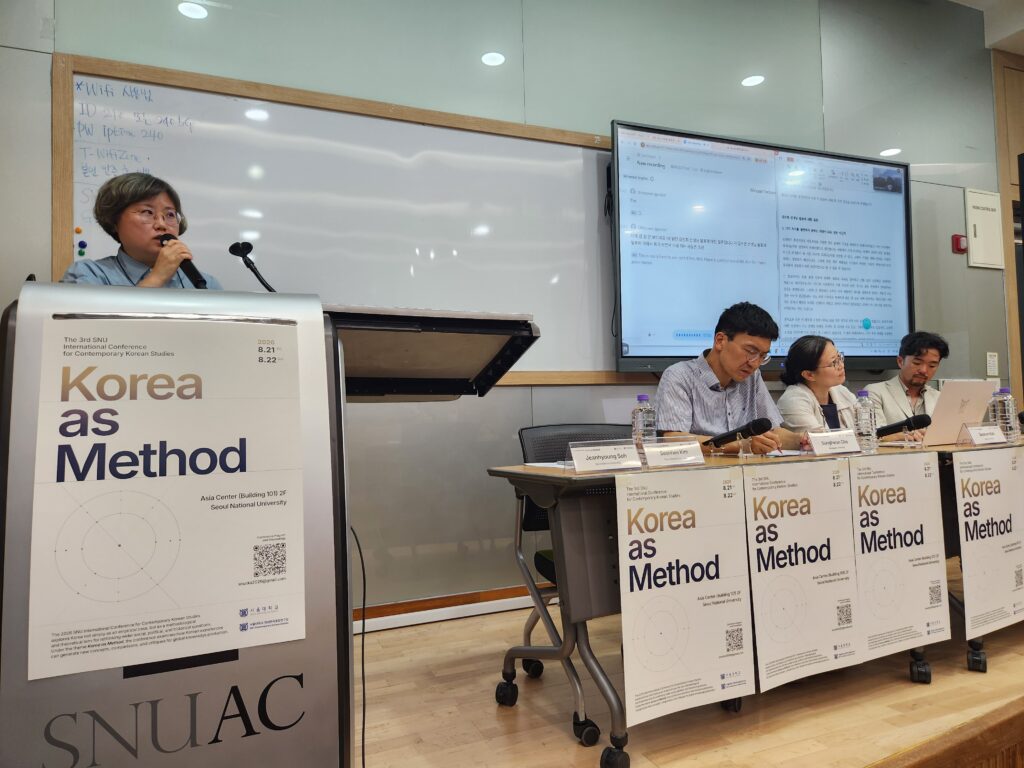
The Center for Contemporary Korean Studies at Seoul National University held a two-day international conference on August 21–22 under the theme “Korea as Method.” The Statehood and Civil Society Team convened its session, “What Can K-Philosophy Be? Innovative and Decolonial Approaches to Conceptualizing Korean Philosophy as an Epistemic Resource for Global Debate,” in Room 240 of the Asia Center, Building 101, Seoul National University. Chaired by Dr. Soh Jeanhyoung (Senior Research Fellow, Kyujanggak Institute for Korean Studies, Seoul National University), the session featured the following four presentations.
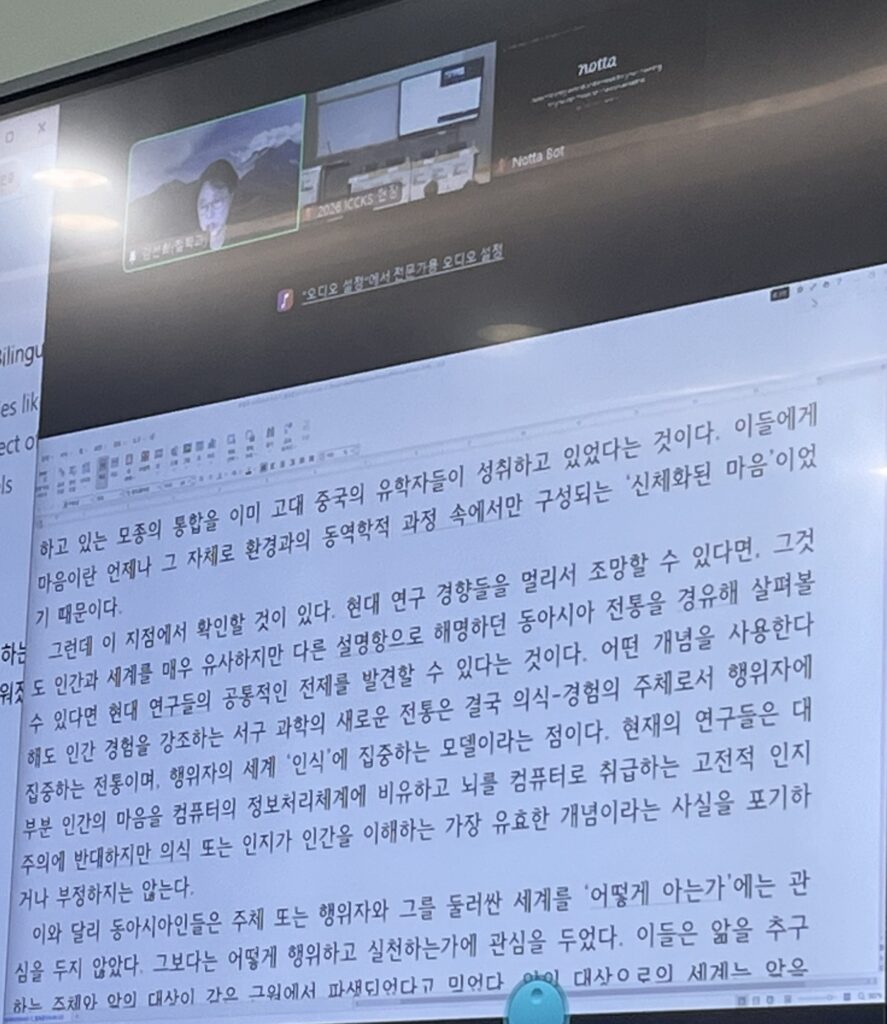
In the first presentation, delivered online, Professor Kim Seonhee (Ewha Womans University) spoke on “Philosophy as Narrative and Korean Philosophy,” examining the role philosophy might play today, at a moment when artificial intelligence externalizes cognition and dissolves cognitive disparities, through the lens of narrative. Noting that philosophy has long functioned, in East and West alike, as a significant narrative intervening in human society, she argued that philosophical narrative-unlike its literary counterpart-carries a demand for normative and prescriptive roles. Philosophy does not “create” worlds, she suggested, but supplies the conditions and conceptual foundations for creation and mediates among countless possible worlds. Working from this premise, she turned to Choe Han-gi, the nineteenth-century Korean philosopher, and to his use of gi (氣) as a neutral, fluid, and connective concept capable of capturing practices that unfold in temporally contingent and spatially open fields-a resource, she proposed, through which Korean philosophy might function as an alternative narrative.
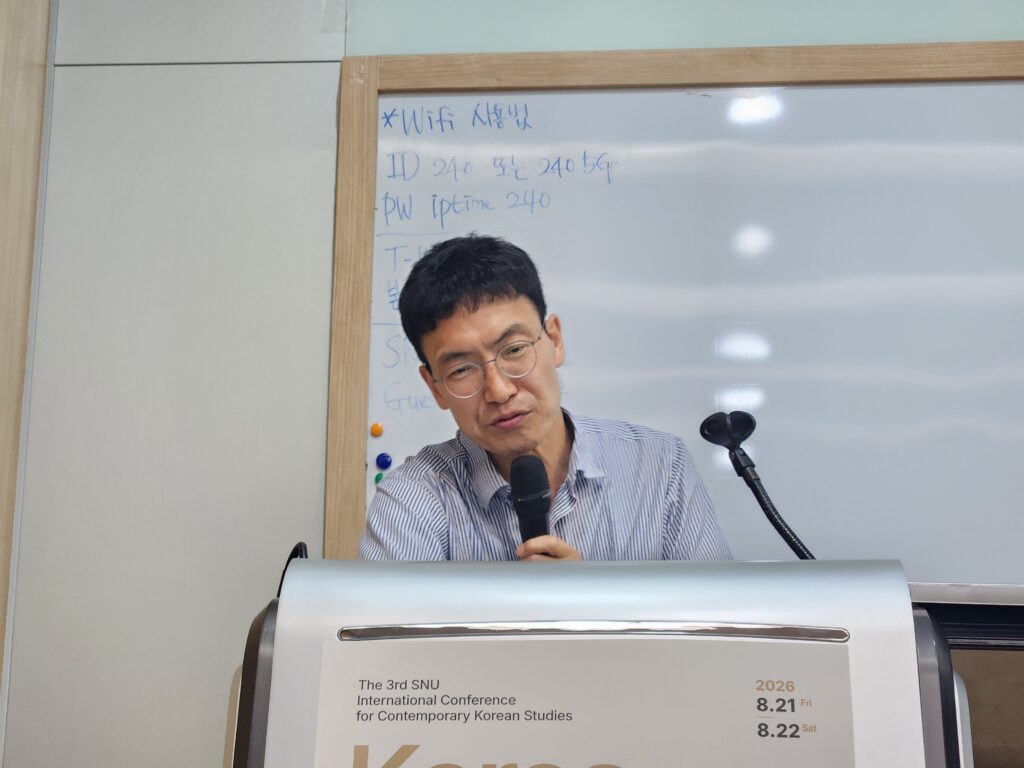
Professor Cho Sunghwan (Wonkwang University) followed with “Korean Philosophy in the Anthropocene: Questioning the Human Condition,” proposing that Korean philosophy, long understood within the hermeneutic frame of “modernity,” be recalibrated from the standpoint of the Anthropocene. He drew on Dipesh Chakrabarty’s argument that the era of climate change marks a transformation of the “human condition,” and in particular on the notion of the “planet” as distinct from the modern “globe.” From this vantage he reinterpreted the thought of Jeong Yak-yong (Dasan), Choe Si-hyeong (Haewol), and Park Jung-bin (Sotaesan) under the rubric of an inquiry into the human condition, asking what messages Korean philosophy-as a “K-philosophy” resonant with the wider world-might articulate in the age of the Anthropocene.
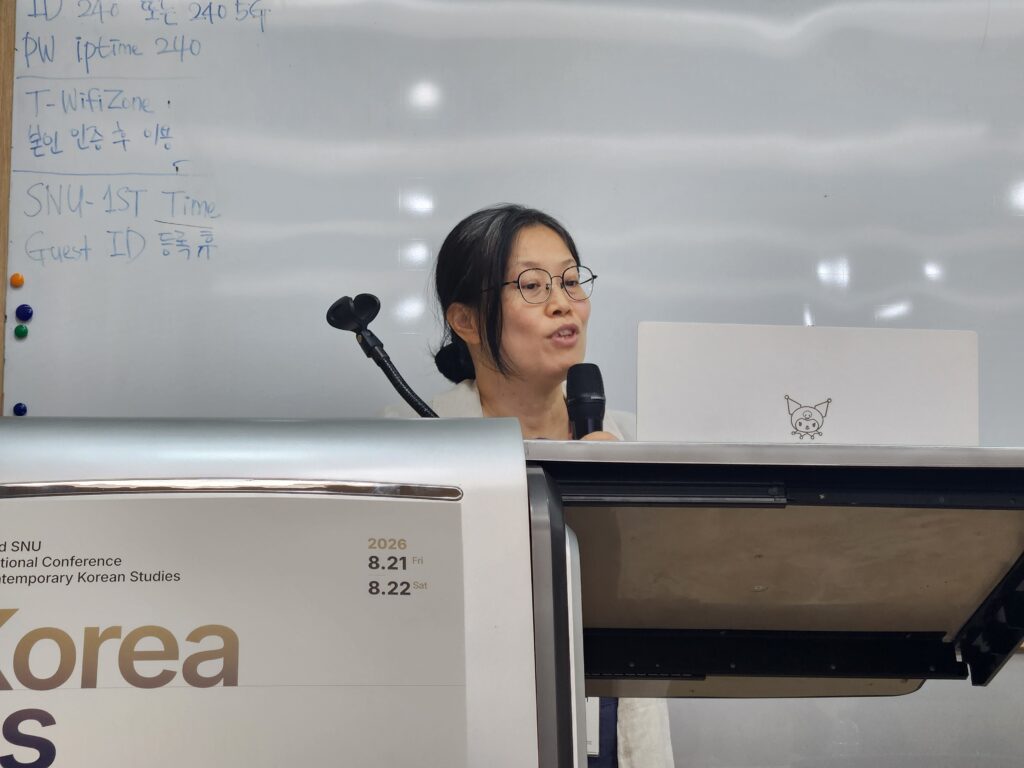
In the third presentation, Research Professor Kim Borum (Anyang University) spoke on “Neo-Confucian Challenge to Ancient Greece: Yi In-jae’s Reinterpretation through Li,” analyzing An Examination of Ancient Greek Philosophy (古代希臘哲學攷辨), written in 1912 by the Korean Neo-Confucian scholar Yi In-jae (1870–1929). She drew attention to how Yi reversed the conventional direction of cross-cultural interpretation, using Neo-Confucian metaphysics to evaluate the foundations of Western thought. Yi charged that Greek philosophers, from the Pre-Socratics through the Stoics, had mistaken li (理) for qi (氣), material substance; he faulted Socrates for confining morality to subjective conscience, Plato for detaching the Ideas from practice, and Aristotle for remaining at the level of material-conditioned nature (氣質之性) without reaching original moral nature (本然之性). While acknowledging the limits imposed by Yi’s reliance on translations mediated through China and Japan, Kim argued that his “inverted gaze” points toward an alternative path for Korean philosophy-one in which traditional categories serve as active tools rather than preserved cultural artifacts.
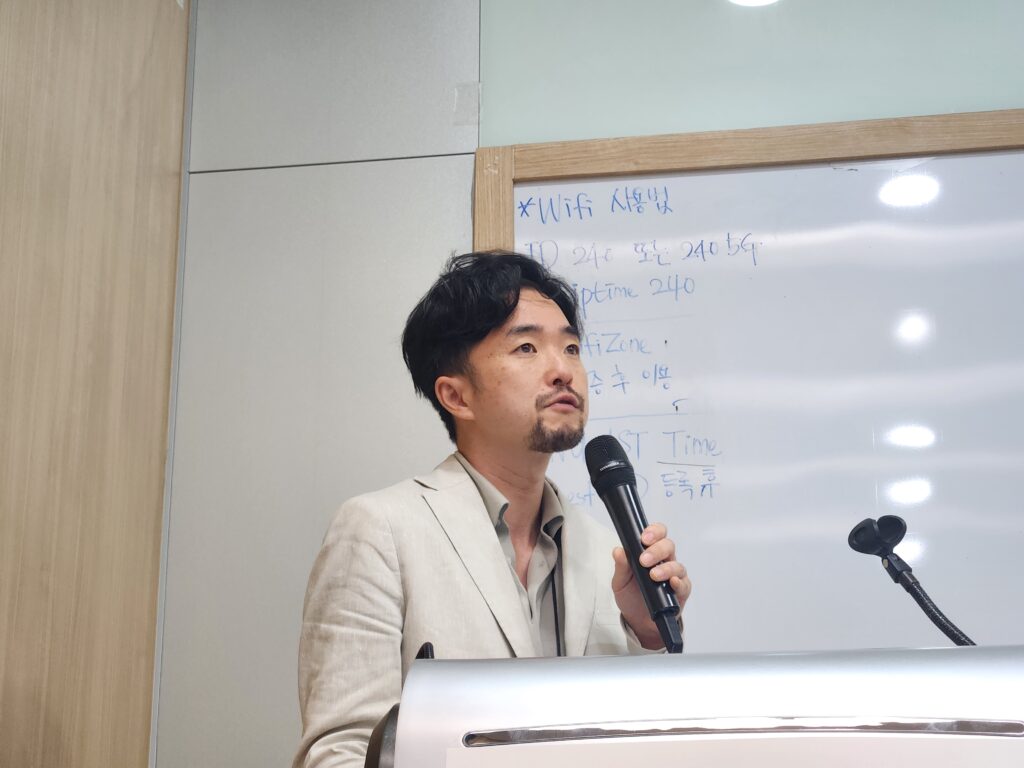
In the final presentation, Professor Park Sool (University of Hildesheim) addressed “The Non-Existence of Korean Philosophy in Global Philosophy,” analyzing from a decolonial perspective the asymmetry between the global standing of Korean literature and culture and the absence of Korean philosophy from global discourse. He argued that this invisibility stems not from insufficient excavation or promotion but from a structural cause: the “colonial metaphysics” inscribed in the historiography and representation of philosophy. As evidence of the colonial gaze in the earliest sources, he cited the Jesuit missionary Martino Martini’s Novus Atlas Sinensis (1655), which portrayed Korean philosophy as uncreative and derivative yet useful for missionary infiltration. He went on to examine critically how the first histories of philosophy written in Korean in the early twentieth century, by authors such as An Hwak and Chang Dobin, internalized the colonial search for a Korean philosophy and confirmed an ethno-essentialism through retrospective projection.
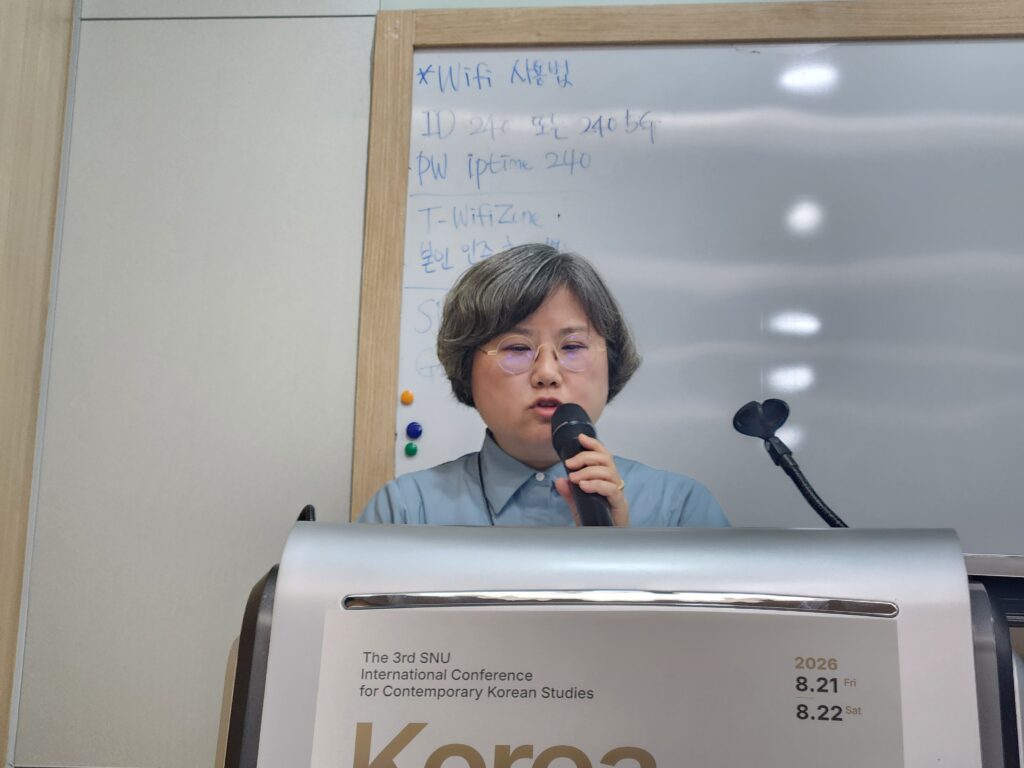
Serving as discussant, Dr. Soh Jeanhyoung observed that the panel had sought to treat Korean philosophy not as an object of historical narration but as an intellectual resource for intervening in present problems. She noted that the four papers deploy the term “K-philosophy” at distinct registers: as a resource to be brought to bear on a global problem (Cho), as a historical precedent for using one tradition as a tool to interpret another (Kim Borum), as a category whose very conditions of possibility are in question (Park), and as a mirror in which the presuppositions of contemporary theory are reflected (Kim Seonhee). Counting among the panel’s achievements that each paper placed a specific figure and text before the audience as verifiable material, she nonetheless raised several questions: whether the concept of gi can account for individual difference and ground ethical judgment; whether an arrangement in which Western theory supplies the explanatory frame and Korean thought becomes the object of interpretation differs structurally from the procedures of the Chosŏn Studies movement; whether “the intervention of translation” is not a more fundamental issue than “the inversion of the gaze”; and whether Japan must be treated as an independent mediating term in any account of Korean philosophy’s absence.

Through approaches as varied as narrative, the Anthropocene, cross-cultural interpretation, and decolonial critique, the session took the category of “Korean philosophy” itself as its object of reflection. Its particular value lay in illuminating Korean philosophy not as a fixed tradition but as a discourse continually reconstituted in relation to global intellectual history-thereby bringing its possibilities and its limits into view at once.

2026 SNU ICCK Session – What Can K-Philosophy Be? Innovative and Decolonial Approaches to Conceptualizing Korean Philosophy as an Epistemic Resource for Global Debate

2026-08-27

The Center for Contemporary Korean Studies at Seoul National University held a two-day international conference on August 21–22 under the theme “Korea as Method.” The Statehood and Civil Society Team convened its session, “What Can K-Philosophy Be? Innovative and Decolonial Approaches to Conceptualizing Korean Philosophy as an Epistemic Resource for Global Debate,” in Room 240 of the Asia Center, Building 101, Seoul National University. Chaired by Dr. Soh Jeanhyoung (Senior Research Fellow, Kyujanggak Institute for Korean Studies, Seoul National University), the session featured the following four presentations.

In the first presentation, delivered online, Professor Kim Seonhee (Ewha Womans University) spoke on “Philosophy as Narrative and Korean Philosophy,” examining the role philosophy might play today, at a moment when artificial intelligence externalizes cognition and dissolves cognitive disparities, through the lens of narrative. Noting that philosophy has long functioned, in East and West alike, as a significant narrative intervening in human society, she argued that philosophical narrative-unlike its literary counterpart-carries a demand for normative and prescriptive roles. Philosophy does not “create” worlds, she suggested, but supplies the conditions and conceptual foundations for creation and mediates among countless possible worlds. Working from this premise, she turned to Choe Han-gi, the nineteenth-century Korean philosopher, and to his use of gi (氣) as a neutral, fluid, and connective concept capable of capturing practices that unfold in temporally contingent and spatially open fields-a resource, she proposed, through which Korean philosophy might function as an alternative narrative.

Professor Cho Sunghwan (Wonkwang University) followed with “Korean Philosophy in the Anthropocene: Questioning the Human Condition,” proposing that Korean philosophy, long understood within the hermeneutic frame of “modernity,” be recalibrated from the standpoint of the Anthropocene. He drew on Dipesh Chakrabarty’s argument that the era of climate change marks a transformation of the “human condition,” and in particular on the notion of the “planet” as distinct from the modern “globe.” From this vantage he reinterpreted the thought of Jeong Yak-yong (Dasan), Choe Si-hyeong (Haewol), and Park Jung-bin (Sotaesan) under the rubric of an inquiry into the human condition, asking what messages Korean philosophy-as a “K-philosophy” resonant with the wider world-might articulate in the age of the Anthropocene.

In the third presentation, Research Professor Kim Borum (Anyang University) spoke on “Neo-Confucian Challenge to Ancient Greece: Yi In-jae’s Reinterpretation through Li,” analyzing An Examination of Ancient Greek Philosophy (古代希臘哲學攷辨), written in 1912 by the Korean Neo-Confucian scholar Yi In-jae (1870–1929). She drew attention to how Yi reversed the conventional direction of cross-cultural interpretation, using Neo-Confucian metaphysics to evaluate the foundations of Western thought. Yi charged that Greek philosophers, from the Pre-Socratics through the Stoics, had mistaken li (理) for qi (氣), material substance; he faulted Socrates for confining morality to subjective conscience, Plato for detaching the Ideas from practice, and Aristotle for remaining at the level of material-conditioned nature (氣質之性) without reaching original moral nature (本然之性). While acknowledging the limits imposed by Yi’s reliance on translations mediated through China and Japan, Kim argued that his “inverted gaze” points toward an alternative path for Korean philosophy-one in which traditional categories serve as active tools rather than preserved cultural artifacts.

In the final presentation, Professor Park Sool (University of Hildesheim) addressed “The Non-Existence of Korean Philosophy in Global Philosophy,” analyzing from a decolonial perspective the asymmetry between the global standing of Korean literature and culture and the absence of Korean philosophy from global discourse. He argued that this invisibility stems not from insufficient excavation or promotion but from a structural cause: the “colonial metaphysics” inscribed in the historiography and representation of philosophy. As evidence of the colonial gaze in the earliest sources, he cited the Jesuit missionary Martino Martini’s Novus Atlas Sinensis (1655), which portrayed Korean philosophy as uncreative and derivative yet useful for missionary infiltration. He went on to examine critically how the first histories of philosophy written in Korean in the early twentieth century, by authors such as An Hwak and Chang Dobin, internalized the colonial search for a Korean philosophy and confirmed an ethno-essentialism through retrospective projection.

Serving as discussant, Dr. Soh Jeanhyoung observed that the panel had sought to treat Korean philosophy not as an object of historical narration but as an intellectual resource for intervening in present problems. She noted that the four papers deploy the term “K-philosophy” at distinct registers: as a resource to be brought to bear on a global problem (Cho), as a historical precedent for using one tradition as a tool to interpret another (Kim Borum), as a category whose very conditions of possibility are in question (Park), and as a mirror in which the presuppositions of contemporary theory are reflected (Kim Seonhee). Counting among the panel’s achievements that each paper placed a specific figure and text before the audience as verifiable material, she nonetheless raised several questions: whether the concept of gi can account for individual difference and ground ethical judgment; whether an arrangement in which Western theory supplies the explanatory frame and Korean thought becomes the object of interpretation differs structurally from the procedures of the Chosŏn Studies movement; whether “the intervention of translation” is not a more fundamental issue than “the inversion of the gaze”; and whether Japan must be treated as an independent mediating term in any account of Korean philosophy’s absence.

Through approaches as varied as narrative, the Anthropocene, cross-cultural interpretation, and decolonial critique, the session took the category of “Korean philosophy” itself as its object of reflection. Its particular value lay in illuminating Korean philosophy not as a fixed tradition but as a discourse continually reconstituted in relation to global intellectual history-thereby bringing its possibilities and its limits into view at once.