

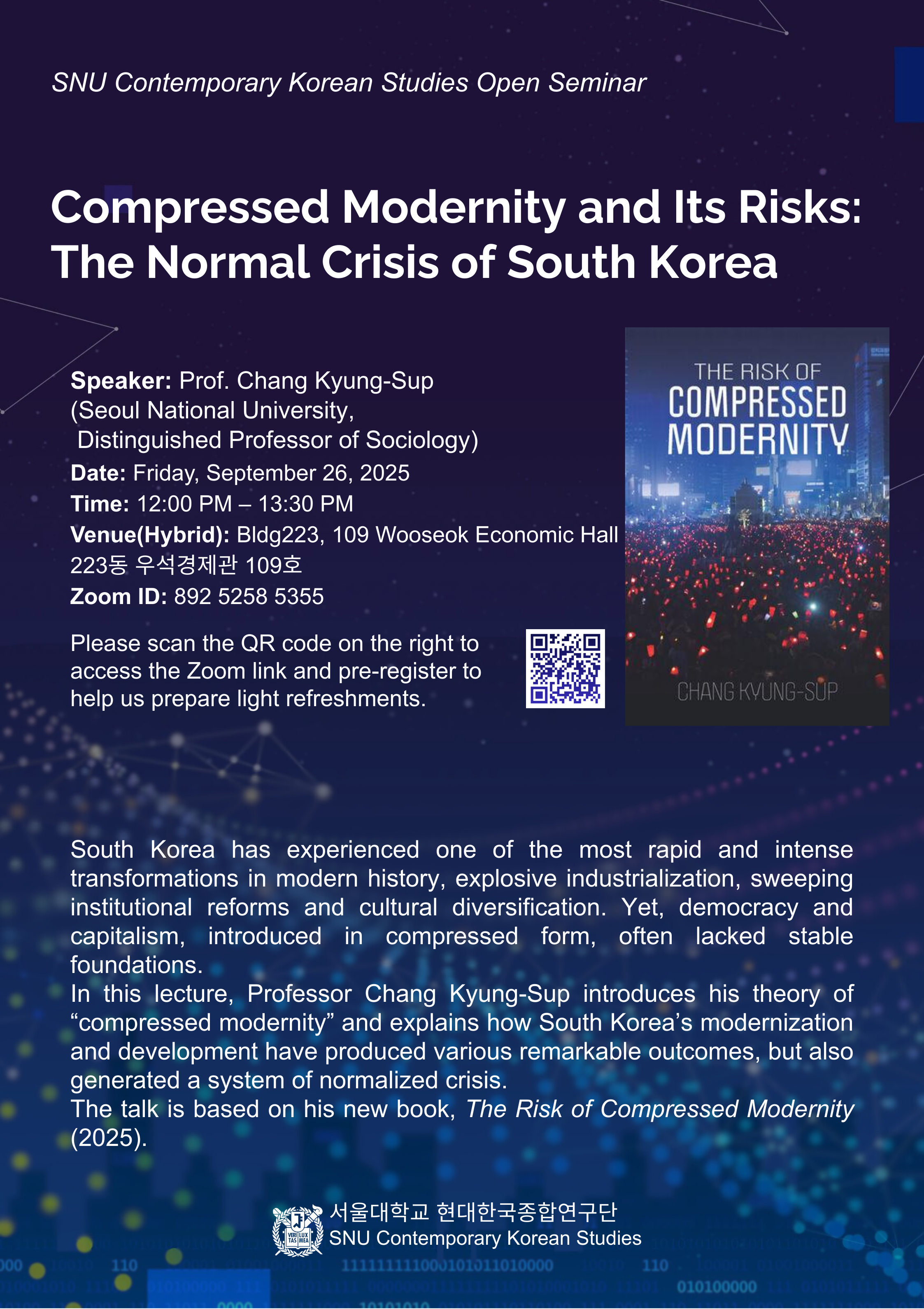
Title: Compressed Modernity and Its Risks: The Normal Crisis of South Korea
Speaker: Prof. Chang Kyung-Sup (Distinguished Professor, Department of Sociology, Seoul National University)
Date: Friday, September 26, 2025, 12:00–13:30 (KST)
Venue: Wooseok Hall (Economics Building), Room 109, Seoul National University
Format: Hybrid (Offline + Zoom) / English
Hosted by: Political Economy Team, SNU Contemporary Korean Studies (CKS), Seoul National University
Seminar Summary
The Political Economy Team at the SNU Center for Contemporary Korean Studies opened its Fall 2025 seminar series with Professor Chang Kyung-Sup, one of Korea’s leading sociologists and a central theorist of compressed modernity. Drawing from his recently published book The Risk of Compressed Modernity (Polity, 2025), Professor Chang provided an in-depth theoretical and empirical reflection on the long-term consequences of Korea’s accelerated modernization process.
Professor Chang introduced the concept of compressed modernity as a civilizational condition in which economic, political, and cultural transformations occur within an exceptionally condensed period of time, leading to the coexistence of disparate historical and social elements within the same system. South Korea’s modernization, he argued, has achieved world-class industrialization and democratization in just a few decades—but at the cost of chronic structural imbalances and social contradictions.
In his lecture, he detailed several dimensions of these contradictions:
●the productive maximization and reproductive deficit created by developmentalist industrialism;
● the persistence of infrastructural familialism, whereby families substitute for underdeveloped public institutions;
●the prevalence of state-projective politics and a “normalization of crisis” in democratic governance; and
●the emergence of individualization without individualism, especially among women, as a distinctive outcome of East Asian modernization.
Professor Chang argued that these tensions illustrate how the very mechanisms that once enabled Korea’s rapid growth—state-driven industrialization, compressed institutional reform, and familism-based resilience—now reproduce instability and inequality across generations. Yet, he also emphasized that these structural risks can generate impulses for renewal, making compressed modernity both a source of crisis and a potential catalyst for social transformation.
By situating the Korean experience within a broader East Asian and global context, Professor Chang proposed a framework for understanding the “normal crisis” of contemporary societies—where development, risk, and adaptation are continuously intertwined. His lecture offered a comprehensive and critical perspective on the limits and possibilities of modernization in late-industrial societies, underscoring the intellectual continuity between The Logic of Compressed Modernity (Polity, 2022) and his new volume The Risk of Compressed Modernity.
🔗 More information: The Risk of Compressed Modernity – Polity Press (2025)