<Overview> Why did both the Full Gospel Church of Cho Yonggi and the Unification Church of Moon Sun-Myong appeal to some Westerners in the 1980s? What did Koreans expect when they converted to Protestantism? How did the rhetoric of these two churches resonate with their followers who belonged to contrasting social classes? How did their religious beliefs change their behavioral patterns and eventually lead them to embrace the ideology of neoliberalism? They developed a very entrepreneurial spirit, accepted to be held accountable for their own and collective performances, and began to dream of what they would afford if they committed themselves to hard work. One of the major businesses that grew out of the hard work of Pentecostal believers is AMWAY Multi-Level Marketing (MLM). MLM companies expanded on a global scale, relying on different religious movements according to the countries where these companies were established. They have developed a remarkable ability to adapt their coaching to the cultural, social and religious profile of their salespersons. In South Korea, the 1997 Asian crisis invalidated the theology of both Korean Pentecostal and Messianic churches. This severe recession slowed Protestant growth but not that of neoliberalism. Behaviors didn’t change. New companies emerged. What happened then? What do all these events teach us about what I call the “Believing system”? This system consists of three levels: the first is the cultural, religious, and economic context, the second is beliefs, and the third is behaviors. They articulate and reshape each other depending on the events.
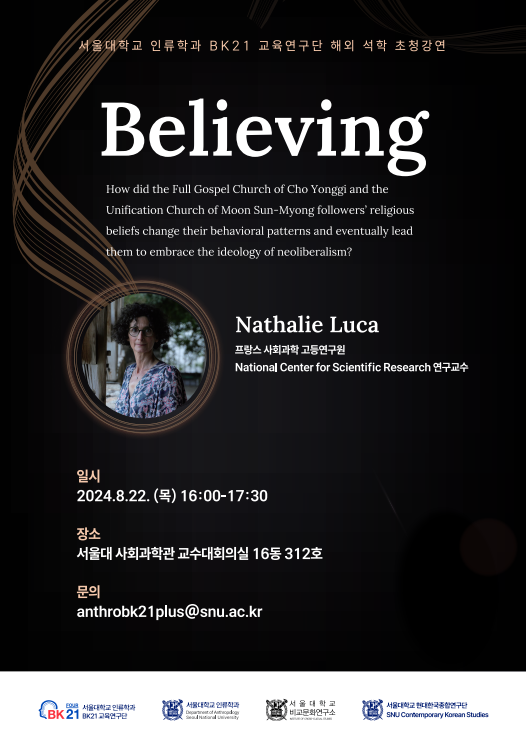
“Believing,” an invited lecture by Professor Nathalie Luca of the School for Advanced Studies in the Social Sciences (EHESS) and the French National Centre for Scientific Research (CNRS), was held on August 22. The event was co-hosted by the BK21 Educational Research Group of the Department of Anthropology at Seoul National University and the K-Future Team of SNU Contemporary Korean Studies. An anthropologist and filmmaker, Luca has conducted research in Korea since the 1990s on religion, belief systems, and mechanisms of social control. Her work offers a significant comparative anthropological framework for examining new religious movements and social formations of belief in Korea.
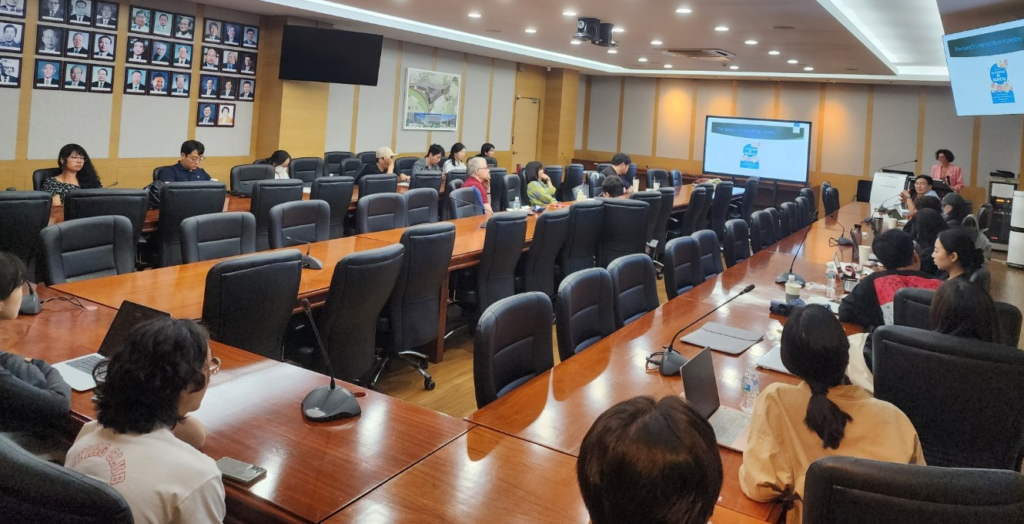
In the lecture, moderated by Professor Seung Cheol Lee (Department of Anthropology, SNU), Luca examined how conversion to Pentecostal churches in Korea became linked to expectations of social and economic advancement, and how Messianic churches such as the Unification Church acquired transnational appeal. Drawing on Amway-style multilevel marketing (Amway Multilevel Marketing, MLM) and the socioeconomic changes that followed the 1997 Asian financial crisis, Luca approached belief as an “ever-evolving system” in which belief context, belief contents, and belief behaviors interact and are continually reconfigured. In this account, belief is not a fixed possession but a process sustained between conviction and doubt; through reliance on the group, admiration for exemplary figures, and repeated practice, it generates an energy of self-transformation. The lecture thus showed how religious belief becomes linked to aspirations for social mobility and neoliberal modes of conduct. The event drew around thirty participants, including K-Future Team researchers, fellow scholars, and graduate students, and was followed by an hour-long discussion and Q&A.