Activities

Statehood

SNU Contemporary Korean Studies conducts interdisciplinary collaboration and international research exchange in the politics, economics, technology, and culture of contemporary Korea.

Research Teams

2026 SNU ICCK Session: East Asian International Relations from the Perspectives of Small State’s History

2026-08-27

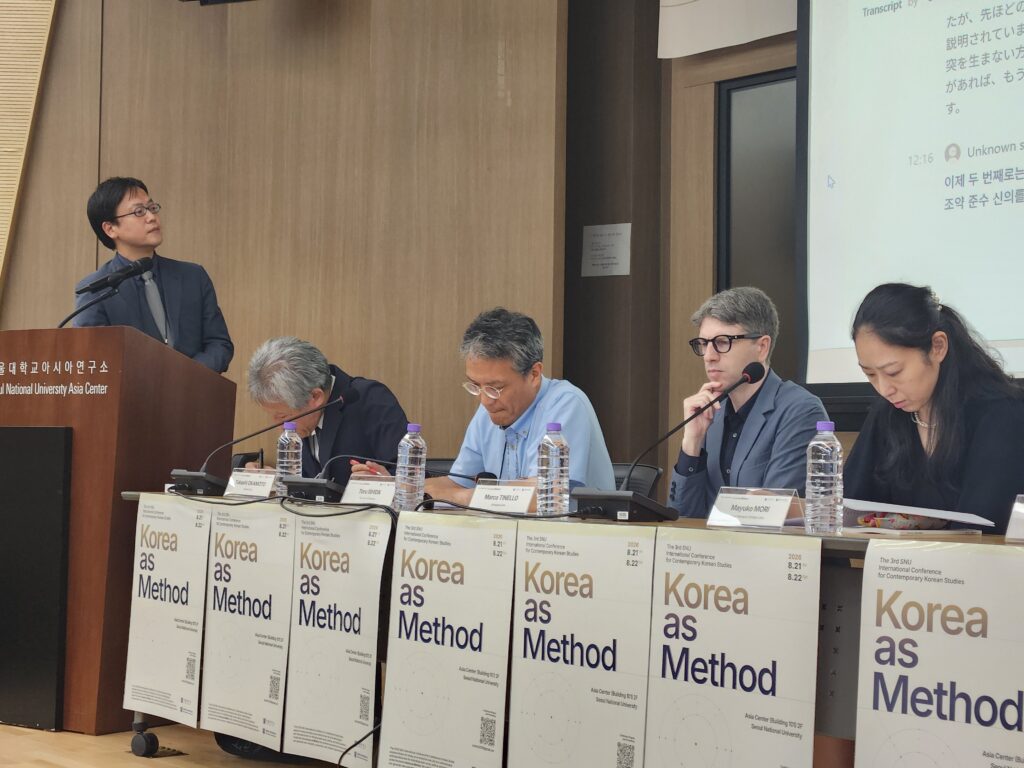
The Center for Contemporary Korean Studies at Seoul National University held a two-day international conference on August 21–22 under the theme “Korea as Method.” The Statehood and Civil Society Team convened its session, “East Asian International Relations from the Perspectives of Small State’s History,” in Youngwon Hall, Building 101, Seoul National University. Chaired by Professor Kim Jong-hak (Seoul National University), the session featured the following four presentations.
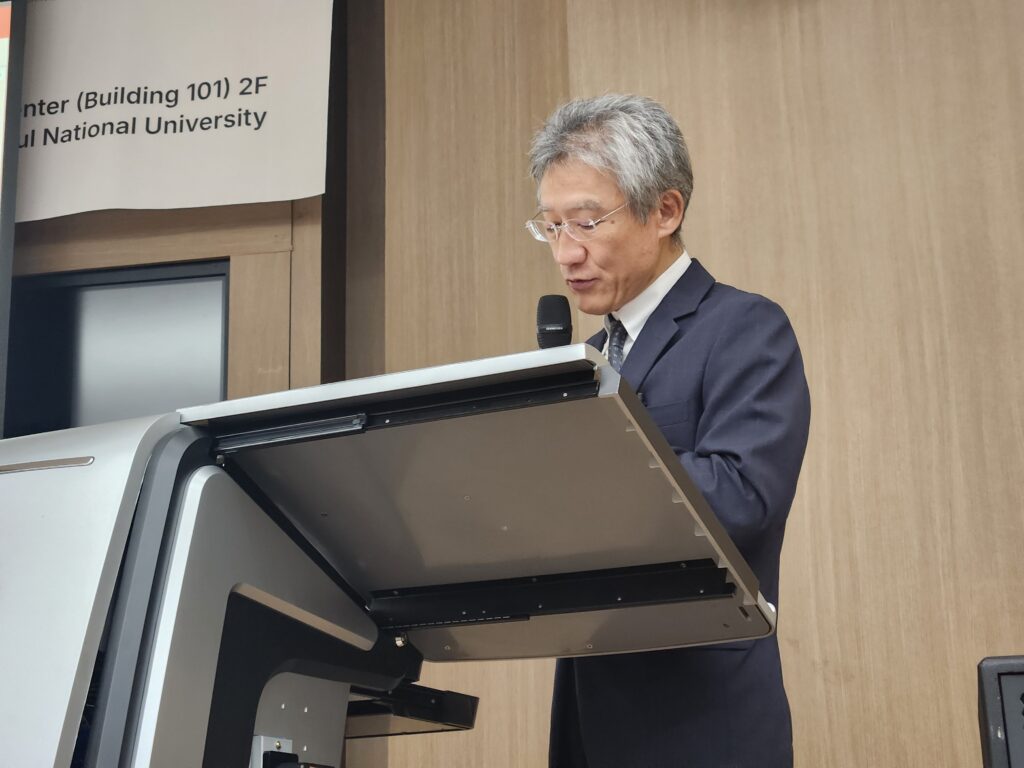
In the first presentation, Professor Okamoto Takashi (Waseda University) spoke on “China and Its Dependencies: A Formation of the Notion of ‘Sovereignty’ in Modern East Asia,” examining the relationship between translated political concepts in China and international order. He observed that it is a striking phenomenon that the preamble to the Constitution of the People’s Republic of China, as revised in 2018, declares Taiwan part of the nation’s “sacred territory” and professes mutual respect for sovereignty and territorial integrity. The concept of “territory” (領土), he noted, took shape in China only in the early twentieth century, emerging alongside the formation of the notion of “sovereignty” (主權) and the rise of modern Chinese nationalism. Both terms originated in the West but were in fact coined in Japan before entering China, and their meanings were formed through China’s negotiations with the West and Japan and through the modern transformation of the traditional East Asian order. Dividing the eighteenth-century Qing world order into four categories, namely hushi (互市), shuguo (屬國), fanbu (藩部), and zhisheng (直省), he pointed out that Han Chinese made no distinction between shuguo and fanbu, referring to both collectively as fanshu (藩屬). As disputes over peripheral regions intensified in the 1880s, Qing authorities began using the term shudi (屬地) in order to distinguish fanbu from shuguo and bind the former more closely to China. Defeat in the Sino-Japanese War, the recognition of Korean “independence and autonomy,” and the ensuing scramble for concessions and the Boxer Uprising aroused among Han intellectuals a fear of partition (瓜分) and an anxiety that the loss of outlying dependencies would extend to the inner provinces themselves. Distinguishing Tibet and Mongolia from the dependencies already lost thus became the first step in the formation of a Chinese “nation,” and the ambiguous fanshu, by way of shudi, was replaced after the 1911 Revolution by “territory,” a term expressing sovereignty rather than suzerainty. This, however, was an entirely one-sided Han conception: Tibetans and Mongols, who neither used Chinese characters nor considered themselves subordinate to China, sought independence instead. Professor Okamoto further showed that Western writing since the Jesuits, drawing analogies with the Roman provincia and the French Ancien Régime, established the “province” (省) as the domain of Qing sovereignty and the fanshu as “dependencies,” with the result that two “Chinas” came to coexist: “China proper” in the narrow sense, and a “Chinese Empire” encompassing the dependencies. The reality, however, differed from what direct rule implied, for the Beijing government possessed no means of superintending provincial administration, and after the 1911 Revolution most provinces declared independence just as Tibet and Mongolia had done. That Communist China never fully succeeded in bringing the whole of the former Qing empire under a single sovereignty, as Taiwan, Hong Kong, Tibet, and Xinjiang attest, is precisely the historical background to the present government’s insistence on the sovereignty and territorial integrity of “One China.”
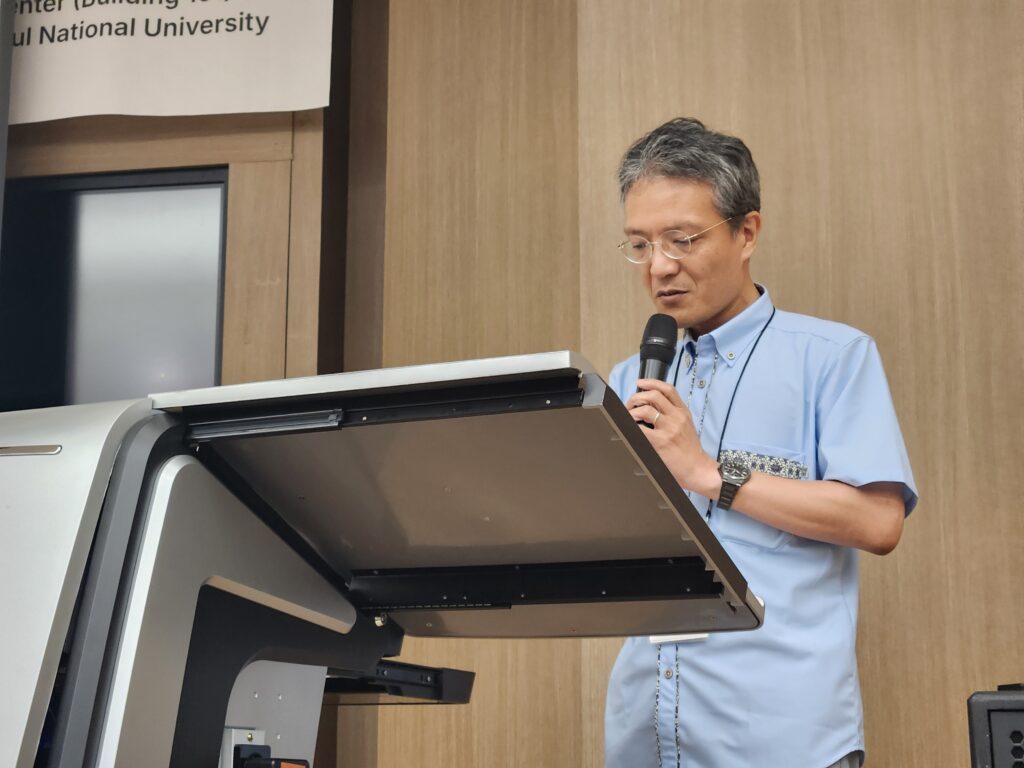
Professor Ishida Toru (The University of Shimane) followed with “Early Modern Korea-Japan Relations Considered from the Perspective of Tsushima,” examining the issues that come into view when early modern Korea-Japan relations are approached from Tsushima, and the points that warrant attention in understanding East Asian history from the opening of the ports onward. He offered three cases. The first concerns the naming of the envoys the Korean court dispatched to the Sō house, the lords of Tsushima. Korea, following strict regulations, designated them munwihaeng, whereas the Tsushima side called them tokai yakkan (渡海譯官), yakushi (譯使), or yakkanshi (譯官使). How, then, should we ourselves name these envoys? The second concerns understandings of the communication envoys (通信使) sent by the Korean king to the Tokugawa shogun. Though these envoys are often cited as the mainstay of early modern Korea-Japan relations, the understanding of the “sin” (信) in “tongsin” differed entirely between Korea and Japan, and in contemporary Japan yet another understanding has taken hold. The third concerns the concept of gyorin (交隣), used to characterize early modern Korea-Japan relations, where the divergence between Korean and Japanese understandings was likewise considerable. In all three cases, Professor Ishida stressed, the “word or Chinese character” and the “envoy itself” were shared, yet the understanding of their content differed entirely among the parties involved. Even if early modern Korea-Japan relations can be described as “interstate relations grounded in the Sinocentric order,” the actual conditions were not the same in each country, and by extension the same situation may obtain in modern Korea-Japan relations as well. What matters, he added, is to consider why the understandings differed and what developments followed from those differences, not to reduce divergence to “distance from a correct answer.” There is a need to accept “discrepancy” as discrepancy, since what took place in the past must first be understood as it was.
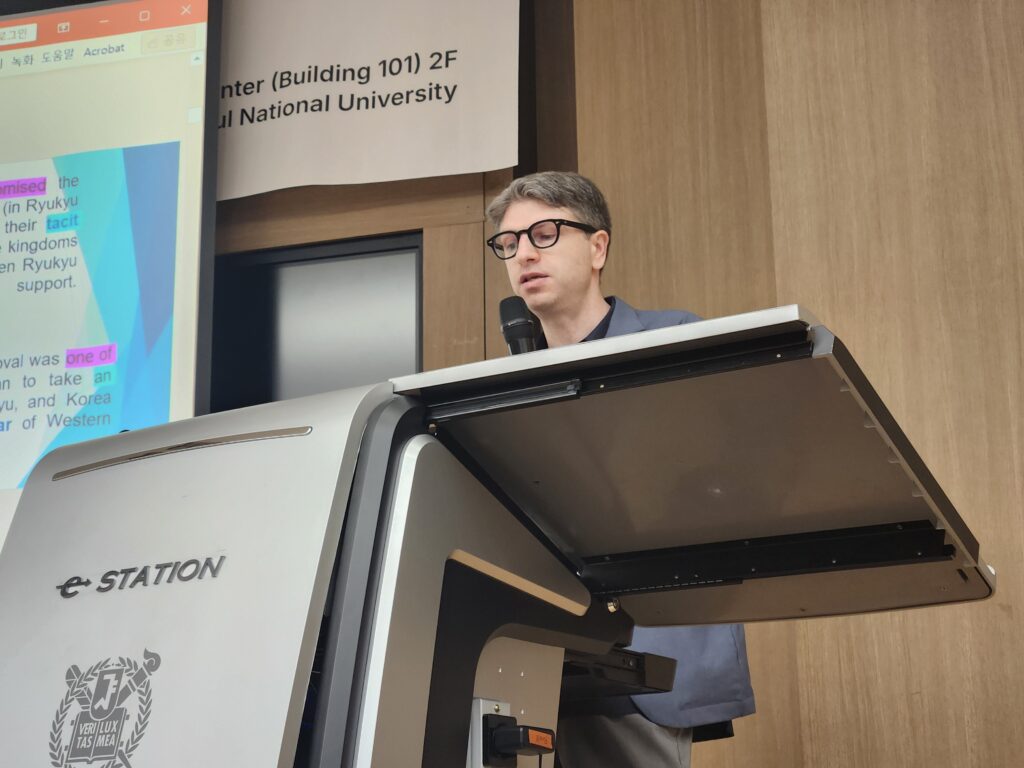
In the third presentation, Professor Marco Tinello (Kanagawa University) spoke on “Meiji Japan’s Relations with Ryukyu and Other Small States in Late 19th and Early 20th Centuries,” arguing that Meiji leaders pursued revision of the unequal treaties concerning the Japanese mainland while simultaneously adopting a policy of maintaining Western treaty rights in newly acquired areas such as Ryukyu, the Ogasawara Islands, Taiwan, Korea, and the Pacific islands. The annexation of these small states and territories must therefore be analyzed together, and this presentation took up the cases of Ryukyu and Korea. Professor Tinello noted that existing scholarship has rightly emphasized the importance of Western acquiescence on the eve of the 1905 protectorate and the 1910 annexation, but has not sufficiently attended to the fact that the Meiji government obtained comparable acquiescence at the time of the annexation of Ryukyu in 1879. Nor has it been sufficiently emphasized that the treaties Ryukyu concluded with Western powers in the 1850s and Korea in the 1880s were among the most sensitive problems Japan faced in the process of annexation. Focusing on these international treaties, he reexamined the annexation of the two kingdoms from the standpoint of negotiations between Japanese and Western diplomats over the treaties in question. By pledging to preserve Western privileges in Ryukyu and Korea, Japanese leaders secured both acquiescence in their encroachment and a posture of nonintervention when Ryukyu and Korea appealed for international support. This international acquiescence, in turn, was a principal factor enabling Meiji Japan to adopt an uncompromising stance in bilateral negotiations with the Qing, Ryukyu, and Korea without fear of Western intervention. On this basis Professor Tinello identified the mechanism that made Meiji Japan’s territorial expansion possible and, in clarifying the interlocking relations among Japan, the Western powers, and East Asia, showed that Meiji leaders were themselves conscious of this interconnectedness and built their diplomacy upon that understanding.

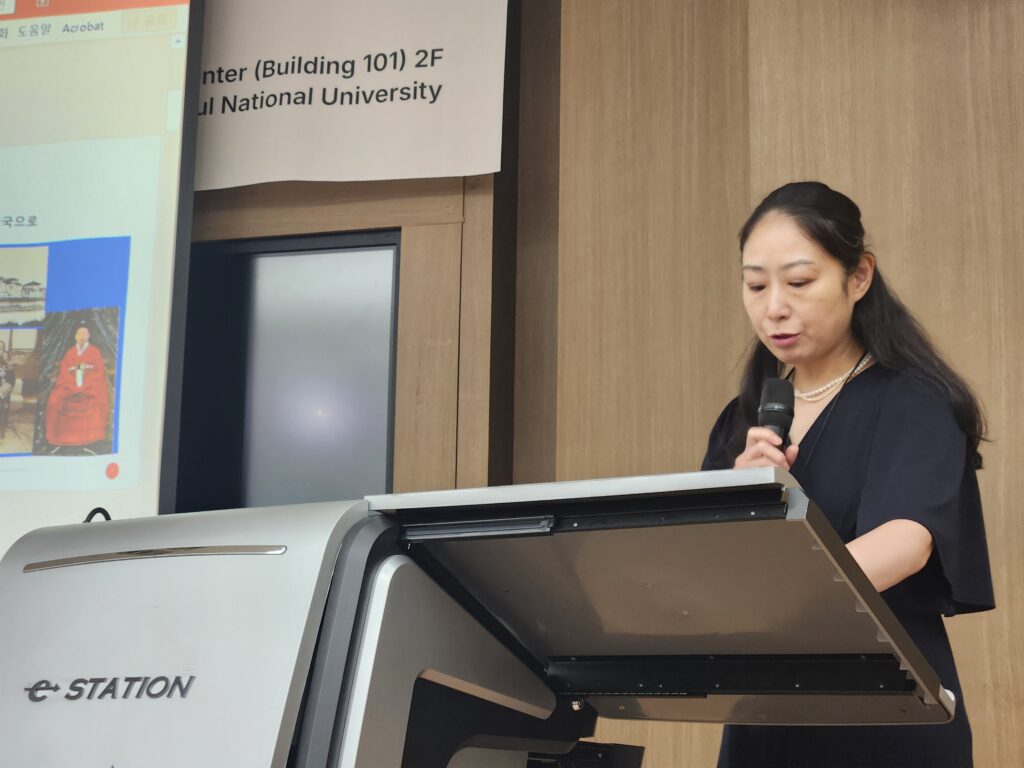
In the final presentation, Professor Mori Mayuko (Tokyo Woman’s Christian University) spoke on “Debates in International Law and International Politics over the ‘Small State’: The Protectorate of the Korean Empire.” She noted that in the late nineteenth century Korea paid tribute to and received investiture from the Qing while also concluding the Japan-Korea Treaty of Amity in 1876 and entering treaty relations with the United States, Britain, and other Western powers from 1882. Under the Treaty of Shimonoseki in 1895 Korea became an “independent and autonomous state,” and the abolition of ceremonial observances toward the Qing, including the rites of tribute (貢獻典禮), was determined. With Gojong’s accession as emperor and the change of the state name in 1897, the Korean Empire was established. It was to leave behind its position as a “small state” within the Sinocentric order and become, under the treaty system, an empire equal to the Qing, Russia, and Japan. Yet with the outbreak of the Russo-Japanese War in 1904, Japan concluded the Japan-Korea Protocol, an agreement of essentially military-alliance character; half a year later it concluded the First Japan-Korea Convention, providing for the dispatch of financial and diplomatic advisors approved by the Japanese government; and in 1905, having obtained the consent of the powers, it concluded the Second Japan-Korea Convention, making the Korean Empire a protectorate. The presentation analyzed at two levels how international law and international politics viewed the Second Japan-Korea Convention. First, it examined the foreign press reports consulted by international lawyers and the assessments those lawyers based upon them; second, it clarified the responses not only of the Japanese government but of the British and American governments, pointing out that these parties interpreted the Korean Empire as having become a de facto Japanese protectorate already by way of the 1904 Protocol and the First Convention rather than the Second.
Two discussants offered comments. Professor Kang Jin-a (Hanyang University) praised Professor Okamoto’s paper for its meticulous tracing of the temporal shifts in diplomatic vocabulary and of the competition among political “representations” surrounding translation, which affords the pleasure of overturning received wisdom. She cautioned, however, that a focus on terminology can weaken attention to the groups that deployed it and to the circumstances of the period. Since it was ultimately the Han literati class that made no distinction between shuguo and fanbu, she asked whether there were no differences of perception within that class, whether Western sources also used the term “state” for the fanbu, and whether the moment and circumstances of the coinage shudi can be traced. She further asked whether taking centralized administration as the criterion of sovereignty renders the “sovereign state” excessively narrow, and whether this scene, in which shudi, existing only under the Qing, and the provinces, persisting since the Qin and Han, appear to converge, should be read as a characteristic of Chinese history at large or as one particular conjuncture. Turning to Professor Mori’s paper, she asked what the requirements were under the international law of the time for recognizing annexation or the establishment of a protectorate as a legitimate procedure, and in particular how procedural legitimacy could be secured when the person due to sign a treaty refused to the end.
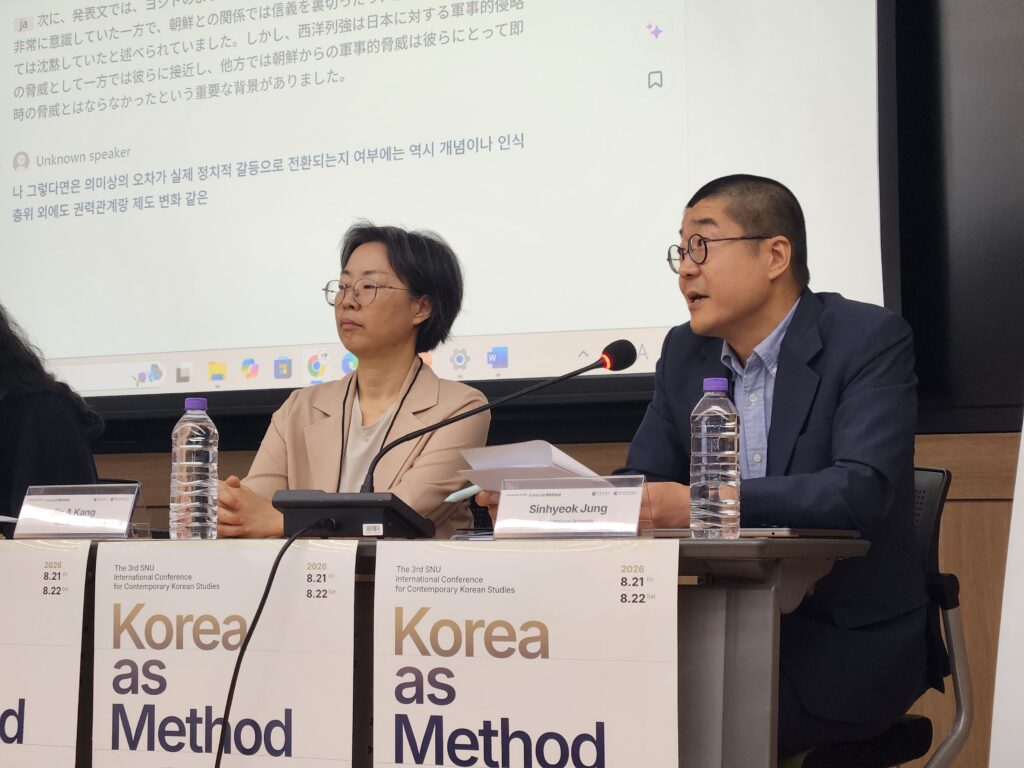
Professor Jeong Sinhyeok (Seoul National University), responding to Professor Ishida, suggested that the ways in which the Korean communication envoys and the Tokugawa shogunate understood and made use of the same object differently according to their respective purposes are closely connected to the presenter’s notion of “discrepancy.” Moving beyond the stance of describing discrepancy as discrepancy, however, he asked what distinguishes discrepancies that issued in conflict, as in the case of the diplomatic credentials (書契) dispute, from those that did not, as with the concept of “sin” (信), and how factors beyond the level of concepts and perceptions, such as power relations and institutional change, operated in converting semantic divergence into actual political conflict. To Professor Tinello he asked what common criterion allows Ryukyu, the Ogasawara Islands, Taiwan, Korea, and the Pacific islands to be grouped within a single analytical category despite the considerable differences among them, and what analytical and historiographical value the category of “small state” possesses. He also asked whether Komura Jutarō’s invocation of the Hawaiian and Madagascan precedents should be seen as the fruit of diplomatic learning accumulated since the 1870s or as a rhetorical device for foreclosing Western objections to annexation. This was at the same time a question addressed to the panel as a whole concerning a working definition of the “small state,” namely how to situate a case such as Tsushima, which was a mere domain within Japan yet persisted as a diplomatic actor between Korea and the shogunate.

This session reconstructed modern East Asian international relations from the vantage point of small state history. The translation of the Qing fanshu system into the language of sovereignty and territory, the treaty politics with the Western powers that underwrote Meiji Japan’s expansion, the divergences of understanding latent beneath a shared vocabulary in early modern Korea-Japan relations, and the opposed interpretations of international law and international politics surrounding the Korean protectorate all demonstrate how the international order of modern East Asia defined and redefined the standing of small states. The session’s particular value lies in having shown that concepts such as “sovereignty,” “dependency,” “communication,” and “protectorate” were never self-evident, and that the gaps in their translation and interpretation were themselves a driving force of historical development.

2026 SNU ICCK Session: East Asian International Relations from the Perspectives of Small State’s History

2026-08-27

The Center for Contemporary Korean Studies at Seoul National University held a two-day international conference on August 21–22 under the theme “Korea as Method.” The Statehood and Civil Society Team convened its session, “East Asian International Relations from the Perspectives of Small State’s History,” in Youngwon Hall, Building 101, Seoul National University. Chaired by Professor Kim Jong-hak (Seoul National University), the session featured the following four presentations.

In the first presentation, Professor Okamoto Takashi (Waseda University) spoke on “China and Its Dependencies: A Formation of the Notion of ‘Sovereignty’ in Modern East Asia,” examining the relationship between translated political concepts in China and international order. He observed that it is a striking phenomenon that the preamble to the Constitution of the People’s Republic of China, as revised in 2018, declares Taiwan part of the nation’s “sacred territory” and professes mutual respect for sovereignty and territorial integrity. The concept of “territory” (領土), he noted, took shape in China only in the early twentieth century, emerging alongside the formation of the notion of “sovereignty” (主權) and the rise of modern Chinese nationalism. Both terms originated in the West but were in fact coined in Japan before entering China, and their meanings were formed through China’s negotiations with the West and Japan and through the modern transformation of the traditional East Asian order. Dividing the eighteenth-century Qing world order into four categories, namely hushi (互市), shuguo (屬國), fanbu (藩部), and zhisheng (直省), he pointed out that Han Chinese made no distinction between shuguo and fanbu, referring to both collectively as fanshu (藩屬). As disputes over peripheral regions intensified in the 1880s, Qing authorities began using the term shudi (屬地) in order to distinguish fanbu from shuguo and bind the former more closely to China. Defeat in the Sino-Japanese War, the recognition of Korean “independence and autonomy,” and the ensuing scramble for concessions and the Boxer Uprising aroused among Han intellectuals a fear of partition (瓜分) and an anxiety that the loss of outlying dependencies would extend to the inner provinces themselves. Distinguishing Tibet and Mongolia from the dependencies already lost thus became the first step in the formation of a Chinese “nation,” and the ambiguous fanshu, by way of shudi, was replaced after the 1911 Revolution by “territory,” a term expressing sovereignty rather than suzerainty. This, however, was an entirely one-sided Han conception: Tibetans and Mongols, who neither used Chinese characters nor considered themselves subordinate to China, sought independence instead. Professor Okamoto further showed that Western writing since the Jesuits, drawing analogies with the Roman provincia and the French Ancien Régime, established the “province” (省) as the domain of Qing sovereignty and the fanshu as “dependencies,” with the result that two “Chinas” came to coexist: “China proper” in the narrow sense, and a “Chinese Empire” encompassing the dependencies. The reality, however, differed from what direct rule implied, for the Beijing government possessed no means of superintending provincial administration, and after the 1911 Revolution most provinces declared independence just as Tibet and Mongolia had done. That Communist China never fully succeeded in bringing the whole of the former Qing empire under a single sovereignty, as Taiwan, Hong Kong, Tibet, and Xinjiang attest, is precisely the historical background to the present government’s insistence on the sovereignty and territorial integrity of “One China.”

Professor Ishida Toru (The University of Shimane) followed with “Early Modern Korea-Japan Relations Considered from the Perspective of Tsushima,” examining the issues that come into view when early modern Korea-Japan relations are approached from Tsushima, and the points that warrant attention in understanding East Asian history from the opening of the ports onward. He offered three cases. The first concerns the naming of the envoys the Korean court dispatched to the Sō house, the lords of Tsushima. Korea, following strict regulations, designated them munwihaeng, whereas the Tsushima side called them tokai yakkan (渡海譯官), yakushi (譯使), or yakkanshi (譯官使). How, then, should we ourselves name these envoys? The second concerns understandings of the communication envoys (通信使) sent by the Korean king to the Tokugawa shogun. Though these envoys are often cited as the mainstay of early modern Korea-Japan relations, the understanding of the “sin” (信) in “tongsin” differed entirely between Korea and Japan, and in contemporary Japan yet another understanding has taken hold. The third concerns the concept of gyorin (交隣), used to characterize early modern Korea-Japan relations, where the divergence between Korean and Japanese understandings was likewise considerable. In all three cases, Professor Ishida stressed, the “word or Chinese character” and the “envoy itself” were shared, yet the understanding of their content differed entirely among the parties involved. Even if early modern Korea-Japan relations can be described as “interstate relations grounded in the Sinocentric order,” the actual conditions were not the same in each country, and by extension the same situation may obtain in modern Korea-Japan relations as well. What matters, he added, is to consider why the understandings differed and what developments followed from those differences, not to reduce divergence to “distance from a correct answer.” There is a need to accept “discrepancy” as discrepancy, since what took place in the past must first be understood as it was.

In the third presentation, Professor Marco Tinello (Kanagawa University) spoke on “Meiji Japan’s Relations with Ryukyu and Other Small States in Late 19th and Early 20th Centuries,” arguing that Meiji leaders pursued revision of the unequal treaties concerning the Japanese mainland while simultaneously adopting a policy of maintaining Western treaty rights in newly acquired areas such as Ryukyu, the Ogasawara Islands, Taiwan, Korea, and the Pacific islands. The annexation of these small states and territories must therefore be analyzed together, and this presentation took up the cases of Ryukyu and Korea. Professor Tinello noted that existing scholarship has rightly emphasized the importance of Western acquiescence on the eve of the 1905 protectorate and the 1910 annexation, but has not sufficiently attended to the fact that the Meiji government obtained comparable acquiescence at the time of the annexation of Ryukyu in 1879. Nor has it been sufficiently emphasized that the treaties Ryukyu concluded with Western powers in the 1850s and Korea in the 1880s were among the most sensitive problems Japan faced in the process of annexation. Focusing on these international treaties, he reexamined the annexation of the two kingdoms from the standpoint of negotiations between Japanese and Western diplomats over the treaties in question. By pledging to preserve Western privileges in Ryukyu and Korea, Japanese leaders secured both acquiescence in their encroachment and a posture of nonintervention when Ryukyu and Korea appealed for international support. This international acquiescence, in turn, was a principal factor enabling Meiji Japan to adopt an uncompromising stance in bilateral negotiations with the Qing, Ryukyu, and Korea without fear of Western intervention. On this basis Professor Tinello identified the mechanism that made Meiji Japan’s territorial expansion possible and, in clarifying the interlocking relations among Japan, the Western powers, and East Asia, showed that Meiji leaders were themselves conscious of this interconnectedness and built their diplomacy upon that understanding.

In the final presentation, Professor Mori Mayuko (Tokyo Woman’s Christian University) spoke on “Debates in International Law and International Politics over the ‘Small State’: The Protectorate of the Korean Empire.” She noted that in the late nineteenth century Korea paid tribute to and received investiture from the Qing while also concluding the Japan-Korea Treaty of Amity in 1876 and entering treaty relations with the United States, Britain, and other Western powers from 1882. Under the Treaty of Shimonoseki in 1895 Korea became an “independent and autonomous state,” and the abolition of ceremonial observances toward the Qing, including the rites of tribute (貢獻典禮), was determined. With Gojong’s accession as emperor and the change of the state name in 1897, the Korean Empire was established. It was to leave behind its position as a “small state” within the Sinocentric order and become, under the treaty system, an empire equal to the Qing, Russia, and Japan. Yet with the outbreak of the Russo-Japanese War in 1904, Japan concluded the Japan-Korea Protocol, an agreement of essentially military-alliance character; half a year later it concluded the First Japan-Korea Convention, providing for the dispatch of financial and diplomatic advisors approved by the Japanese government; and in 1905, having obtained the consent of the powers, it concluded the Second Japan-Korea Convention, making the Korean Empire a protectorate. The presentation analyzed at two levels how international law and international politics viewed the Second Japan-Korea Convention. First, it examined the foreign press reports consulted by international lawyers and the assessments those lawyers based upon them; second, it clarified the responses not only of the Japanese government but of the British and American governments, pointing out that these parties interpreted the Korean Empire as having become a de facto Japanese protectorate already by way of the 1904 Protocol and the First Convention rather than the Second.

Two discussants offered comments. Professor Kang Jin-a (Hanyang University) praised Professor Okamoto’s paper for its meticulous tracing of the temporal shifts in diplomatic vocabulary and of the competition among political “representations” surrounding translation, which affords the pleasure of overturning received wisdom. She cautioned, however, that a focus on terminology can weaken attention to the groups that deployed it and to the circumstances of the period. Since it was ultimately the Han literati class that made no distinction between shuguo and fanbu, she asked whether there were no differences of perception within that class, whether Western sources also used the term “state” for the fanbu, and whether the moment and circumstances of the coinage shudi can be traced. She further asked whether taking centralized administration as the criterion of sovereignty renders the “sovereign state” excessively narrow, and whether this scene, in which shudi, existing only under the Qing, and the provinces, persisting since the Qin and Han, appear to converge, should be read as a characteristic of Chinese history at large or as one particular conjuncture. Turning to Professor Mori’s paper, she asked what the requirements were under the international law of the time for recognizing annexation or the establishment of a protectorate as a legitimate procedure, and in particular how procedural legitimacy could be secured when the person due to sign a treaty refused to the end.

Professor Jeong Sinhyeok (Seoul National University), responding to Professor Ishida, suggested that the ways in which the Korean communication envoys and the Tokugawa shogunate understood and made use of the same object differently according to their respective purposes are closely connected to the presenter’s notion of “discrepancy.” Moving beyond the stance of describing discrepancy as discrepancy, however, he asked what distinguishes discrepancies that issued in conflict, as in the case of the diplomatic credentials (書契) dispute, from those that did not, as with the concept of “sin” (信), and how factors beyond the level of concepts and perceptions, such as power relations and institutional change, operated in converting semantic divergence into actual political conflict. To Professor Tinello he asked what common criterion allows Ryukyu, the Ogasawara Islands, Taiwan, Korea, and the Pacific islands to be grouped within a single analytical category despite the considerable differences among them, and what analytical and historiographical value the category of “small state” possesses. He also asked whether Komura Jutarō’s invocation of the Hawaiian and Madagascan precedents should be seen as the fruit of diplomatic learning accumulated since the 1870s or as a rhetorical device for foreclosing Western objections to annexation. This was at the same time a question addressed to the panel as a whole concerning a working definition of the “small state,” namely how to situate a case such as Tsushima, which was a mere domain within Japan yet persisted as a diplomatic actor between Korea and the shogunate.

This session reconstructed modern East Asian international relations from the vantage point of small state history. The translation of the Qing fanshu system into the language of sovereignty and territory, the treaty politics with the Western powers that underwrote Meiji Japan’s expansion, the divergences of understanding latent beneath a shared vocabulary in early modern Korea-Japan relations, and the opposed interpretations of international law and international politics surrounding the Korean protectorate all demonstrate how the international order of modern East Asia defined and redefined the standing of small states. The session’s particular value lies in having shown that concepts such as “sovereignty,” “dependency,” “communication,” and “protectorate” were never self-evident, and that the gaps in their translation and interpretation were themselves a driving force of historical development.