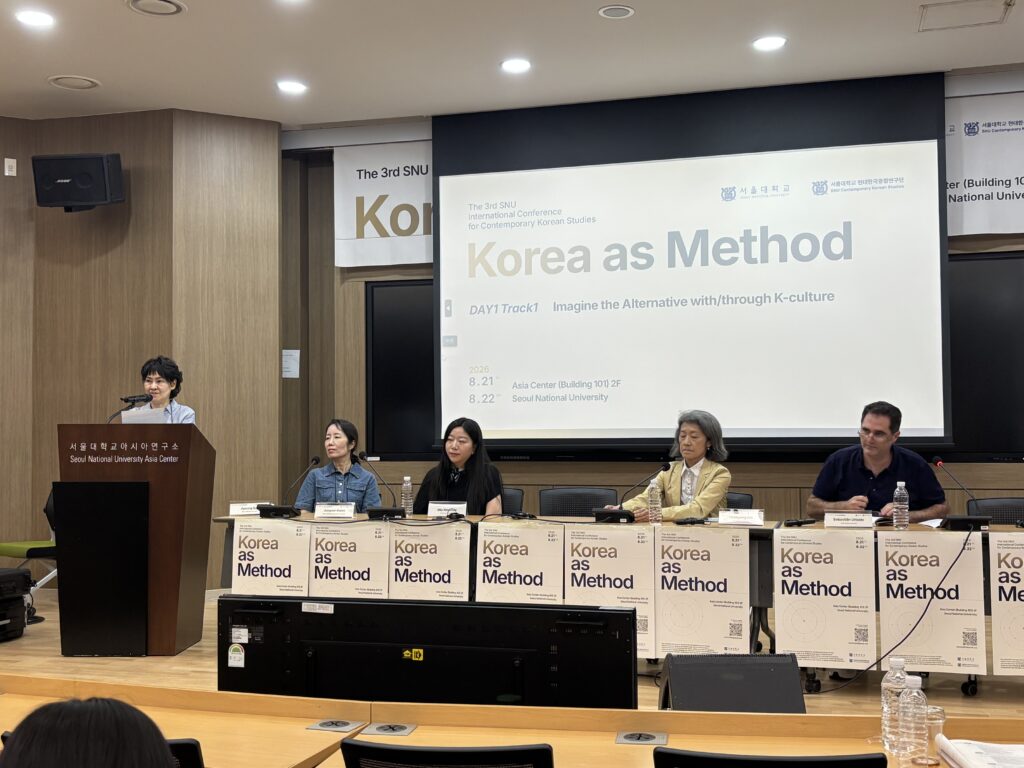
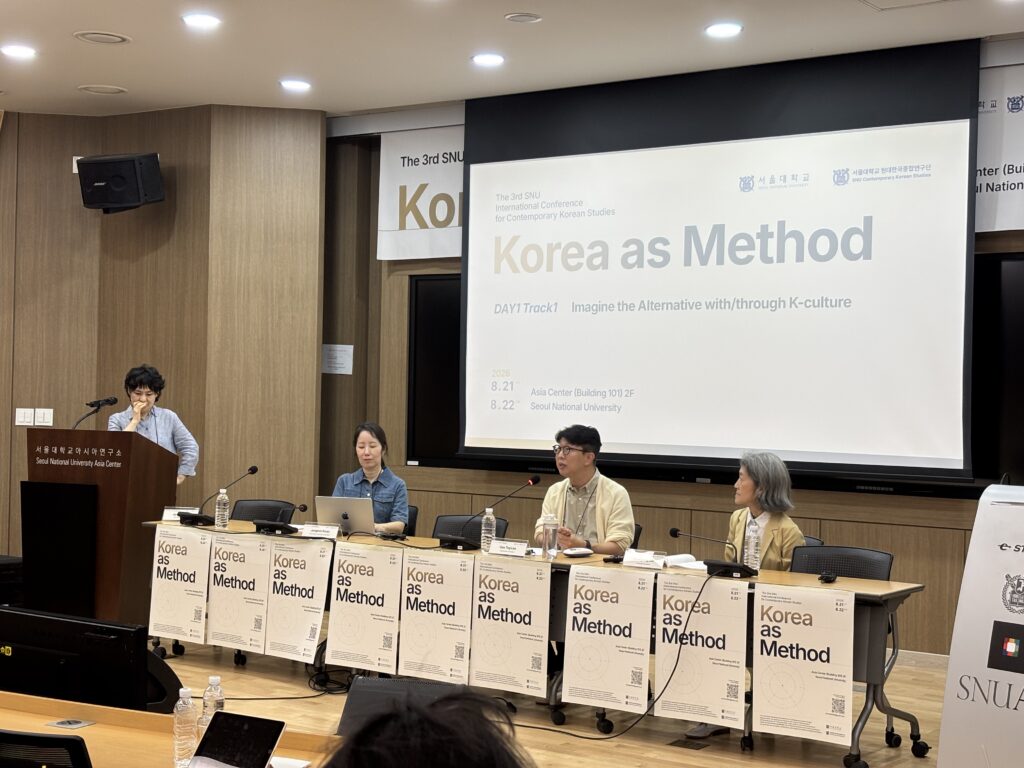
The SNU Center for Contemporary Korean Studies hosted an international conference on August 21 and 22 under the theme “Korea as Method.” The Global Hallyu Team presented the final session of the first day, titled “Imagine the Alternative with/through K-culture.” The session was chaired by Jiyoung Suh (Seoul National University), with Gyu Tag Lee (George Mason University) and Huikyong Pang (Sungkonghoe University) serving as discussants. The session brought together four presentations that explored how K-culture reveals existing social orders and cultural hierarchies, while also opening up possibilities for imagining alternatives, through diverse sites including education and K-pop, virtual idols, transnational fandom, and K-pop consumption among young people in Bolivia.
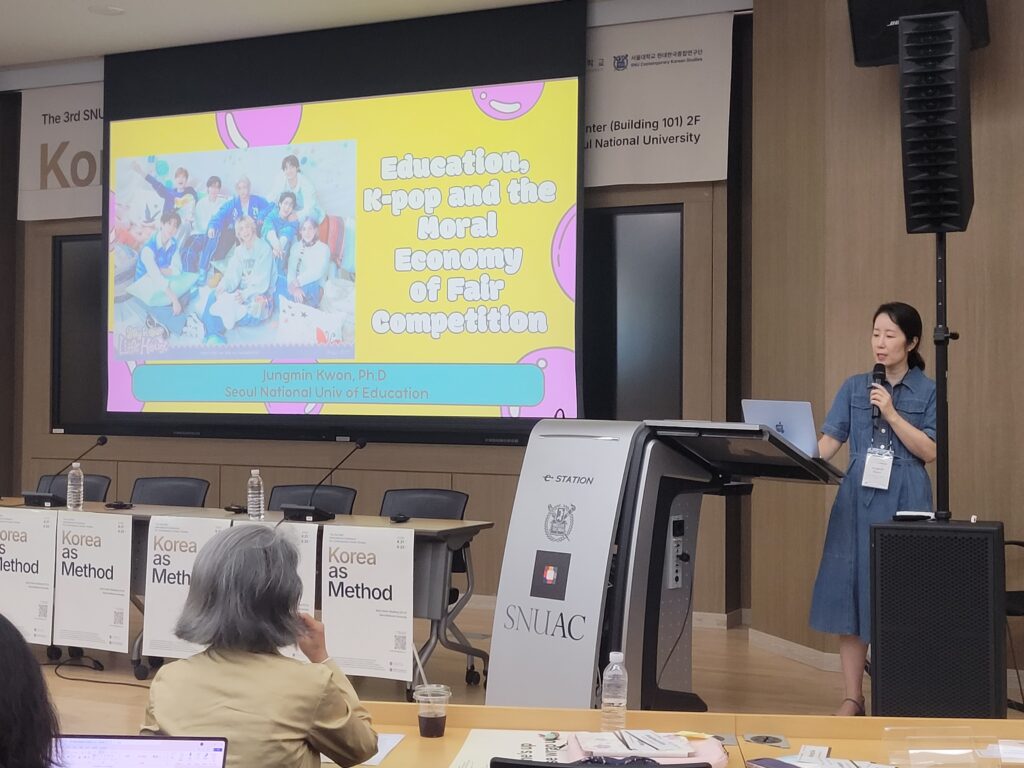
Jungmin Kwon (Seoul National University of Education) presented “Education, K-pop and the Moral Economy of Fair Competition,” examining the question of fairness in the allocation of scarce resources through a comparison of educational competition in Korea and K-pop concert ticketing. Both arenas involve intense competition for limited opportunities, and participants place particular importance on whether the procedures leading to unequal outcomes are legitimate. Practices such as the use of macros and VIP invitations are understood as ways of bypassing the intended procedures of competition. The presentation then raised the question of who is recognized as a legitimate competitor. The boundaries between Korean and international fans, fans and non-fans, and ordinary purchasers and VIP recipients are not fixed; rather, they may be continually redrawn through struggles over access. As long as scarcity persists, conflicts over fairness may recur in new forms. The presentation thus invited us to ask not only how competition can be made fairer, but also why education and cultural experiences should depend so heavily on scarce competitions in the first place.
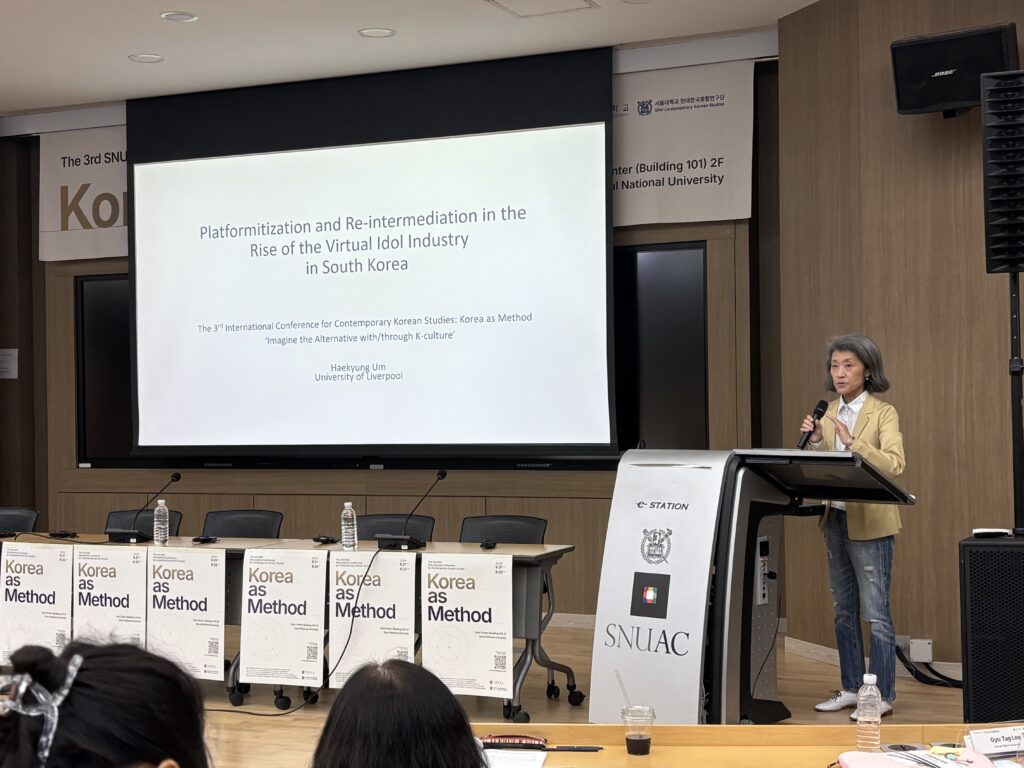
Haekyung Um (University of Liverpool) presented “Platformitization and Re-intermediation in the Rise of the Virtual Idol Industry in South Korea,” examining the growth of the virtual idol industry and the technological and industrial transformations associated with it. Focusing on Plave and MAVE:, the presentation showed that virtual idols are not simply technological products that replace human idols, but industrial formations produced through the combination of diverse technologies and actors, including real-time motion capture, graphics engines, social media, and streaming platforms. In this process, the role of traditional artist management is reorganized through new intermediaries, such as technologists, CGI artists, and content creators. At the same time, fans interpret the authenticity of virtual idols through values associated with human idol fandom, sometimes even accepting technological glitches and imperfections as expressions of authenticity. The presentation raised questions about what new possibilities and challenges these transformations pose for the production and consumption of K-pop, the relationship between fans and artists, and the global expansion of the Korean Wave.
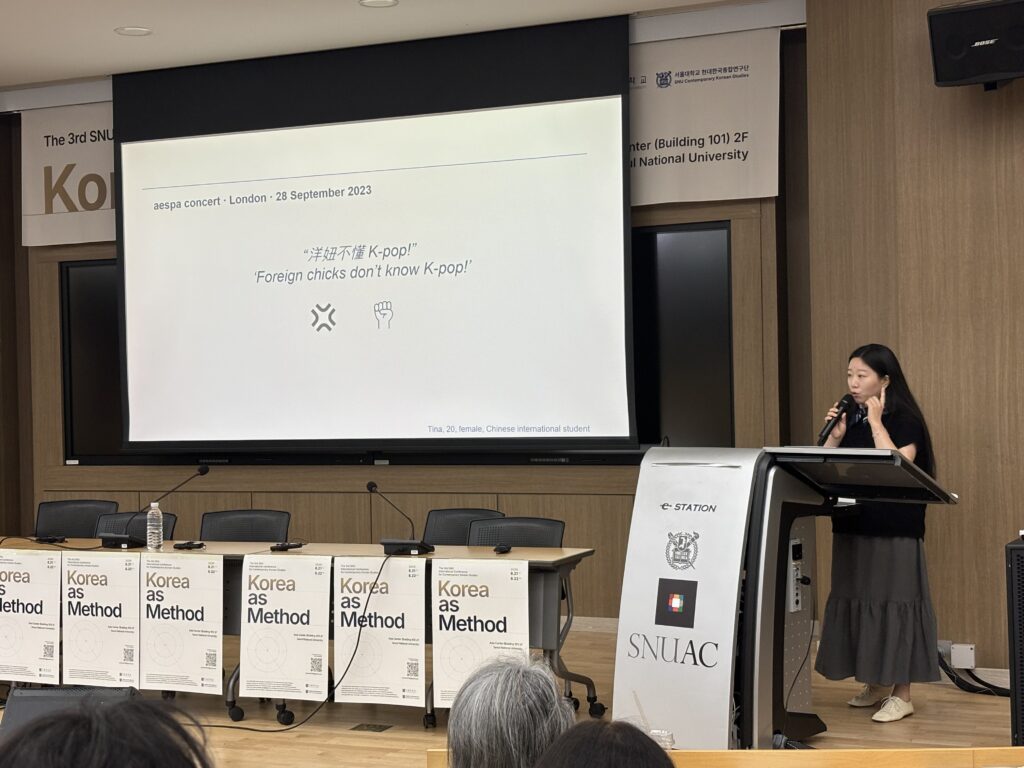
Mia Xinrui Liu (The University of Sheffield) presented “‘FOREIGN CHICKS’ DON’T KNOW K-POP: Anti-Western Discourse and Imagined East Asianness in Chinese K-pop Fandom,” analyzing the formation of anti-Western discourse and East Asian identity within Chinese K-pop fandom. Drawing on online and offline ethnography and interviews, the presentation focused on how Chinese fans imagine Western fans as an “other” who lack sufficient knowledge of and commitment to K-pop. In this context, fandom authority extends into claims to moral legitimacy based on how much one spends, how much one knows, and how deeply one is involved. Chinese fans may be positioned as Chinese in their tensions with Korean fans, but when encountering Western fans, they may also imagine themselves as part of a broader “East Asian fandom.” The presentation pointed out that this shift in identity can function as a form of resistance to Western cultural hierarchy while simultaneously producing new hierarchies within fandom. Transnational fandom was thus presented as a space where cultural authority and legitimacy are negotiated and reconstructed.
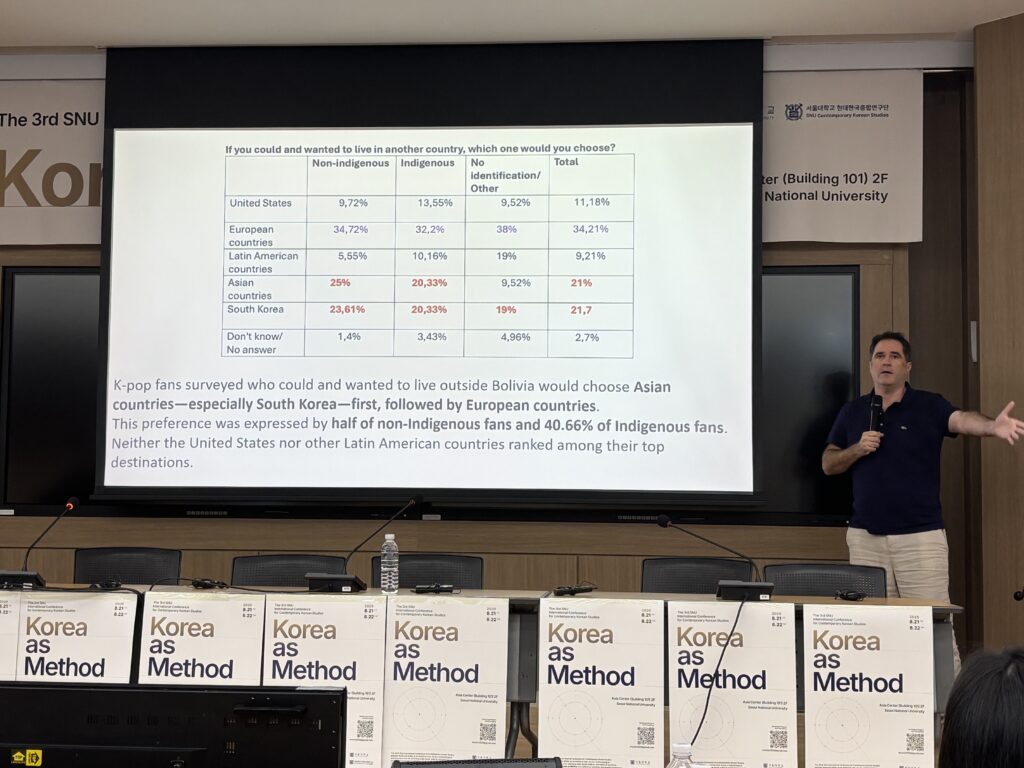
Sebastián Urioste (La Rochelle Université) presented “‘Asian Imaginary’ in the Andes: Bolivian Youth and the Appeal of K-Pop,” exploring the images of Asia constructed through K-pop consumption among young people in Bolivia and their cultural implications. For urban youth in Bolivia, including Indigenous youth, Korean cultural products function as a source of external inspiration that extends beyond both the realities of life in their own country and a cultural imagination centered on the United States. Yet this alternative imagination also constructs Korea as a geographically distant place associated with idealized physical beauty, thereby involving a form of “Latin American Orientalism.” The presentation emphasized that this phenomenon is a complex one, shaped by the processes of decolonization and the global reconfiguration of cultural hegemony. K-culture can open up new possibilities for imagining ways of life, but such imagination may itself be constructed through stereotypes and processes of exoticization.
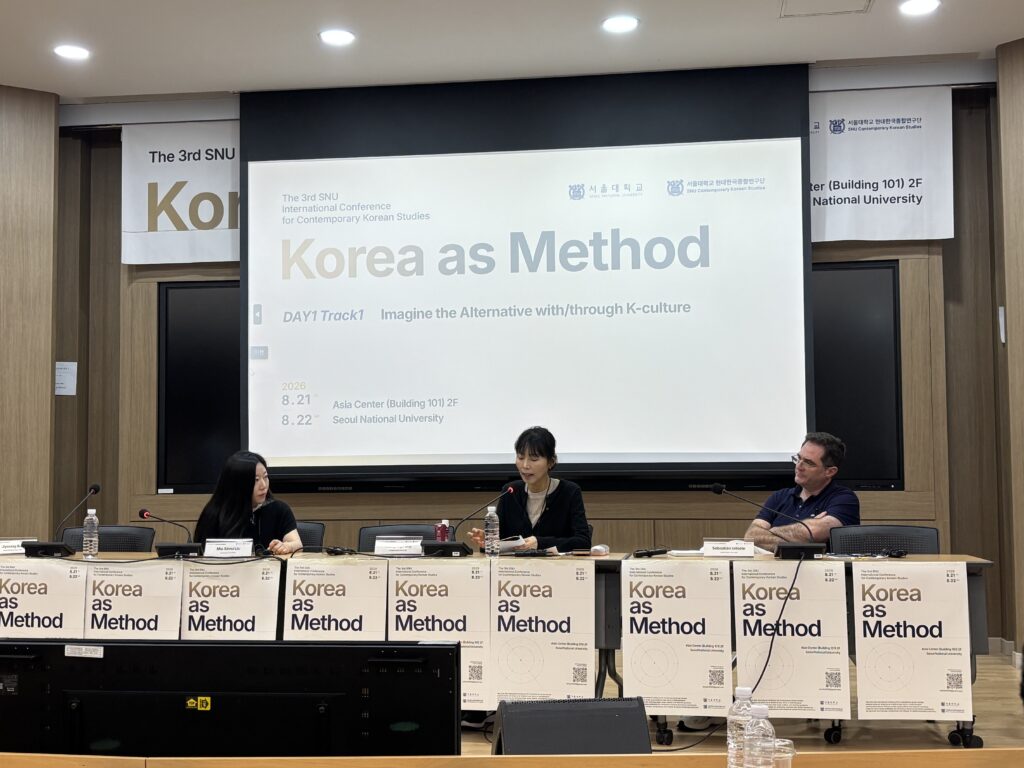
In this session, the Global Hallyu Team approached K-culture as a site where fairness, technology, fandom, identity, and cultural imagination intersect. Although the four presentations examined different research subjects and employed distinct methodological approaches, they collectively demonstrated that K-culture constitutes a site of cultural contestation in which new possibilities are opened up even as new boundaries and hierarchies are produced. In this sense, the Global Hallyu Team extended the conference’s broader question of “Korea as Method” by asking not only what can change through K-culture, but also under what conditions—and with what limitations—such alternative imaginations are constructed.