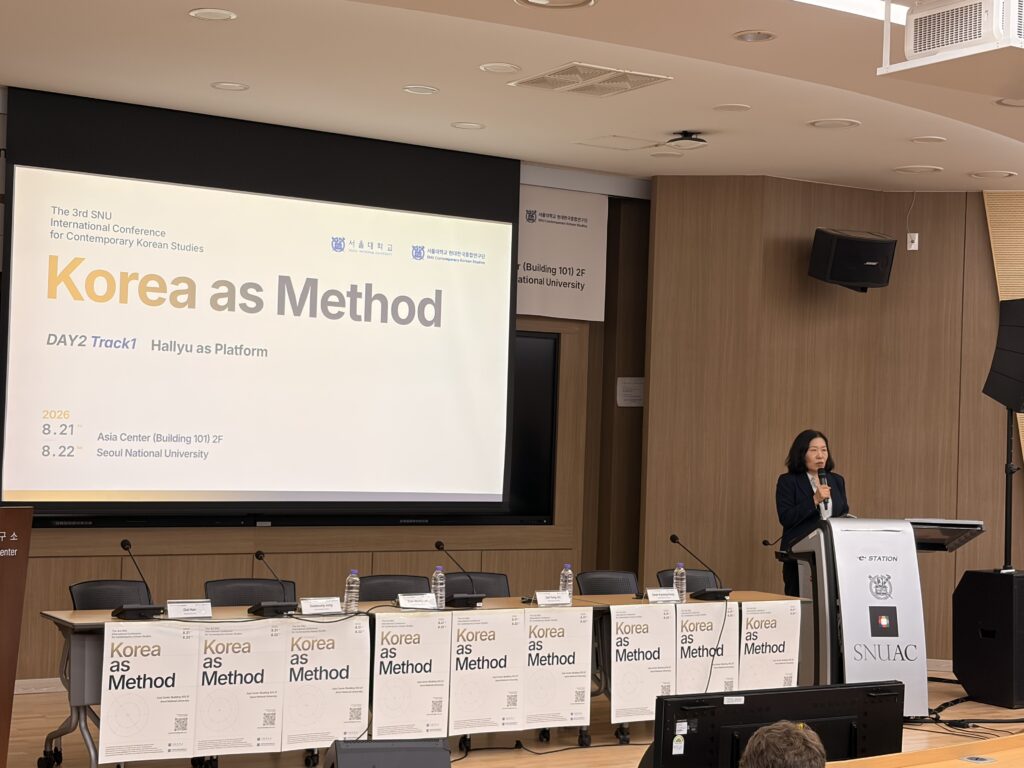
The Seoul National University Center for Contemporary Korean Studies held an international conference on August 21 and 22 under the theme “Korea as Method.” On the second day, the Global Hallyu Team organized the second session, “Hallyu as Platform.” Chaired by Professor Seok-Kyeong Hong (Seoul National University), the session featured four presentations that sought to understand Hallyu not merely as cultural content distributed through digital platforms, but as an ecosystem in which cultural production and consumption, fandom practices, and cultural norms are formed and circulated.
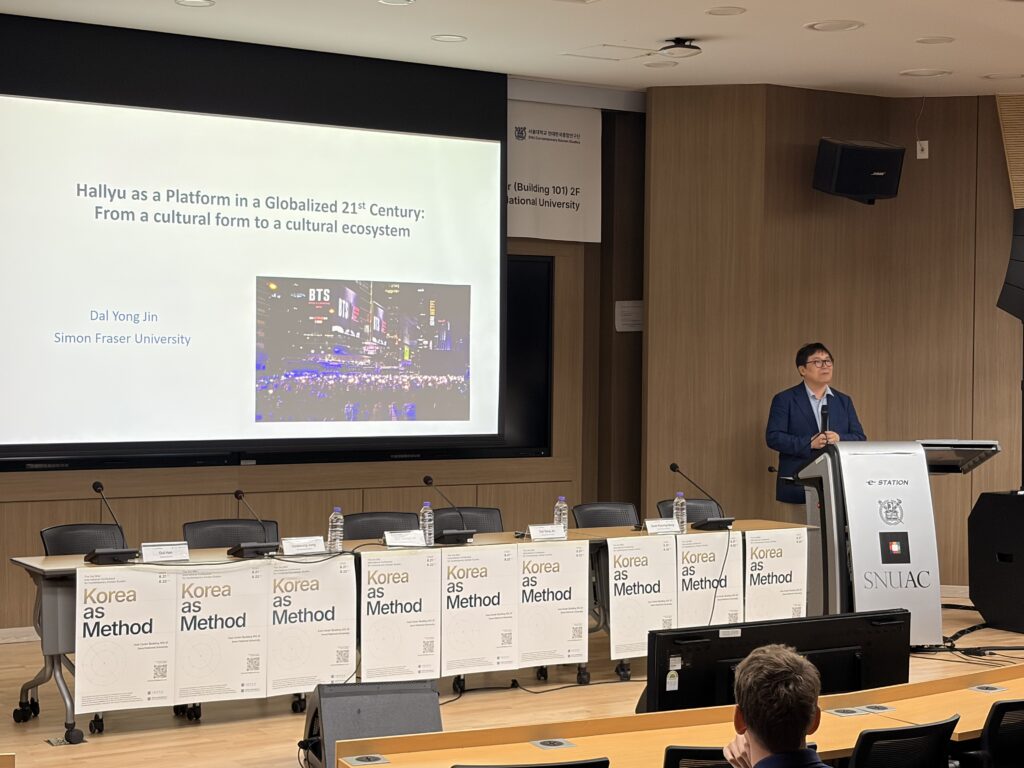
Professor Dal Yong Jin (Simon Fraser University) presented “Hallyu as a Platform in a Globalized 21st Century: From a Cultural Form to a Cultural Ecosystem,” arguing that Hallyu functions as a platform that enables diverse forms of cultural production and practice beyond its role as a cultural form in itself. The presentation explained Hallyu’s platform characteristics through four interrelated logics: openness, affordance, narrative, and networks. Hallyu provides a space in which global creators and audiences can share and develop cultural content and ideas, while its interaction with global platforms and local cultural industries generates new modes of cultural production and circulation. Hallyu was presented not only as a counter-hegemonic force challenging Western-dominated cultural flows, but also as a model of a “win-win” cultural ecosystem in which Korean and global cultural industries collaborate. The presentation thus proposed understanding Hallyu not as the export of finished cultural products, but as an evolving ecosystem in which diverse actors and cultural practices converge.
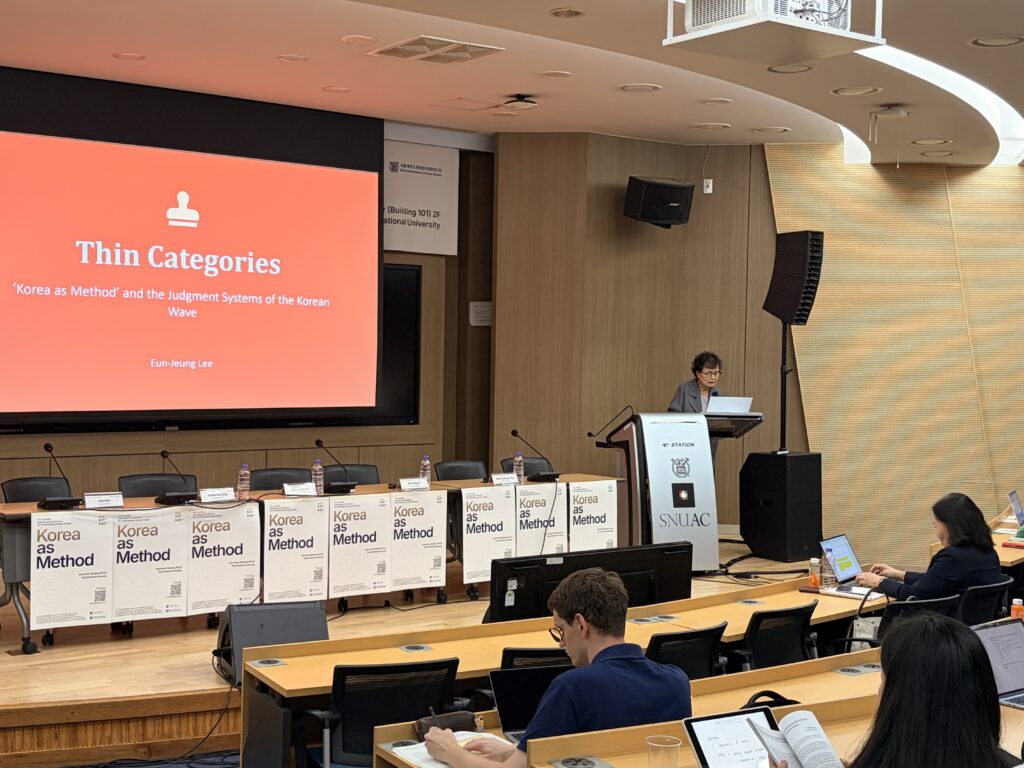
Professor Eun-Jeung Lee (Freie Universität Berlin) presented “‘Korea as Method’ and the Judgment Systems of the Korean Wave,” examining the systems of cultural judgment and classification surrounding Hallyu. The presentation distinguished between evaluating “authenticity” or resemblance to an original and the practice of attribution, or identifying the source of a cultural product, in order to explore how cultural judgment changes in the digital environment. In particular, it explained that thin categories such as K-pop, K-beauty, and “Korean” are sustained not by presupposing a particular essence or owner, but through the procedure of identifying their sources. From this perspective, Hallyu can be understood not as a cultural category exclusively owned by a particular nation, but as a cultural practice in which diverse actors assign, use, and reconfigure names. The presentation proposed “Korea as Method” not as a definition intended to explain Korea’s particularity, but as an analytical method for asking where cultural judgments are made, who establishes the standards, and how those standards operate.
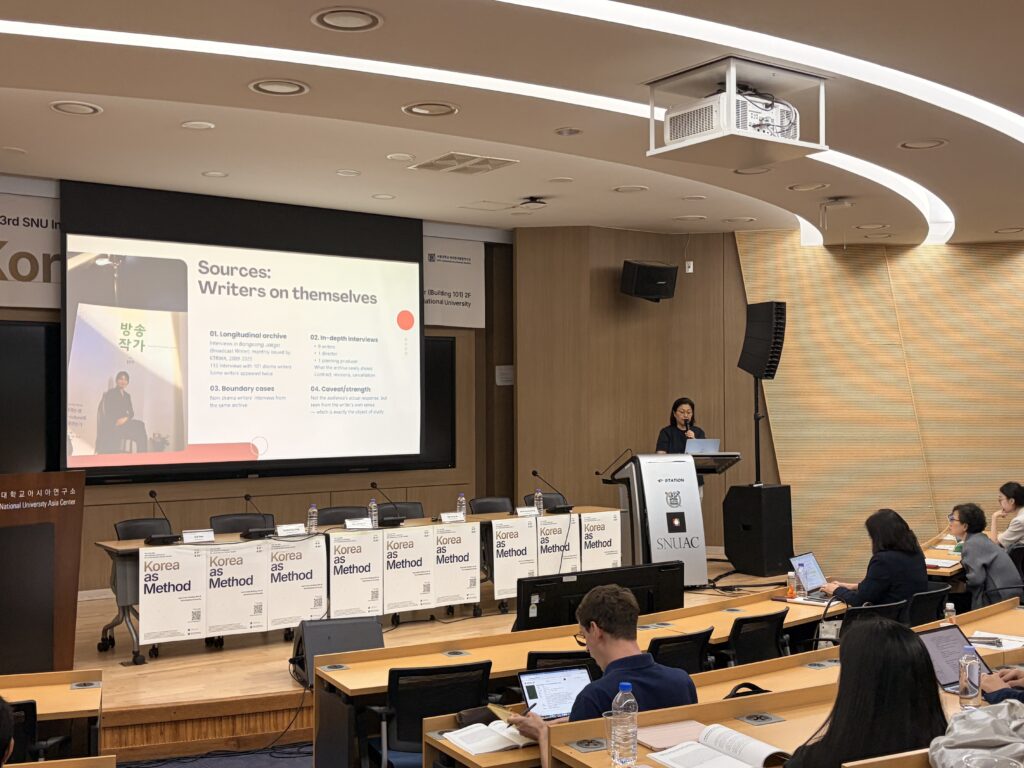
Sookeung Jung (Freie Universität Berlin) presented “Writing Korea as Method: Relational Authorship in Korean Television Drama,” exploring how authorship among Korean television drama writers is constituted within the production process. The presentation focused on the situation in which writers have increasingly come under the influence of capital and platforms, while responsibility for and the reputation of the final work continue to be attributed to them. To explain this dynamic, Jung proposed the concept of “relational authorship,” arguing that authorship is shaped not solely by individual creative ability or industrial structures, but through relationships with the various actors surrounding the writer. In particular, the presentation identified the asymmetry between authority and responsibility, as well as the timing of audience responses—whether they arrive during the writing process or after the work has been completed—as two central analytical axes. In this way, the experience of Korean drama writers was presented as a theoretical resource for understanding how authorship and creative responsibility are being reconfigured in a changing platform environment.
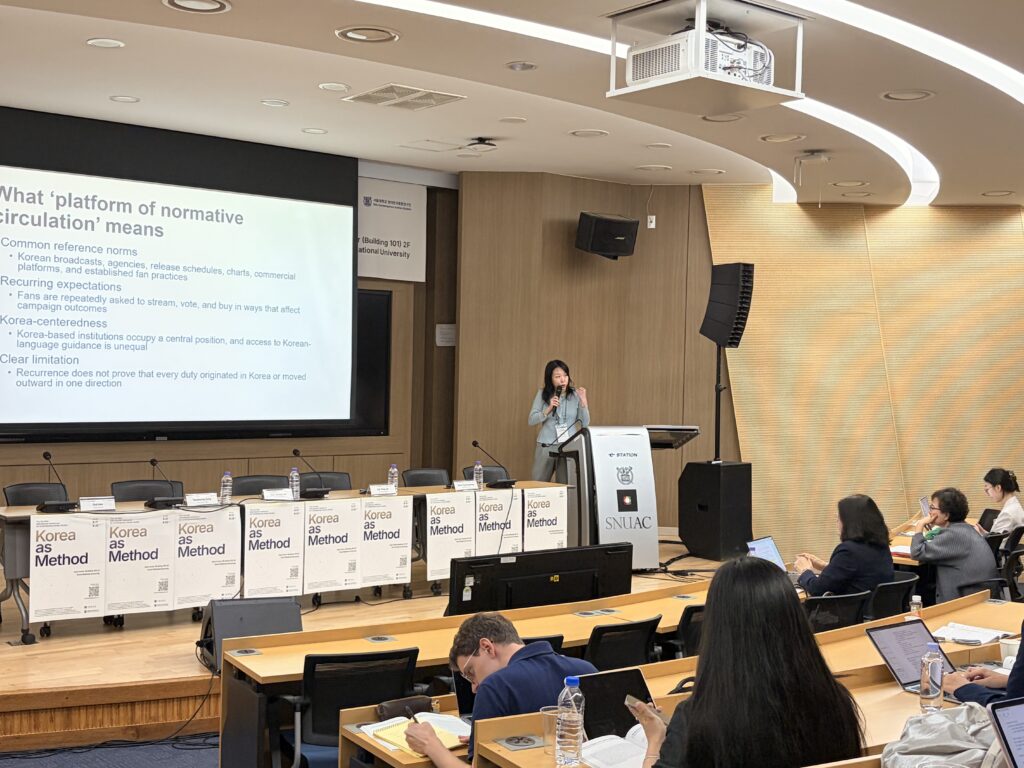
Professor Oul Han (Sogang University) presented “Hallyu as a Platform of Normative Circulation: K-pop Fan Duties Across Language Settings,” examining how fan duties and practical norms circulate across K-pop fandoms in different linguistic contexts. The presentation compared fan-produced campaign materials in Korean and English to explore how practices such as streaming, voting, and purchasing are repeatedly demanded in both language environments. The analysis showed that fans in both contexts share expectations to follow official release schedules and platform rules and to vote, purchase, and stream in particular ways, while the actual practices vary according to the distribution routes and platform systems of each market. The presentation conceptualized this phenomenon as “normative circulation,” explaining that Hallyu platforms function as sites through which not only content but also fandom practices and norms of participation circulate across national borders. At the same time, it pointed out that the available materials do not allow the origins of these norms or a unidirectional trajectory of their diffusion to be definitively established.
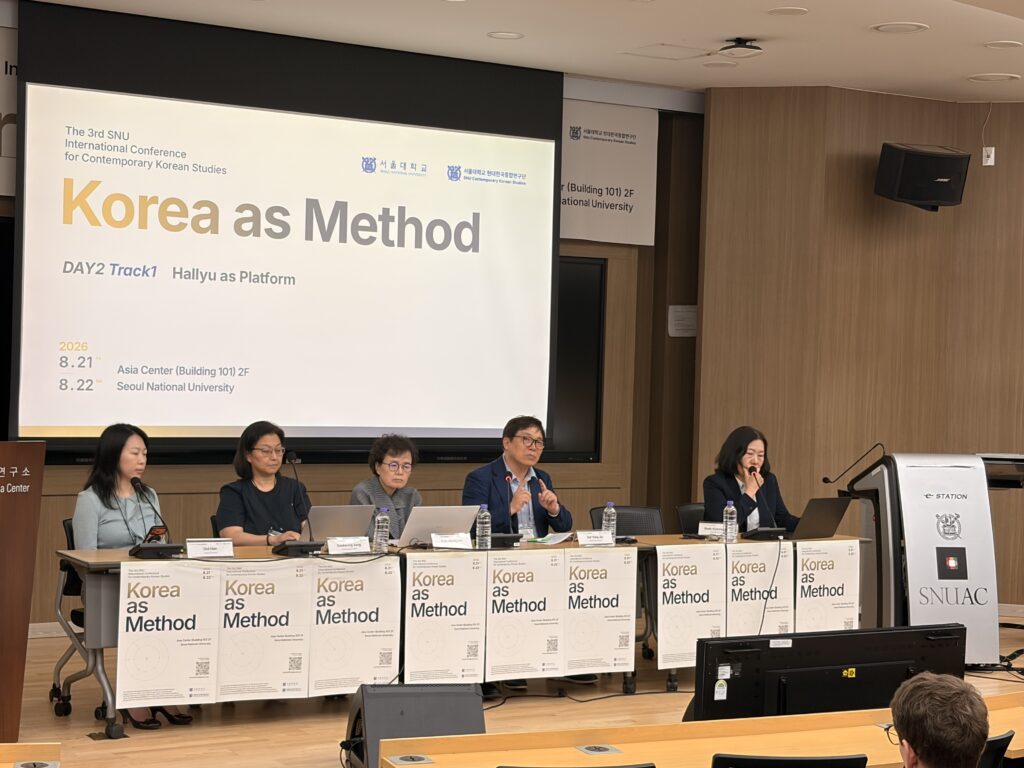
The session extended the understanding of Hallyu beyond cultural content in circulation or technological platforms toward a relational ecosystem in which cultural production and judgment, authorship, and fandom norms are formed and circulated. Although the four presentations examined different research subjects and employed distinct methodological approaches, they collectively demonstrated that Hallyu constitutes a platform that opens up new possibilities for cultural exchange and collaboration while also reconfiguring relationships among particular standards, norms, and forms of authority. Through these discussions, the Global Hallyu Team raised questions not only about what Hallyu produces and circulates, but also about who judges and assumes responsibility in the process, and what norms circulate through it.