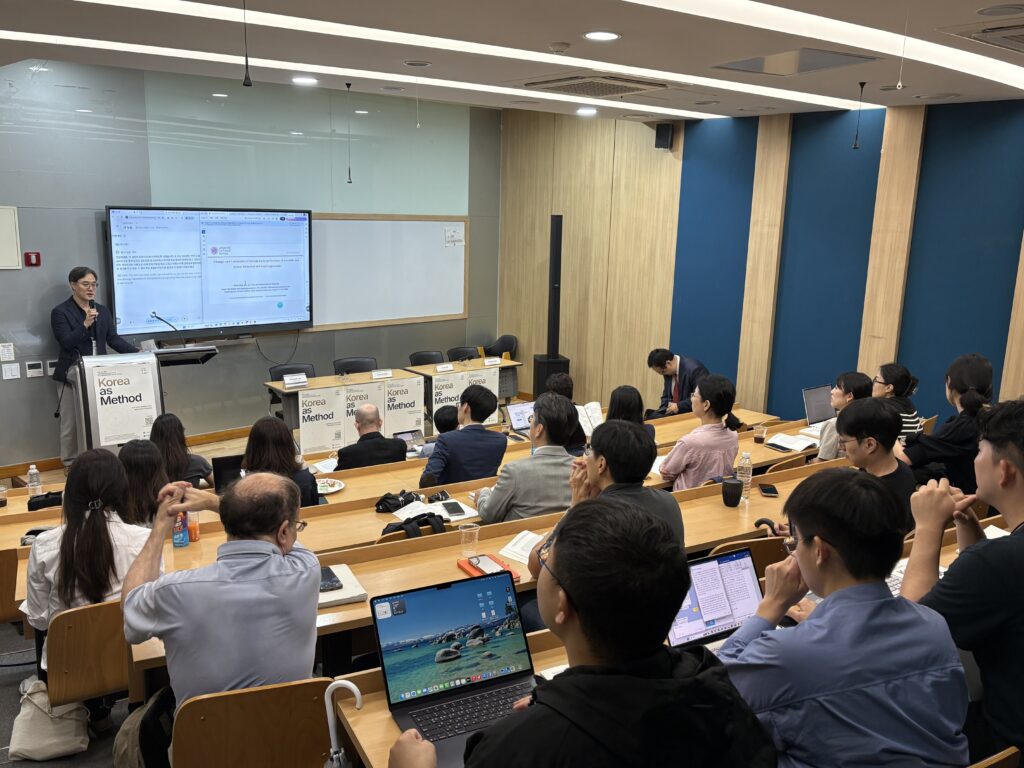
The SNU Center for Contemporary Korea Studies held an international conference under the theme “Korea as Symptom” on August 21 and 22. During the second session on the first day, the Modernity Team presented a panel entitled “Modernity and Development.” Chaired by Dongwon Lee (Seoul National University), the three presentations examined the legal framework governing freedom of assembly and demonstration in Korea, protest and police suppression tactics during the Bu-Ma Democratic Uprising, and the transnational discourse of Zainichi Koreans on the minjung (“the people”) in the 1970s. Through these historical cases, the panel sought to shed light on the development of democracy in Korean society and its contemporary condition.
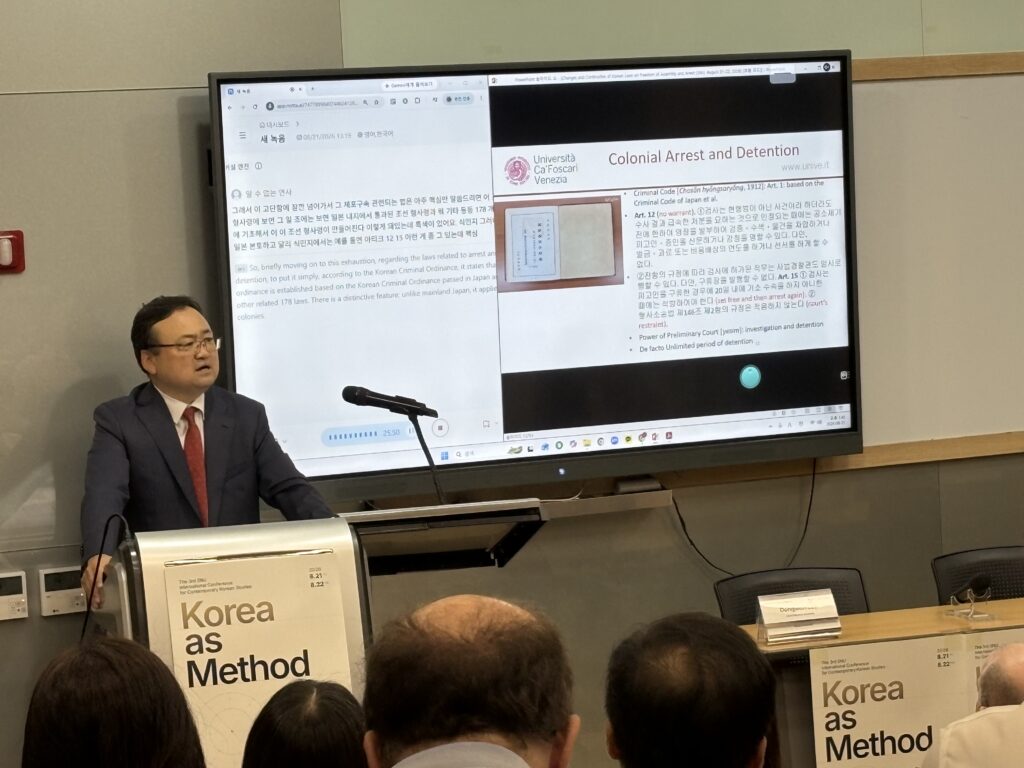
First, Professor Jong-chul Ahn (Ca’ Foscari University of Venice) examined a series of laws and regulations governing freedom of assembly and demonstration in Korean society from the colonial period through the U.S. military government and up to 1987, with particular attention to the political dynamics surrounding enforcement decrees. The legal mechanisms established during the colonial period to control Koreans were abolished under the U.S. military government. Nevertheless, the military government continued to restrict these freedoms according to arbitrary standards, leaving behind historical legacies of censorship and techniques of governance that persisted in Korean society thereafter. His presentation extended these historical questions into the present, asking what the “politics of enforcement decrees” means in contemporary Korea and whether restrictions on public assemblies can be justified as a means of maintaining order during public health emergencies such as COVID-19.
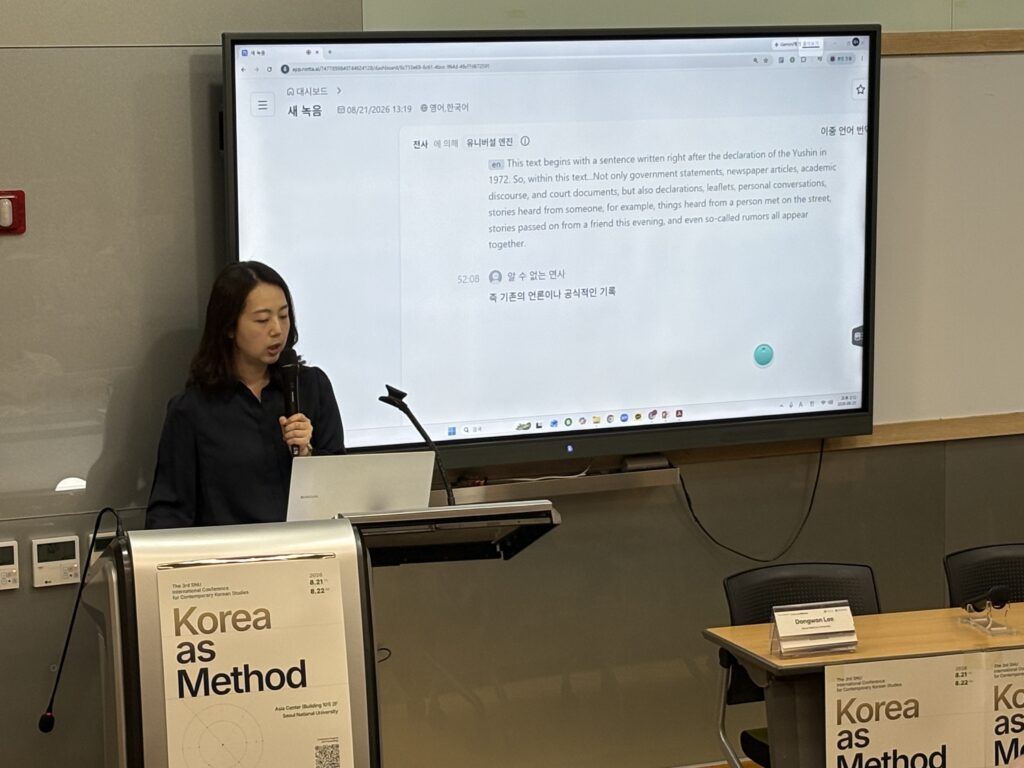
Next, Professor Eun-ae Cho (Yonsei University) drew attention to the existence of transnational information networks connecting Korea and Japan against the backdrop of South Korea’s democratization movement in the 1970s and 1980s. Her analysis focused on Communications to Korea, a publication written under the pseudonym “T·K生(Saeng).” She interpreted the publication as a kind of “archive of exile” produced from a diasporic position. Through this perspective, she reconsidered the historical significance of the publication within discourses on Korean democratization and reunification that emerged from Japan, while also analyzing how its author articulated the idea of the minjung.
Finally, Professor Hyuk-eun Kwon (Seoul National University) analyzed the “guerrilla-style” protests that characterized the early stages of the Bu-Ma Democratic Uprising, as well as the tactics employed by the police to suppress them. Using a Historical Geographic Information System (HGIS) methodology, he sought to reconstruct aspects of protest and suppression that cannot be fully captured through conventional documentary sources. Moving beyond records of protesters produced primarily from the perspective of the military and police, his research reconstructed the spatial patterns of police suppression and historically traced the interactions between protesters and law enforcement. The presentation demonstrated that protesters resisted the Yushin regime through the very act of demonstrating, repeatedly moving through the complex urban landscape without a clearly defined destination.
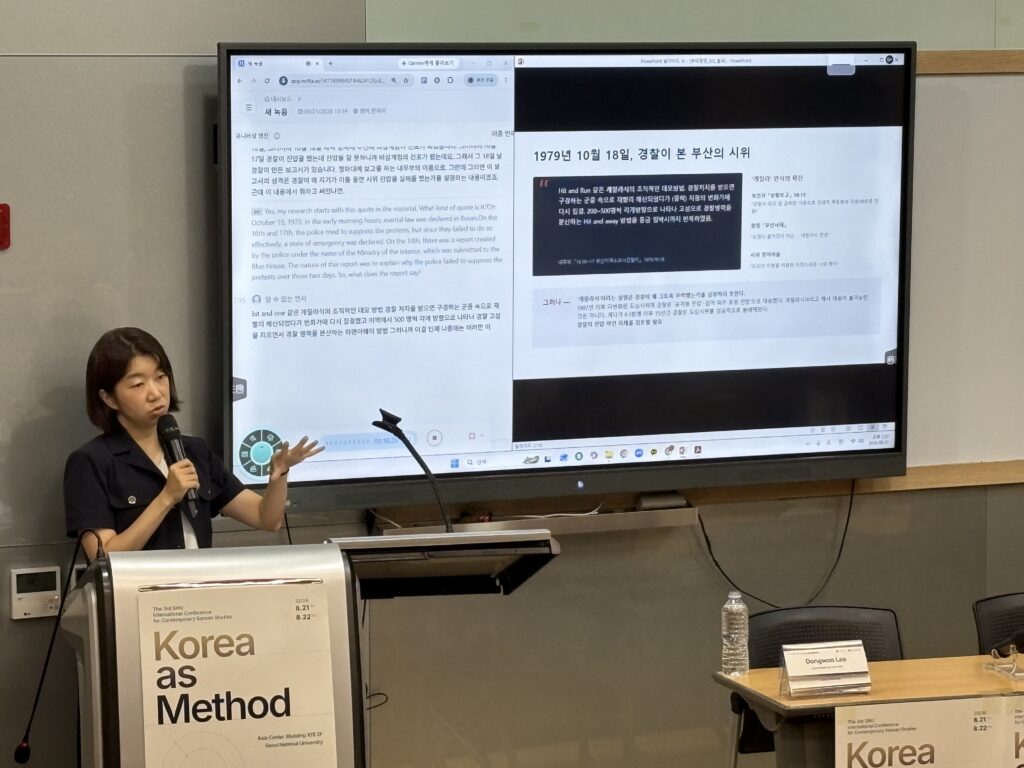
Taken together, the three presentations demonstrated that the formation and development of Korean democracy cannot be understood simply as the outcome of institutional change. The legal and governmental regulation of assembly and demonstration, the interactions between protesters and state power in urban space, and the transnational articulation of democratization and minjung discourse all reveal how democracy has been historically constituted through the continuous interplay of law and institutions, practices of resistance, and acts of memory and expression. By approaching democracy through these historical processes, the panel not only offered new perspectives on South Korea’s democratization but also provided an important framework for reconsidering the meanings of freedom of assembly and expression, the exercise of state power, and democracy itself in contemporary Korean society.