At 13:30 in Youngwon Hall, the session Political Polarization and the Perils of Korean Democracy examined Korean democracy from three connected perspectives: citizens’ well-being, party organization, and constitutional adjudication.
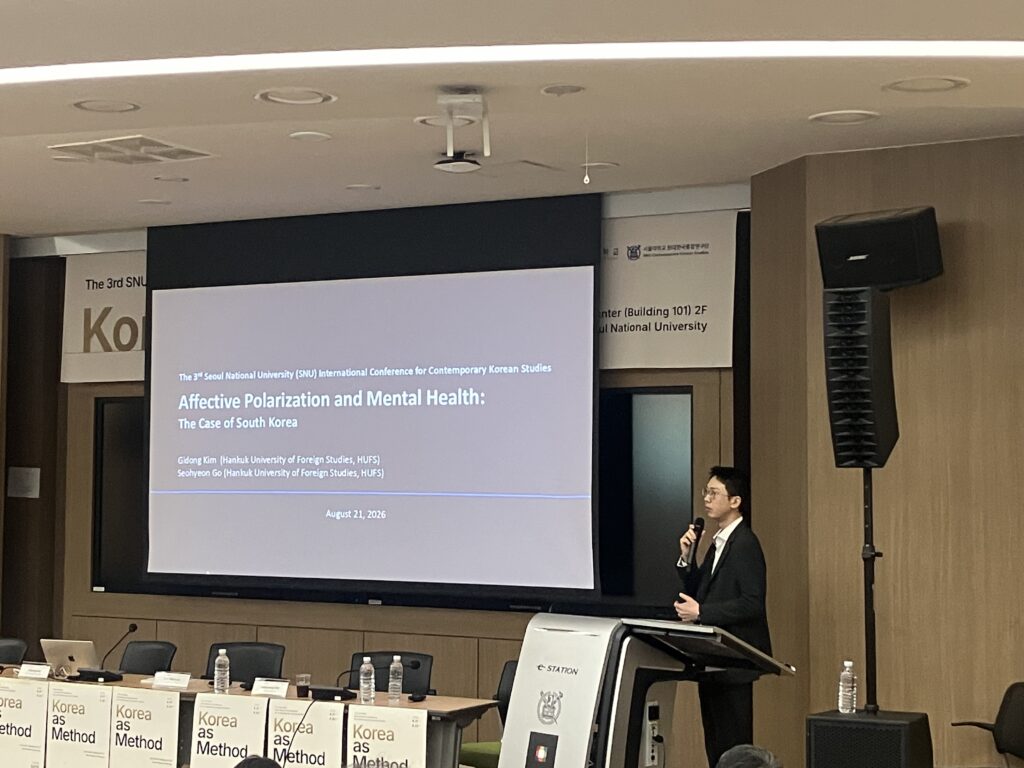
Gidong Kim(Hankuk University of Foreign Studies)’s presentation, “Affective Polarization and Mental Health,” investigated whether partisan hostility affects mental health in South Korea. Using a 2025 national survey, he found no overall direct association, but partisan identity sharply conditioned the relationship: affective polarization was associated with poorer mental health among weak identifiers and higher mental-health scores among strong identifiers. The presentation was especially thought-provoking in showing how polarization may deepen inequalities in political participation and well-being.
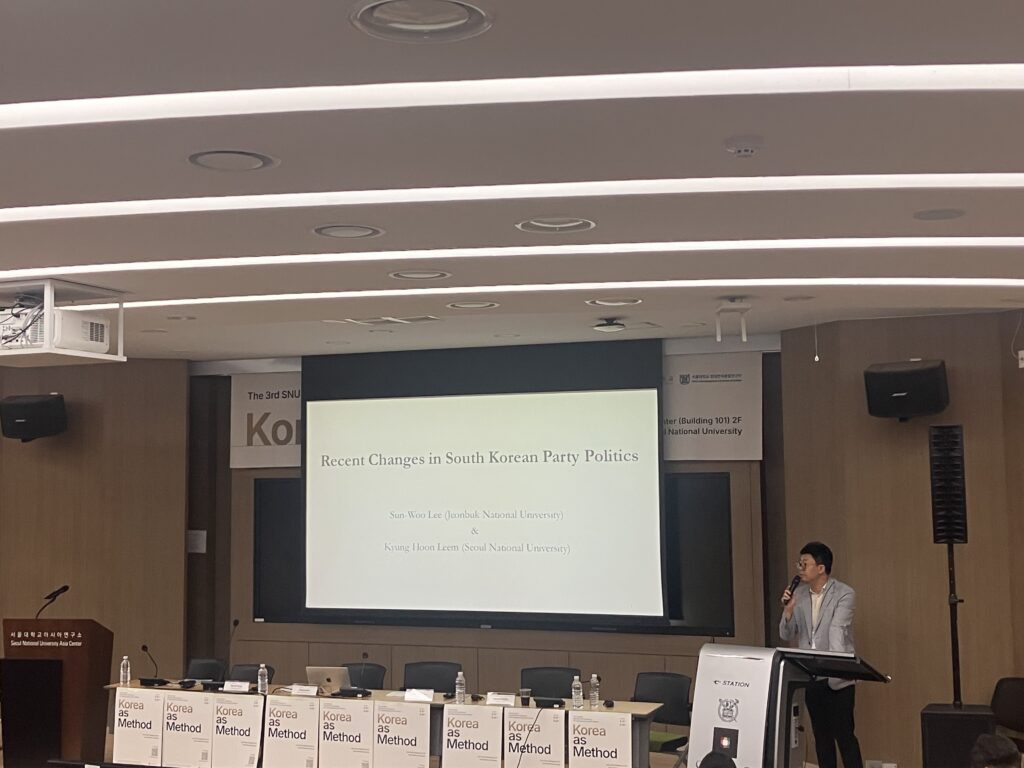
Sun-Woo Lee(Jeonbuk National University)’s presentation, “Recent Changes in South Korean Party Politics,” explained escalating polarization as a form of endogenous institutional decay. He argued that strong presidentialism, a cartelized two-party system, and weakly institutionalized yet intensely partisan parties have reinforced one another, while reforms intended to broaden participation have strengthened centralized leadership and digital fandom politics. His analysis offered a persuasive account of why democratic reforms can generate unintended consequences for intra-party democracy and moderation.
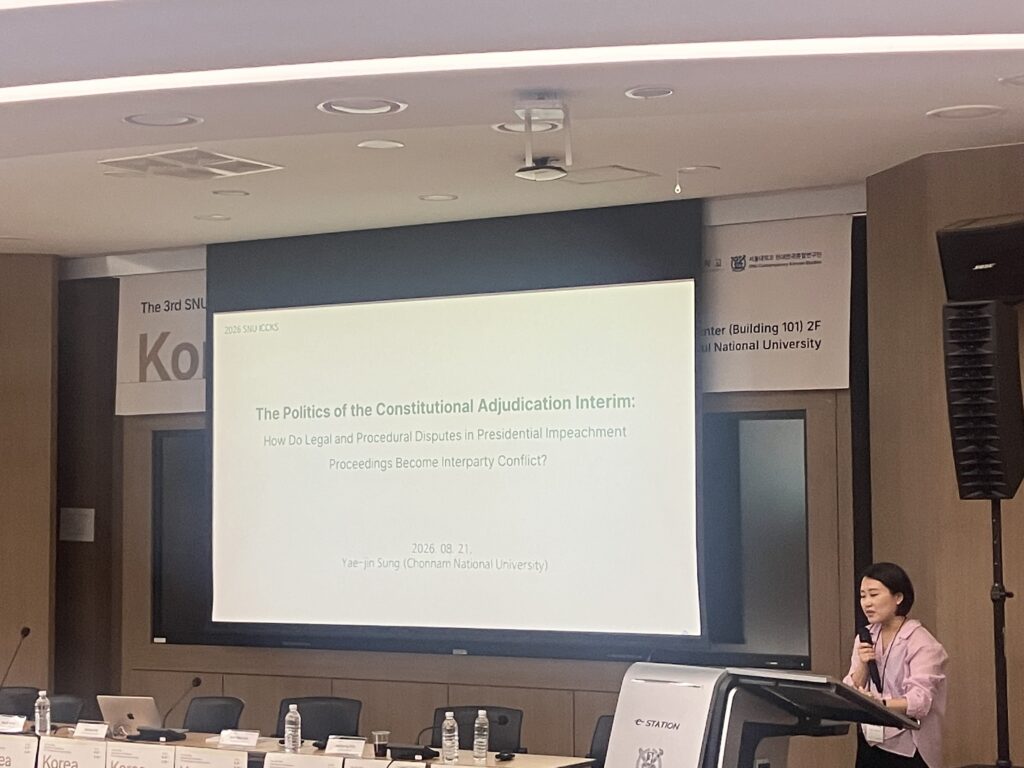
Yae-jin Sung(Chonnam National University)’s presentation, “The Politics of the Constitutional Adjudication Interim,” examined how legal and procedural disputes during presidential impeachment proceedings become interparty conflicts. Comparing the Roh Moo-hyun, Park Geun-hye, and Yoon Suk-yeol cases, she showed that parties selectively adopt and recast legal claims, shifting conflict toward procedure, timing, and the legitimacy of the Constitutional Court. The presentation provided a valuable temporal perspective on how judicial processes can reconfigure, rather than simply resolve, political conflict.
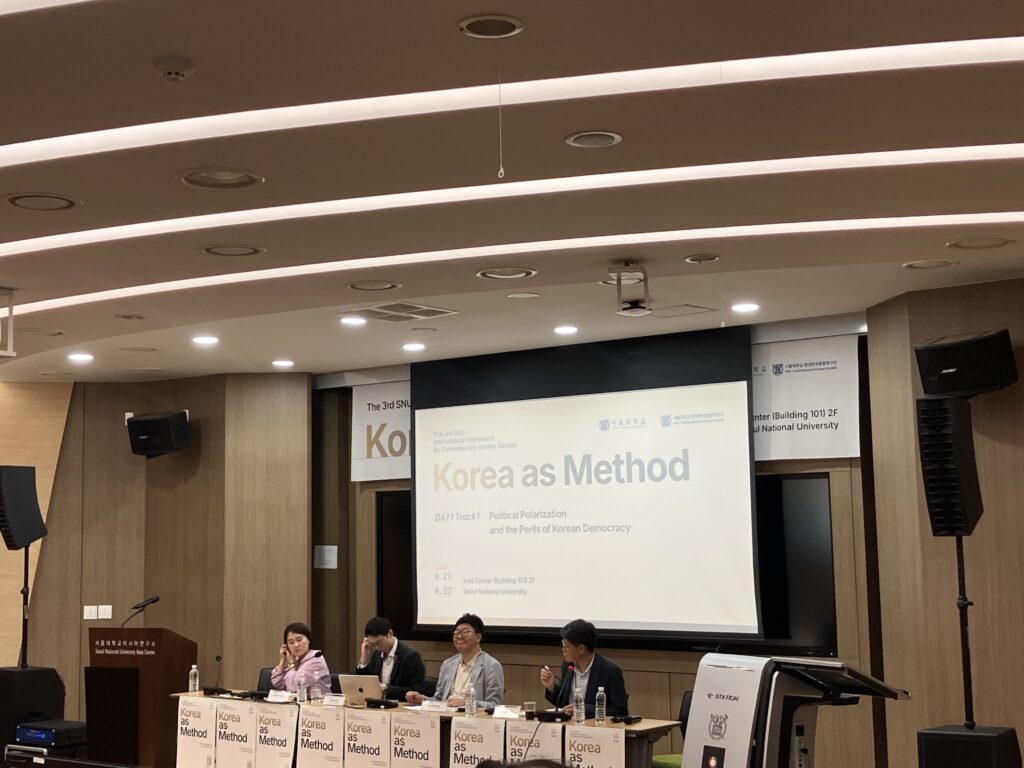
Taken together, the three presentations demonstrated that political polarization is not simply a matter of growing ideological distance among voters or intensified competition between parties. Rather, it operates across multiple levels of Korean democracy, affecting individual well-being and political participation, the internal organization of political parties, and the institutional processes through which constitutional conflicts are addressed. The findings that affective polarization may have different consequences depending on the strength of partisan identity, that reforms designed to expand participation can unintentionally reinforce centralized party leadership and fandom politics, and that even constitutional adjudication can become reconfigured through partisan conflict collectively highlight the complex challenges facing Korean democracy today. By connecting citizens, parties, and judicial institutions, the session underscored the need to understand polarization not merely as an electoral or attitudinal phenomenon, but as a structural issue shaping the broader operation of democratic politics.