1. Overview
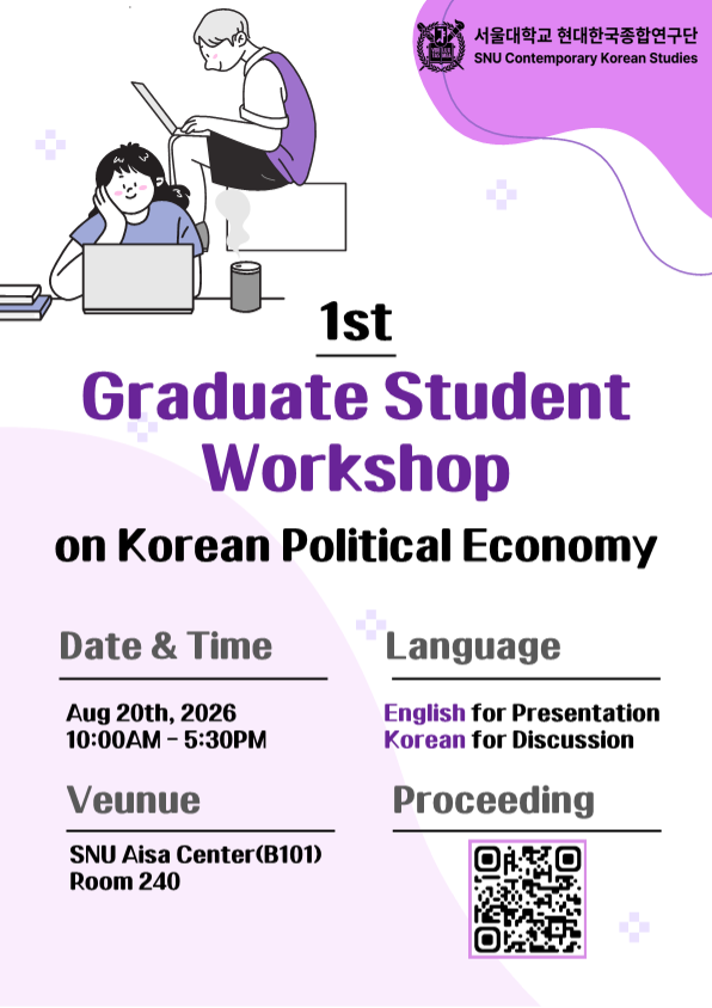
On 20 August 2026, the Political Economy Team of Contemporary Korean Study held the 1st Graduate Student Workshop on Korean Political Economy at the SNU Asia Center. The workshop brought together early-career researchers working on Korean political economy, based both in Korea and abroad, to present work in progress and receive intensive feedback from established scholars in the field.
The workshop was intended to be more than a conventional presentation session. Its explicit aim was to consider together how each paper might be developed into a publishable article, and to share advice on building a career as a researcher. Each session was therefore organized so that presenters delivered ten-minute presentations consecutively, after which senior scholars in attendance offered comments and questions on each paper, opening into a broader discussion. Keeping presentations short and allocating generous time to discussion was a deliberate choice, placing the weight of the event on feedback and exchange rather than on presentation itself.
Serving as discussants across the sessions were Hyunji Kwon (Seoul National University), Kyungmi Kim (Sapienza University of Rome), Jiyeoun Song (Seoul National University), Nahee Kang (King’s College London), Christopher Khatouki (UNSW), Timo Fleckenstein (LSE), Kahee Cho (University of Sheffield), Sungjin Kim (Korea Environment Institute), Jongseok Yoon (University of Seoul), and Hyeong-ki Kwon (Seoul National University), among others. Most participants stayed for the full day, producing a dense level of interaction in which discussions carried across session boundaries.
2. Sessions and Presentations
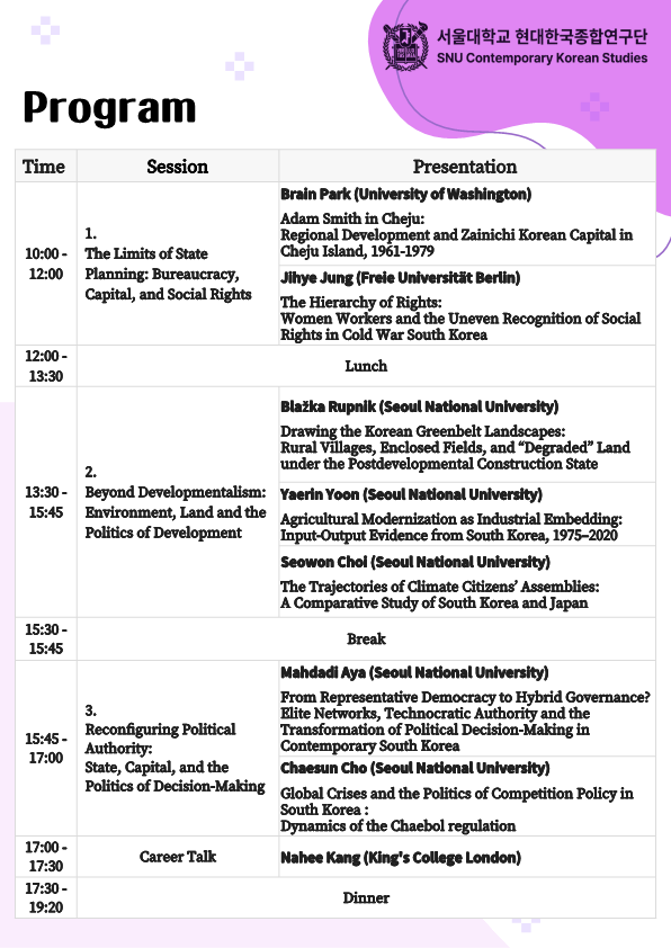
■ Session 1. The Limits of State Planning: Bureaucracy, Capital, and Social Rights (10:00–12:00)
The first session examined how the planning capacity of the developmental state was refracted and constrained in the provinces and on the shop floor.
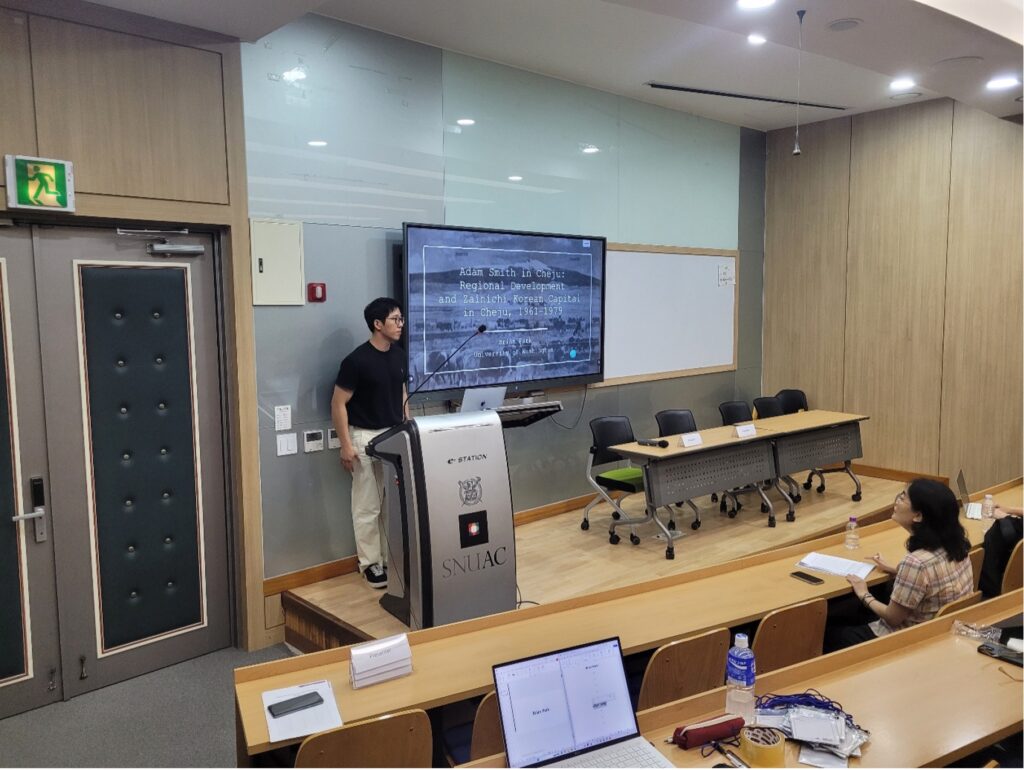
In “Adam Smith in Cheju: Regional Development and Zainichi Korean Capital in Cheju Island, 1961–1979,” Brian Park (University of Washington) noted that scholarship on the Park Chung Hee era has concentrated on Seoul and the central government, and turned instead to the regional dimension of rapid industrialization through the case of Cheju Island. Tracing how the inflow of Zainichi Korean capital converged with and clashed against the state’s vision for regional development, he showed historically how plans formulated at the center were reconstituted at the periphery.
In “The Hierarchy of Rights: Women Workers and the Uneven Recognition of Social Rights in Cold War South Korea,” Jihye Jung (Freie Universität Berlin) compared the Dong-il Textile struggle (1972–1980) with the Hurea/Adler case (1986–87). Although both attracted comparable transnational visibility and solidarity, the former was understood through a framework of anti-authoritarian democratization and political rights, while the latter came to be read in terms of social rights and corporate accountability. She explained this divergence through a “hierarchy of rights” in Cold War international human-rights discourse, which privileged civil and political rights while marginalizing social-rights claims.
■ Session 2. Beyond Developmentalism: Environment, Land and the Politics of Development (13:30–15:30)
The second session addressed how Korean developmentalism persists and mutates in the domains of land, agriculture, and environmental governance.
In “Drawing the Korean Greenbelt Landscapes: Rural Villages, Enclosed Fields, and ‘Degraded’ Land under the Postdevelopmental Construction State,” Blažka Rupnik (Seoul National University) analyzed the Seoul Metropolitan Area greenbelt through three landscape types. Pointing to the contradiction by which authoritarian regulatory legacies, the democratizing reforms of the late 1990s, and supply-centered housing policy coexist within the same territory, she revealed a circular structure in which conditions of “degradation” produced by decades of restriction and neglect are subsequently mobilized to justify deregulation and large-scale development.
“Agricultural Modernization as Industrial Embedding: Input-Output Evidence from South Korea, 1975–2020,” presented by Yaerin Yoon (Seoul National University), harmonized benchmark input-output tables from 1975 to 2020 into sixteen sectors in order to trace the changing position of agriculture. Agriculture’s total backward linkage rose from 1.550 to 2.219, while its total forward linkage fell from 3.049 to 1.706. She interpreted this not as agricultural isolation but as a reversal in the direction of integration — a policy-mediated industrial embedding in which agriculture weakened as a domestic supplier while growing more dependent on industrial and service inputs.
In “The Trajectories of Climate Citizens’ Assemblies: A Comparative Study of South Korea and Japan,” Seowon Choi (Seoul National University) drew on policy diffusion theory to ask why climate citizens’ assemblies followed different paths of diffusion and institutionalization in the two countries. In Japan, non-governmental actors such as university researchers introduced the innovation first and it spread horizontally among local governments, but with weak legal institutionalization. In South Korea, by contrast, an innovation initiated by a local government diffused upward to the national level and then re-diffused downward — a vertical pathway accompanied by comparatively strong legal institutionalization.
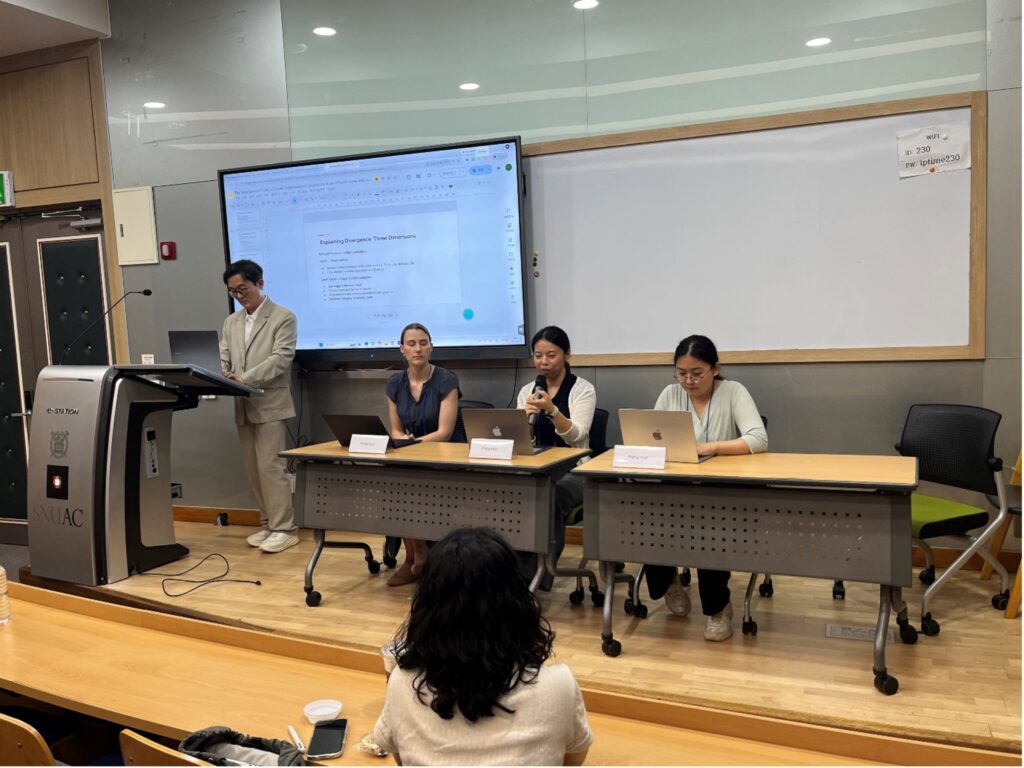
■ Session 3. Reconfiguring Political Authority: State, Capital, and the Politics of Decision-Making (15:45–17:00)
The third session asked where political authority resides under contemporary conditions in which the relationship between state and capital is being reorganized.
In “From Representative Democracy to Hybrid Governance? Elite Networks, Technocratic Authority and the Transformation of Political Decision-Making in Contemporary South Korea,” Mahdadi Aya (Seoul National University) examined how political authority is relocated when public administration comes to depend on privately held technological infrastructures and expertise. She argued that as the infrastructures, experts, and corporate actors of platform capitalism are integrated into the policy sphere, networks linking senior bureaucrats, technical experts, and corporate leaders take shape, and decisions come to be legitimized through discourses of technical expertise, efficiency, national competitiveness, and digital sovereignty — raising the possibility of an emergent “hybrid governance.”
In “Global Crises and the Politics of Competition Policy in South Korea: Dynamics of Chaebol Regulation,” Chaesun Cho (Seoul National University) compared three critical junctures: the 1997–98 Asian financial crisis, the 2008 global financial crisis, and the compound crisis of the COVID-19 pandemic and intensifying US–China rivalry after 2020. Treating crises as no more than permissive conditions for change, he proposed a dual-axis framework in which the direction of change is set by president-mediated state autonomy. The central conclusion is that agendas formed before a crisis yielded comprehensive reform, whereas responses induced by a crisis produced selective, sector-specific exceptions pursued through industrial-policy statutes.
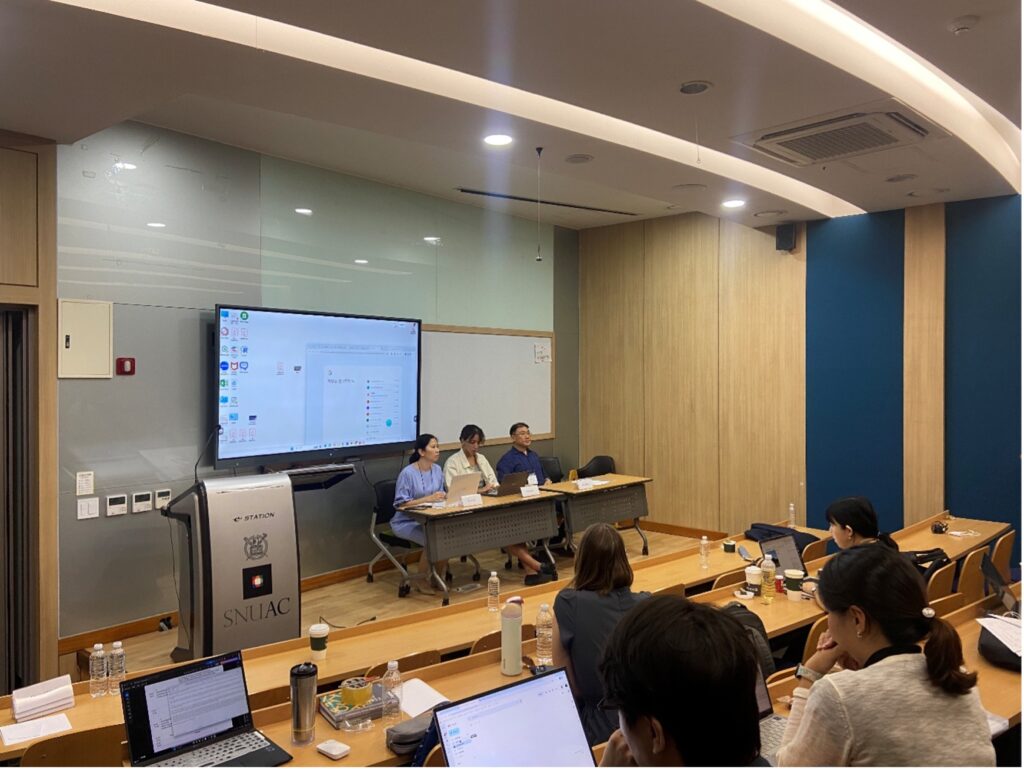
■ Career Talk (17:00–17:30)
The day concluded with a career talk by Professor Nahee Kang (King’s College London). She shared her experience of the questions early-career researchers confront in practice — building a career in academia abroad, strategies for journal publication, and planning a path beyond the doctorate — and the conversation continued over the dinner that followed.
3. Outcomes and Significance
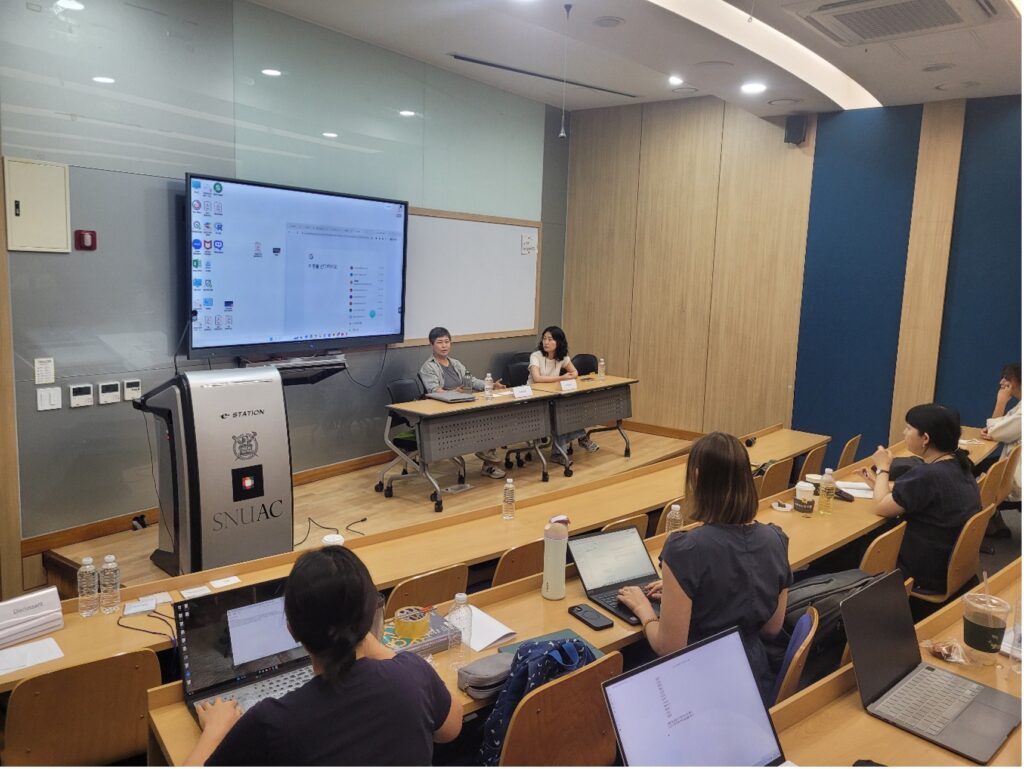
The workshop advanced each presenter’s project by offering concrete advice on refining theoretical frameworks, justifying case selection, strengthening evidence, and identifying prospects for publication. By bringing together research conducted across sociology, political science, public administration, and geography, it also generated substantive discussion among scholars working in different regions, disciplines, and research traditions. More broadly, by creating an occasion for researchers affiliated with institutions in the United States, Germany, the United Kingdom, Australia, and elsewhere to meet and speak with one another directly, the workshop made a meaningful contribution to network formation among researchers in the field.