
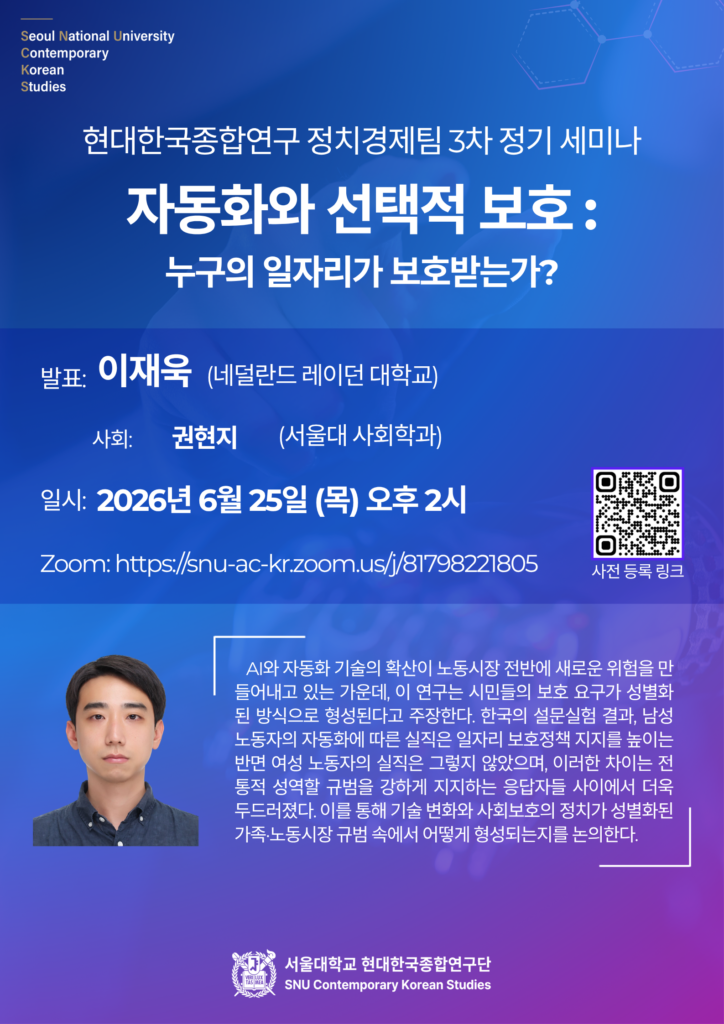
On June 25, 2026, the Political Economy Team of the SNU Contemporary Korean Studies hosted a colloquium featuring Dr. Jaewook Lee of Leiden University. The talk, titled “Automation and Selective Protection: Whose Jobs Are Protected?”, examined how the spread of artificial intelligence and automation technologies is generating new risks across labor markets, and how demands for protection in response to these risks are shaped in gendered ways.
The paper, co-authored with Professor Soohyun Cho, draws on a survey experiment conducted with 1,697 respondents in South Korea, a country characterized by both high automation exposure and a large gender wage gap. Participants were shown scenarios in which a worker is displaced by automation, with the displaced worker’s gender randomly assigned. The results show that the displacement of male workers significantly increases support for job protection policies, while the displacement of female workers produces no comparable effect. This gap was especially large among respondents who strongly endorsed traditional gender role norms reflecting a broader pattern in which male job loss is perceived not merely as individual misfortune but as a threat to household livelihoods and social stability. The study demonstrates that the perceived need for protection varies depending on who is displaced, and that this variation is mediated by male breadwinner norms. The findings also suggest that demand for protection tends to concentrate on ex-ante rather than ex-post matters. The authors argue that these dynamics raise important concerns about the extent to which policy frameworks may systematically underprotect female workers.
The presentation was followed by lively discussion. One particularly notable exchange centered on the question of how the study’s findings speak to the specificity of automation-induced displacement — that is, whether the gendered pattern of protection demand is distinctive to automation or reflects more long-standing inequalities. Dr. Lee responded that while the gender bias in protection demand predates the current moment of automation, what makes the findings significant is that the gap persists even as automation increasingly affects a broad range of occupations beyond traditionally male-dominated industries.
The colloquium was held online and drew approximately 40 participants. It offered a productive space for researchers to engage with questions about the pathways through which technological change reproduces inequality, and to discuss the policy implications that follow.