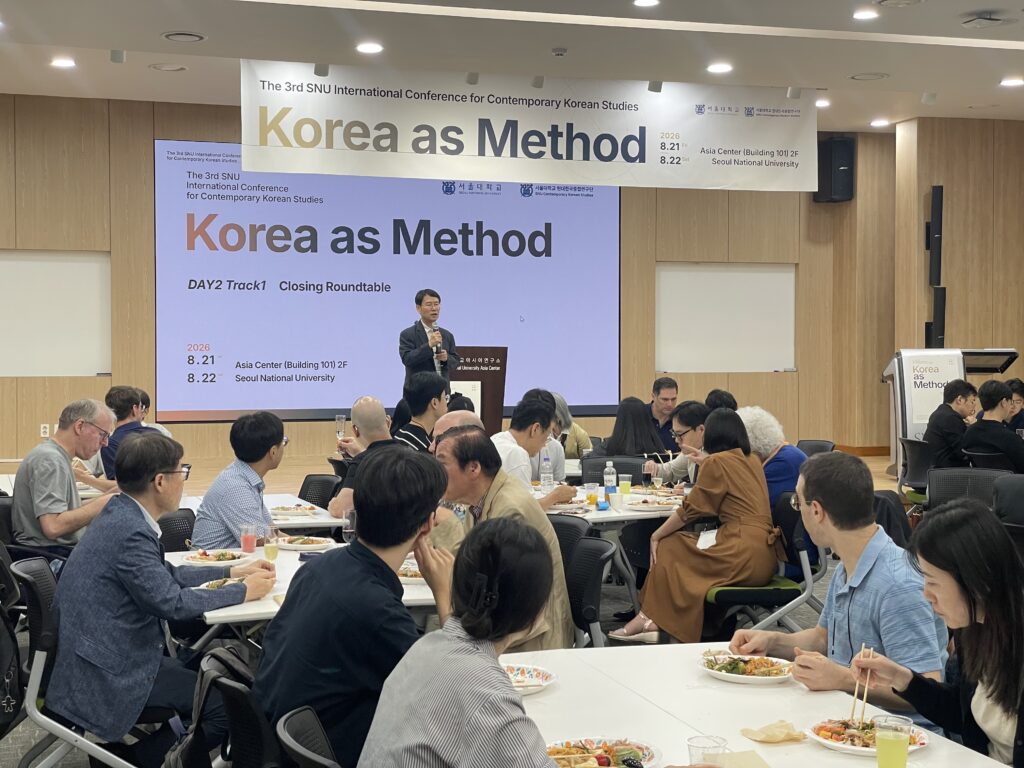
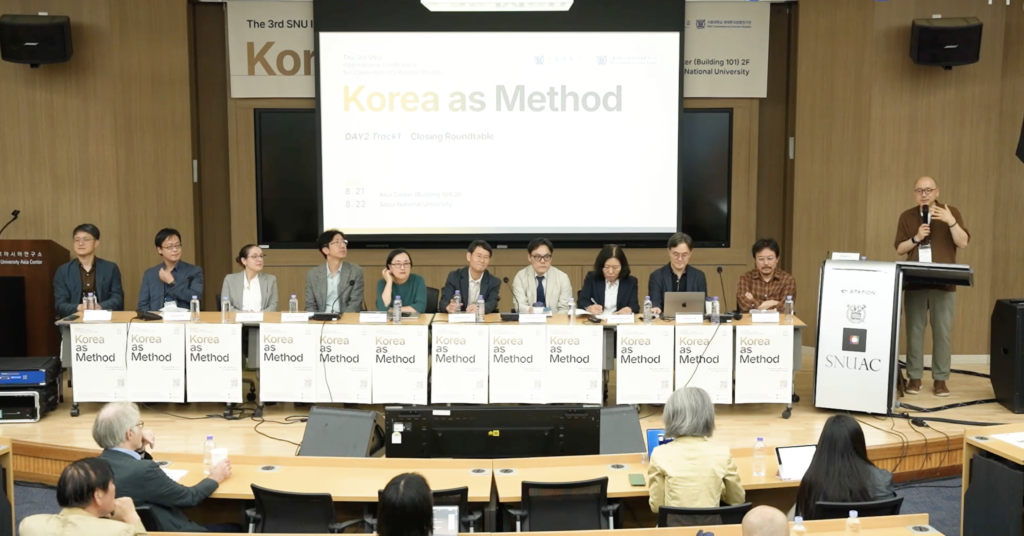
The 3rd International Conference of the Seoul National University Contemporary Korea Research Group concluded with a roundtable reflecting on the conference theme, “Korea as Method.” Moderated by Professor Dongshin Yi (Seoul National University), the roundtable provided an opportunity to look back on two days of presentations and discussions and to consider what “Korea as Method” might mean for the work of the Research Group’s various teams. Following an introductory reflection by Professor Hong-Jung Kim (Seoul National University), representatives of the research teams shared their recent work and future directions.
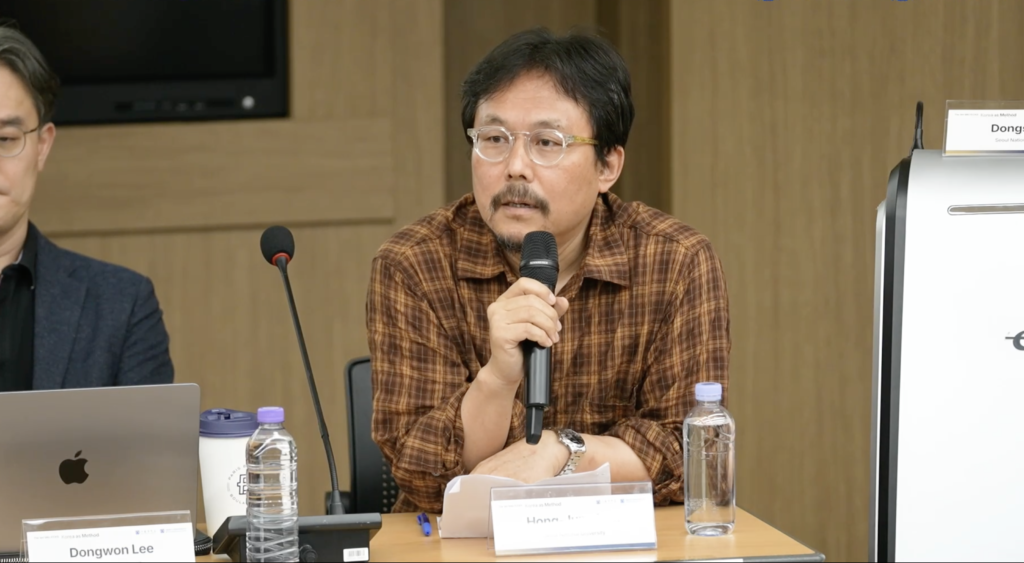
Professor Hong-Jung Kim began by explaining the intellectual trajectory connecting the previous conference theme, “Korea as Symptom,” to this year’s “Korea as Method.” “Korea as Symptom,” he argued, proposed that Korea should not be approached simply as a fixed object or a collection of facts to be explained through already established theories. Rather, Korea should be understood as a “symptom”: a changing and dynamic site from which unfamiliar phenomena, events, texts, people, and discourses continually emerge and pose new questions to researchers. The task was therefore to temporarily bracket familiar theories and grand narratives and begin again from the strange and intriguing phenomena encountered in Korean society.
This perspective, Kim explained, leads naturally to “Korea as Method.” If Korea is not merely an object to which existing theories and methodologies are applied, but a living and changing reality that challenges researchers’ assumptions, then the methods and theories used to study it must themselves become open to transformation. “Korea as Method,” in this sense, does not refer to a single methodological technique. Rather, it is an invitation to pause and reconsider the scholarly conventions and theoretical premises that have come to be taken for granted within different disciplines. Instead of simply applying theories developed from particular Western historical experiences to Korea, Kim emphasized the possibility of using Korean materials and experiences to question, revise, and even criticize those theories themselves.
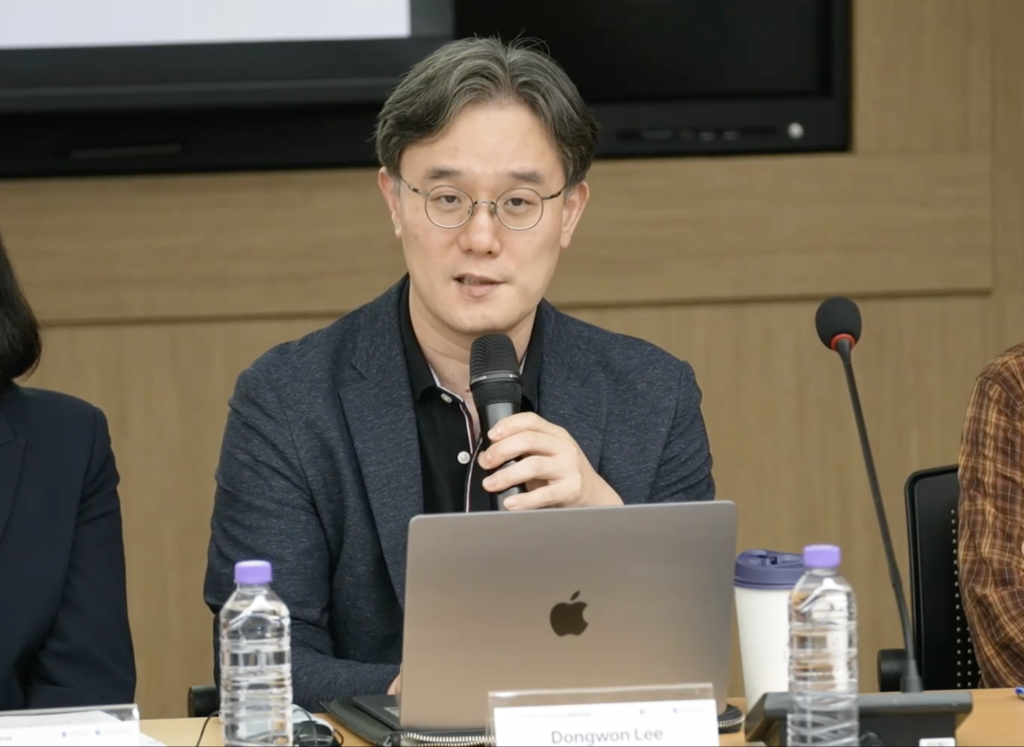
The research teams then discussed how this broader intellectual orientation has been translated into their own areas of inquiry. Professor Dongwon Lee introduced the Modernity and Development Team, an interdisciplinary group bringing together historians and economists to explore aspects of Korean modernity that cannot be fully captured by established discussions of “colonial modernity.” He drew particular attention to Korea’s seemingly contradictory historical location: a society shaped by colonial rule, division, war, Cold War anti-communism, and close alignment with the United States, while at the same time retaining postcolonial and Third World orientations. The coexistence of a “First World” position with “Third World” characteristics—and of Third World experiences with a persistent orientation toward the First World—may, he suggested, offer an important point of departure for rethinking Korean modernity.
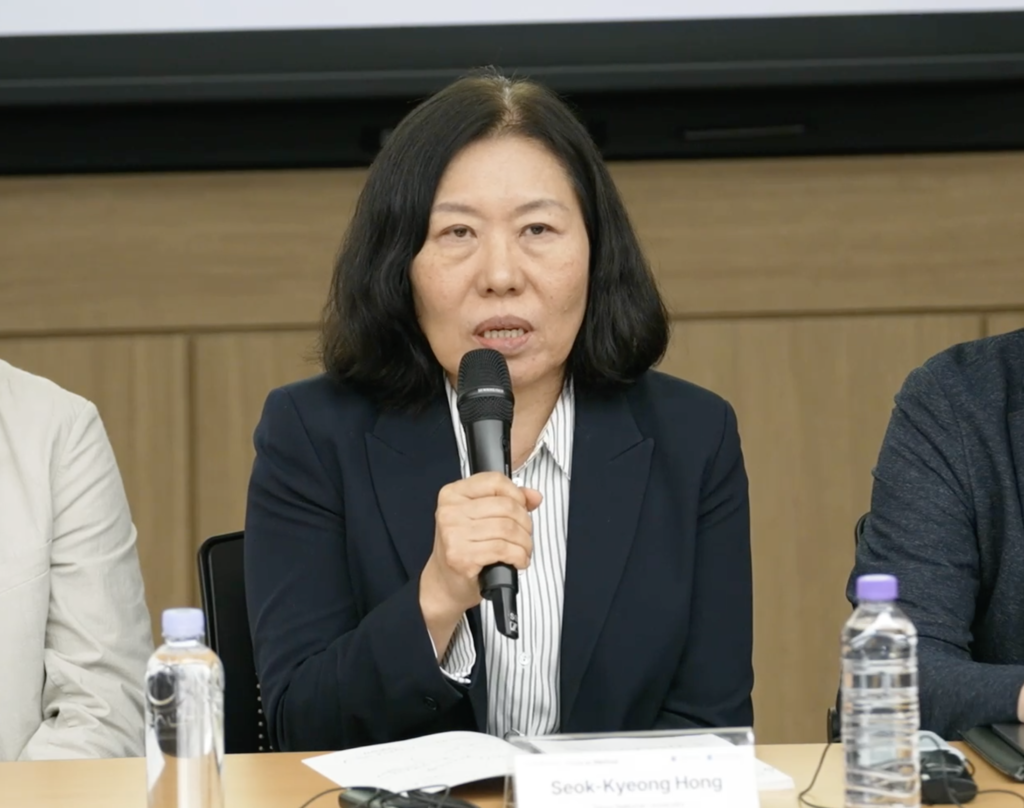
Professor Suk-Kyung Hong, representing the Global Hallyu Team, noted that Hallyu Studies has from the outset developed alongside the question of how a rapidly changing and often surprising cultural phenomenon can itself be made into an object of scholarly inquiry. While much existing Hallyu scholarship has accumulated studies of reception in different countries and regions, she argued that the field has reached a point at which it must ask what new theoretical insights can be generated from those diverse cases. She connected this task to the possibility of “Hallyu as Method,” describing the “K” of Hallyu as a kind of “floating signifier” around which new forms of cultural practice and identification emerge. Korea’s compressed growth, democratization, and struggles for freedom of expression, she suggested, have also shaped the hybridity, creativity, and narrative distinctiveness of contemporary Korean popular culture.
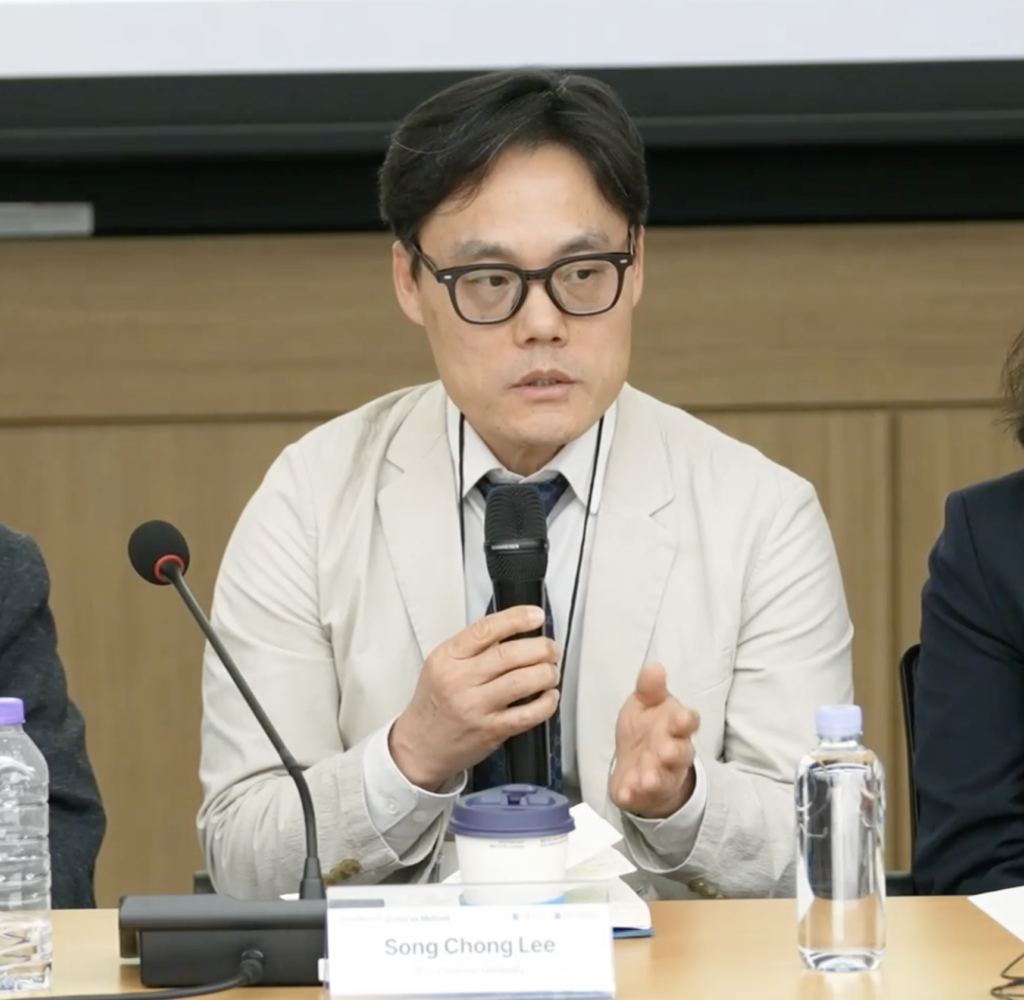
Professor Sung-Chung Lee introduced the Values and Identity Team as a group concerned with questions such as “Who is Korean culture?” and “What defines us today?” Bringing together researchers from religious studies, anthropology, sociology, media studies, women’s studies, and other fields, the team examines how values and identities are constructed across and beyond established boundaries. This year, its work focused particularly on religion and politics, while treating “religion” in an expansive sense that includes not only institutional religions but also fandom and popular culture. The team plans to explore the relationship between popular culture and religion more extensively in its future research.
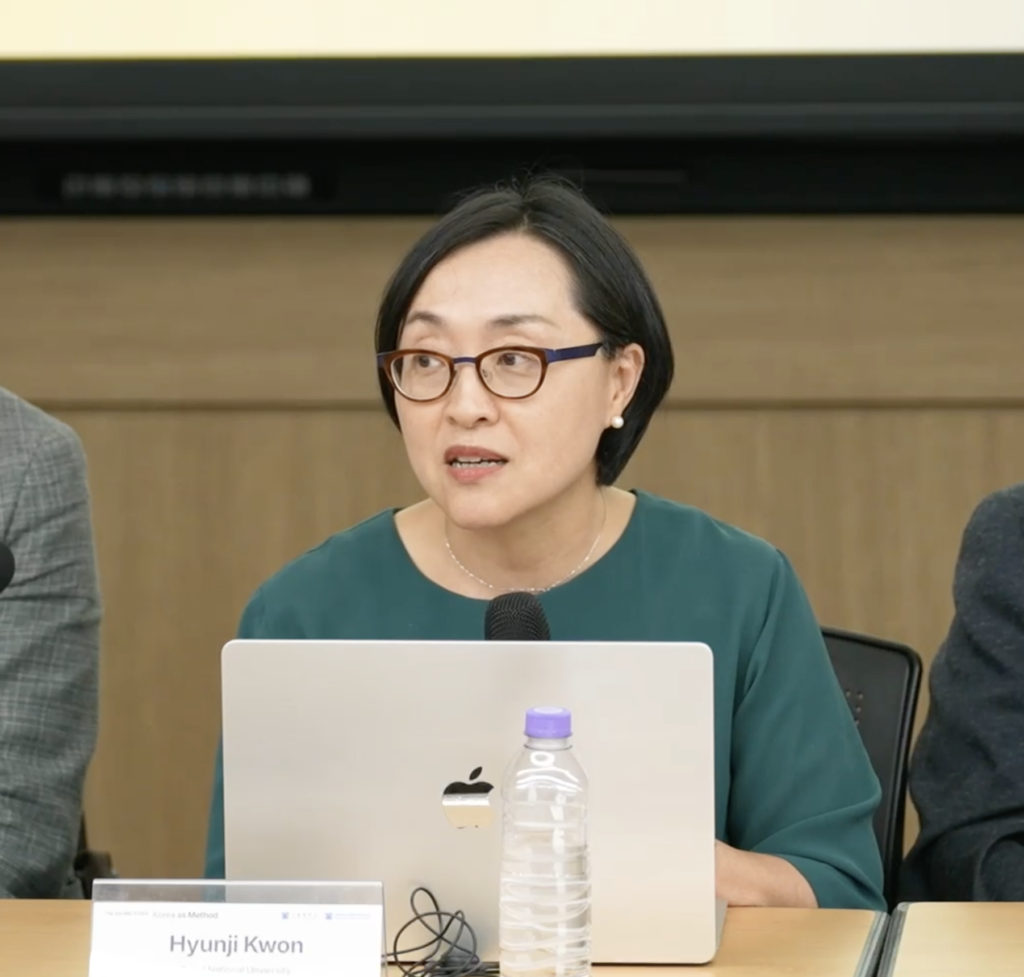
Professor Hyunji Kwon of the Political Economy Team turned to the difficulty of locating Korean capitalism within established comparative theories of capitalism. Korea is often described as a “hybrid” because it fits neither the liberal market economy nor the coordinated market economy model particularly well. Yet, she suggested, the term “hybrid” may reveal less about Korea itself than about the limits of the theories attempting to classify it. From this perspective, “Korea as Method” does not mean restating Korean exceptionalism in more sophisticated terms or promoting Korea as a model to be copied elsewhere. Instead, Korea’s experiences of compressed development, social transformation, and democratization can expose the hidden assumptions of supposedly universal theories and allow scholars to question the meaning of the “universal” itself. The team plans to bring labour, social dynamics, and democracy more fully into its study of Korea’s developmental model, with particular attention to the challenges posed by AI and digital transformation to labour markets and social institutions.
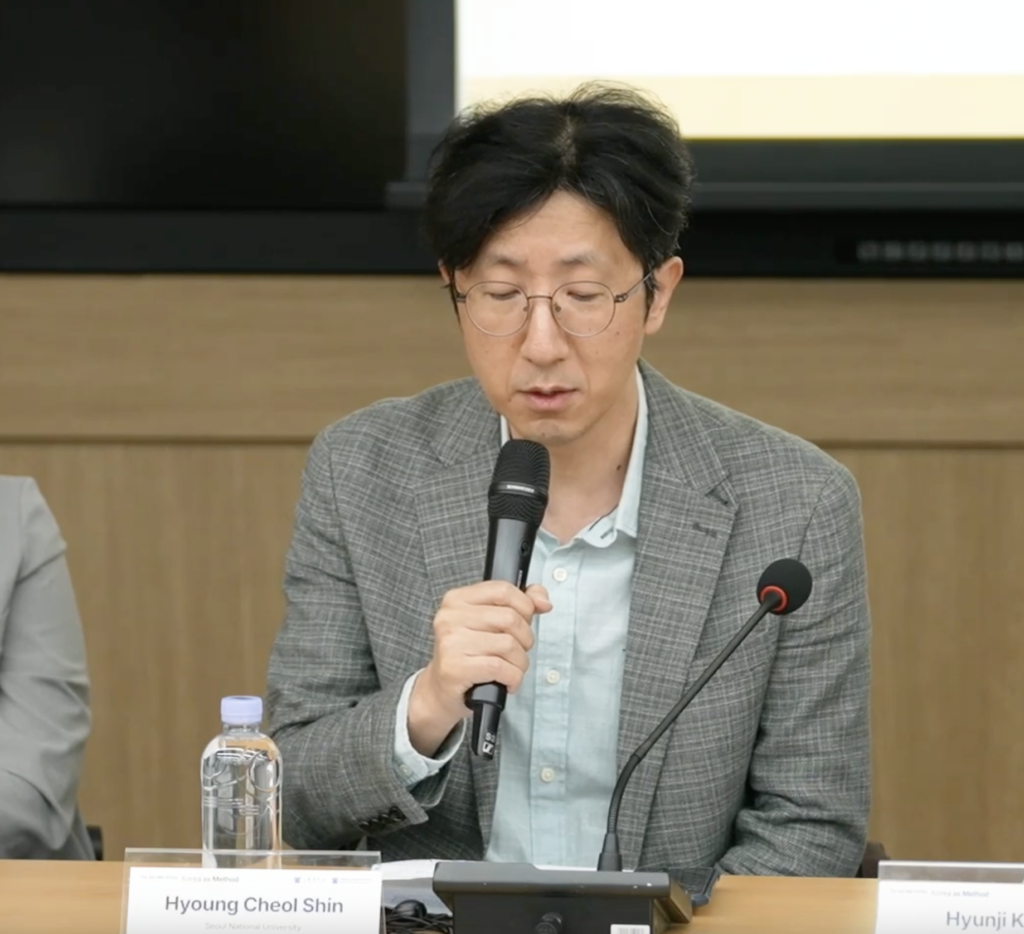
The K-Narrative Team, headed by professor Hyoung Cheol Shin, began from an even more fundamental question: whether such a thing as a distinct “K-narrative” actually exists. One dimension of its research examines recurring “K-masterplots” in Korean genres such as disaster narratives, horror, and romance. At the same time, the team employs a broader social-scientific understanding of narrative as a form of meaning-making that arranges actors and events in temporal sequence and assigns meanings of harm, responsibility, and resolution. Narratives, from this perspective, generate both causal explanations and normative orientations. The team is currently examining Korean masculinity and, in particular, the narratives that shape the identities and values of young Korean men, including the ways in which anti-feminist discourse intersects with meritocracy and ideas of fairness. Its broader questions are: What narratives do we inhabit? How do they shape us? And is it possible to move beyond them?
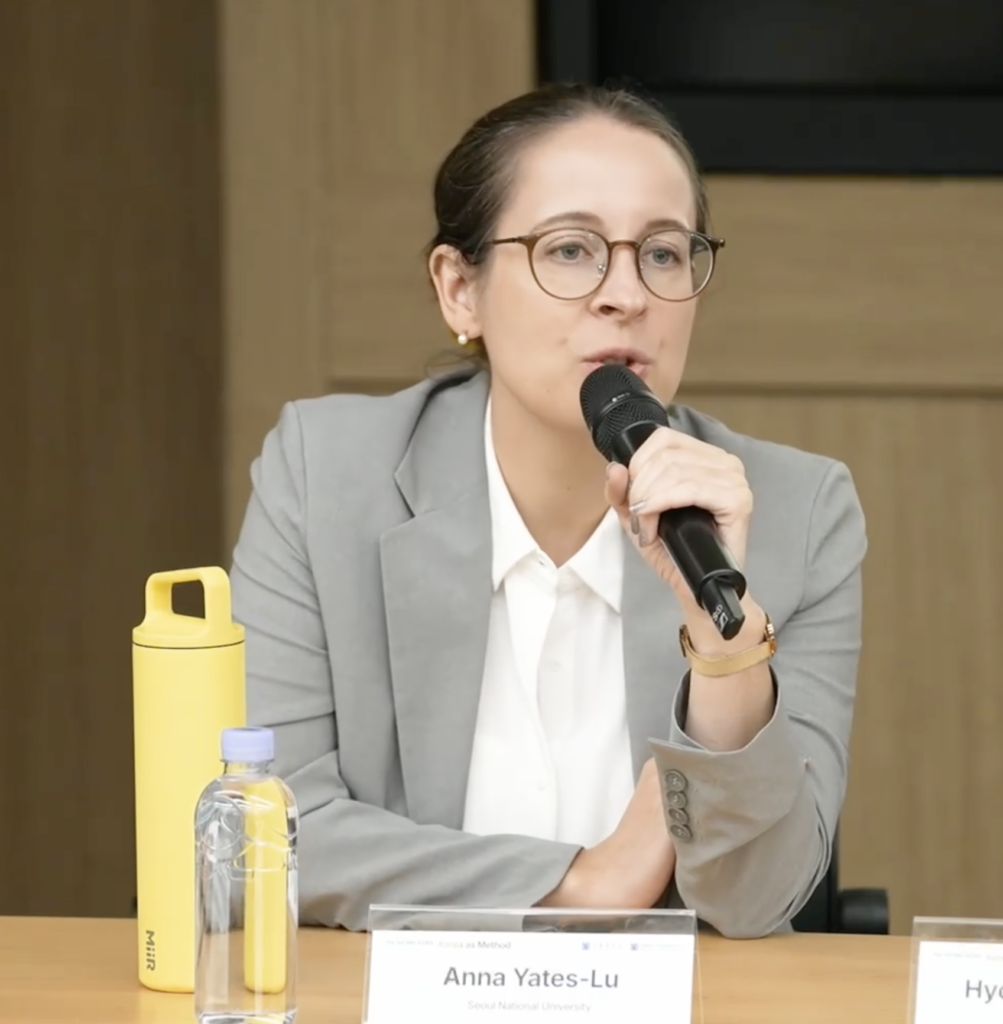
The Music Team, headed by professor Anna Yates-Lu, likewise seeks to reconsider the boundaries of the category “Korean Music.” Rather than maintaining the conventional divisions between gugak, K-pop, classical music, trot, and other genres, the team brings these fields into conversation while also extending its scope to diasporic music. From the perspective of “Korea as Method,” this approach makes it possible to ask what existing music theory—much of it developed around European male composers—has rendered invisible. Why, for example, are the forms of musical creation practiced by gisaeng or shamans not ordinarily described as “composition”? By beginning with the concrete histories and practices of Korean music, the team seeks to expose the blind spots built into established musicological concepts and to generate alternative ways of thinking about musical creation and tradition.
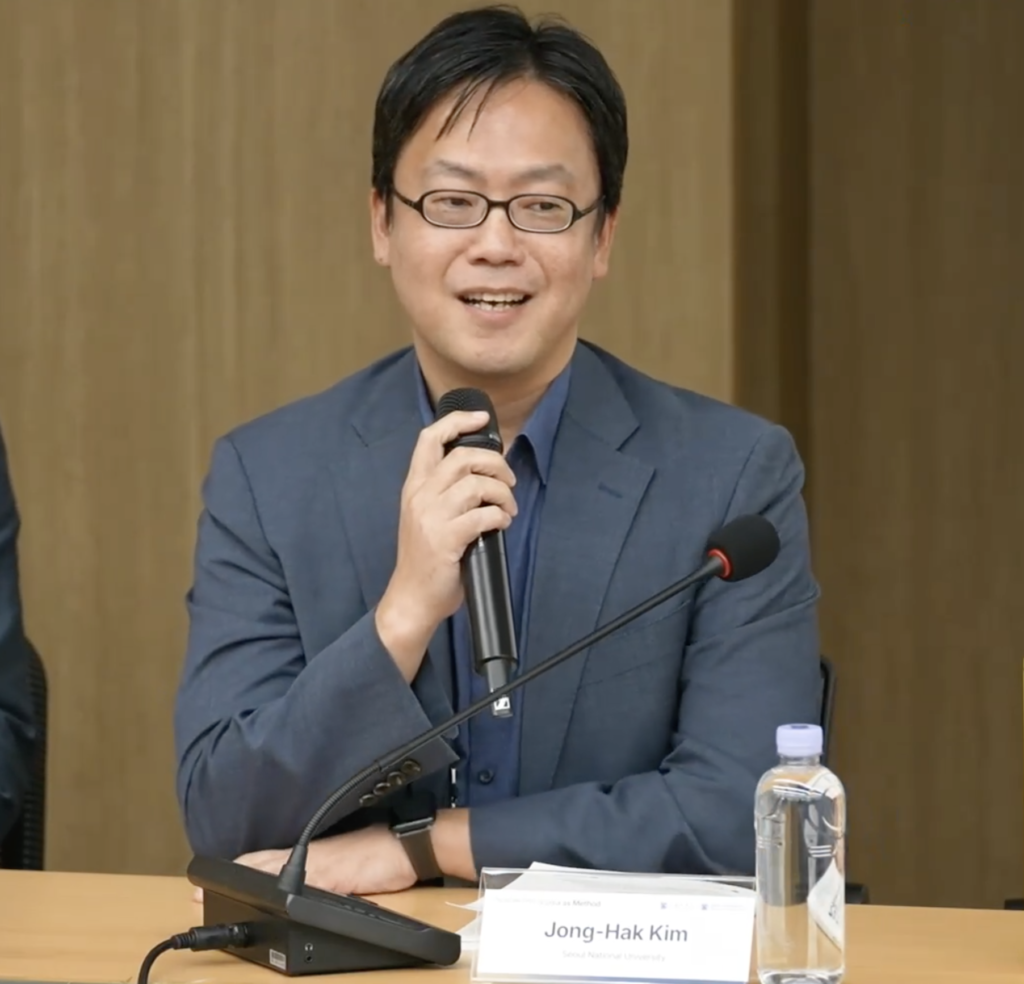
Professor Jonghak Kim introduced the Korean Nationhood Team through a deceptively simple question: “What kind of country is Korea, and what is Korea?” Rather than applying a single pre-existing theory of the state or nation to Korea, the team invites scholars working on different periods and from different perspectives to propose concepts capable of illuminating particular dimensions of Korea. These partial perspectives can then be assembled like a collage in order to reconsider Korea as a larger whole. Kim also introduced the team’s effort at this conference to revisit East Asian international relations from the perspective of “small states,” bringing Japanese historians into the discussion and moving beyond narratives centered primarily on great powers. He emphasized the importance of expanding scholarly exchange not only within Anglophone academia but also with researchers in Japan, China, and other intellectual contexts.
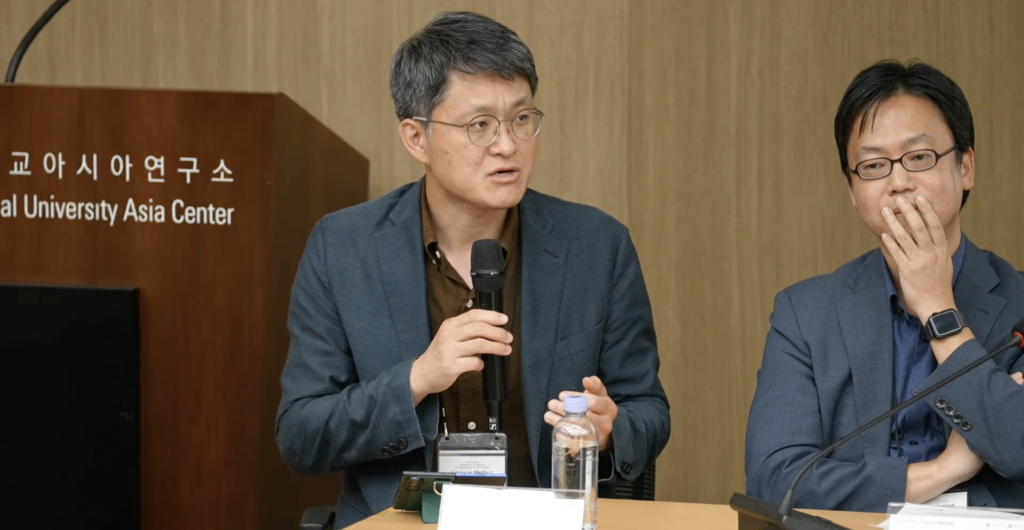
Finally, the Democracy Team, headed by professor Joohyung Kim, reflected that Korean democracy may still be less a completed “method” than an unresolved question. Korea’s compressed trajectory has combined state-building, economic development, authoritarianism, democratization, and more recent episodes of political crisis and institutional recovery. The team therefore questioned whether established frameworks such as Western theories of democratic transition can adequately explain the Korean experience. It also called for moving beyond political science approaches centered primarily on institutions, elites, and voter behavior toward a more multilayered understanding that incorporates history, culture, values, and social habits. In this context, the concept of politeia was invoked as a way of thinking not only about formal political institutions but also about the principles, dispositions, and ways of life through which political order is constituted. The question “What is Korea’s politeia?” was thus presented as a fundamental point of departure for understanding Korean democracy.
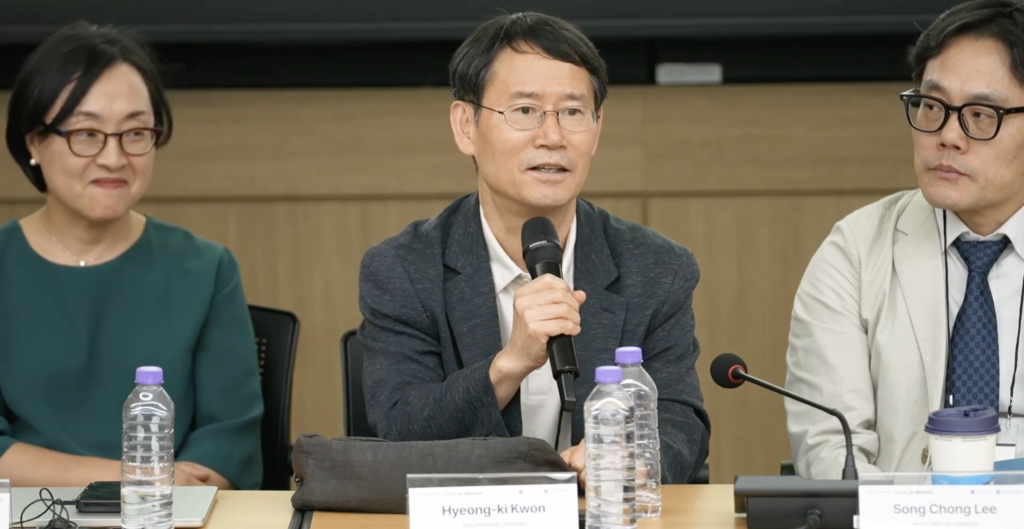
Although the teams represented very different disciplines, objects of study, and methodological traditions, the roundtable revealed a shared concern: a refusal to reduce Korea to a case that merely confirms theories already regarded as universal. Closer attention to Korean modernity and capitalism, Hallyu and music, values and identity, narratives, nationhood, and democracy repeatedly brings into view phenomena that established concepts cannot fully explain. It is precisely at these points of friction that theory itself can be questioned and revised. “Korea as Method,” in this sense, emerged not as a slogan asserting Korean particularity, but as a collective scholarly project for reexamining the concepts, methods, and assumptions through which the “universal” itself has been constructed.