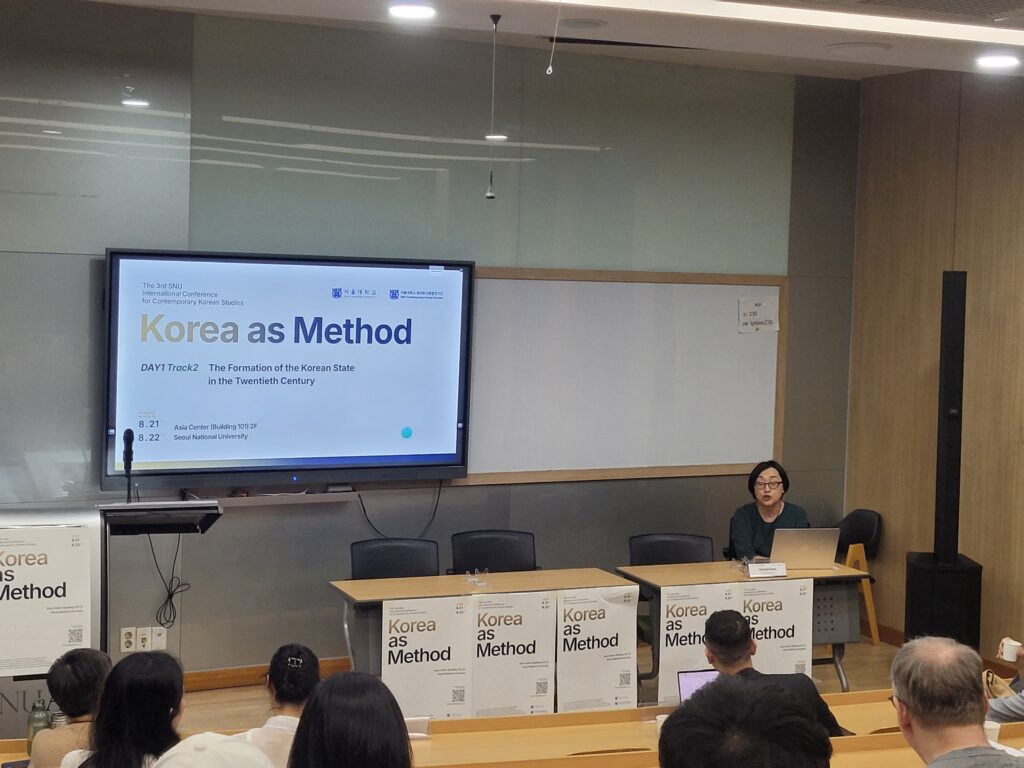
On the second day of the 3rd International Conference, held by the SNU Center for Contemporary Korean Studies on August 21 and 22 under the theme “Korea as Method,” the session “Korean Political Economy” took place in Room 230 of the SNU Asia Center. Chaired by Hyunji Kwon (Seoul National University), the session featured presentations by Timo Fleckenstein (The London School of Economics and Political Science), Nahee Kang (King’s College London), and Christopher Khatouki (University of New South Wales). Addressing social reform, the transition from middle- to high-income status, and green industrial transformation, the speakers examined the institutional and political limits that have emerged as South Korea confronts a new generation of socioeconomic challenges.
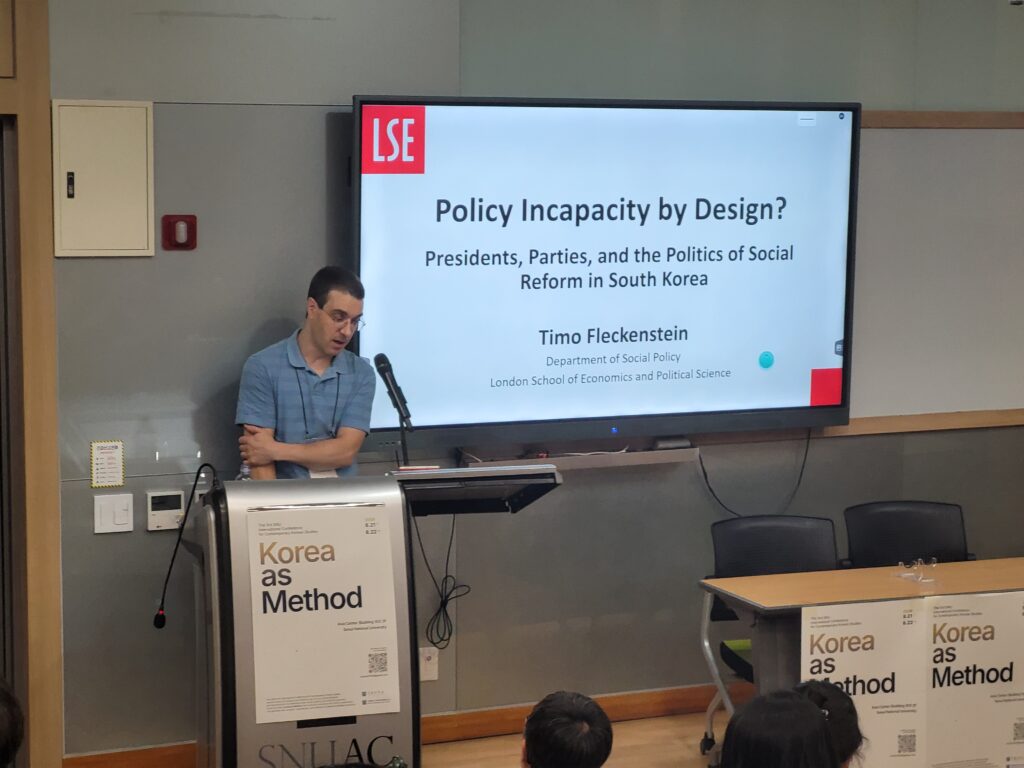
Timo Fleckenstein (The London School of Economics and Political Science), in “Policy Incapacity by Design? President, Parties, and the Politics of Social Reform in South Korea,” connected South Korea’s labour-market polarization, old-age poverty, low fertility, and intense educational competition to pervasive economic insecurity. Despite substantial reforms pursued by successive presidents and competition between parties over social policy, the measures needed to reduce this insecurity have repeatedly stalled. Drawing on Korea’s experience of labour-market and welfare reform, Fleckenstein argued that the country’s powerful presidential system itself undermines its capacity to sustain long-term reform. He therefore proposed reconsidering Korea’s constitutional architecture in ways that place political parties more firmly at the center of the reform process.
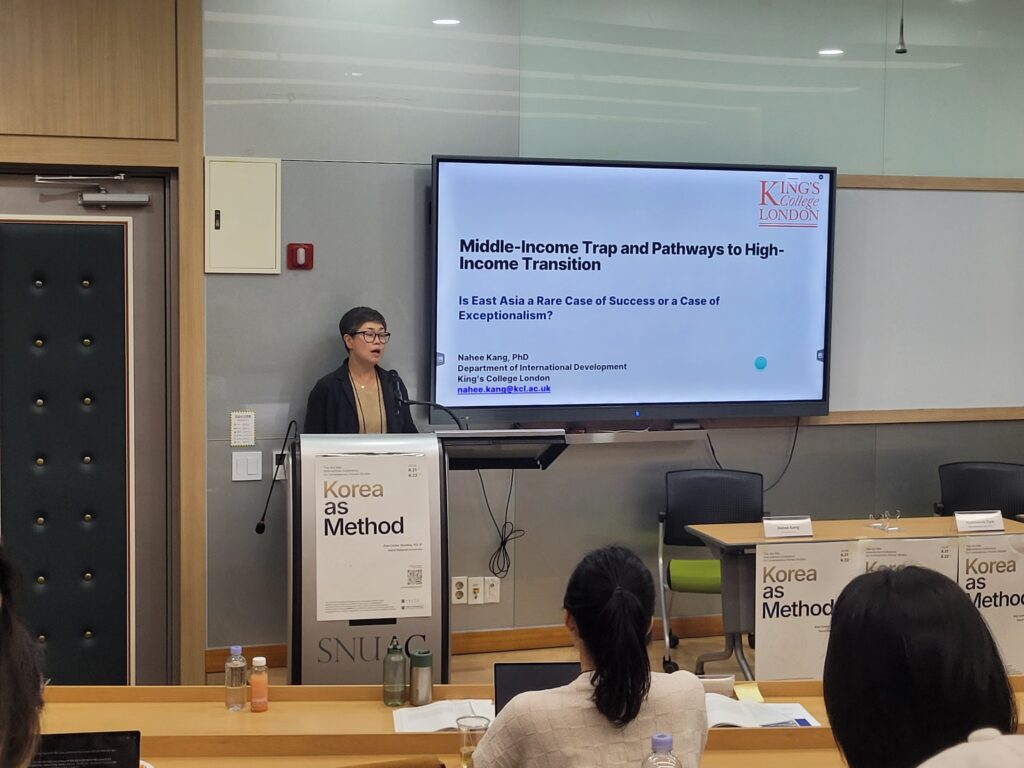
Nahee Kang (King’s College London), in “Middle-Income Trap and High-Income Transition: Is South Korea a Rare Case of Success or a Case of Exceptionalism?,” revisited South Korea’s development through debates over the middle-income trap. Development scholarship has long criticized modernization approaches that treat Western capitalist democracies as the normative model, while East Asia’s subsequent success has often been viewed ambivalently—as either a replication of the Western trajectory or an exceptional experience with limited theoretical relevance. Kang argued that this dichotomy constrains research on how countries actually move from middle- to high-income status. Using South Korea as an in-depth case, she suggested that East Asia should instead be examined as a rare but empirically valuable instance of successful transition, capable of generating broader insights into development pathways.
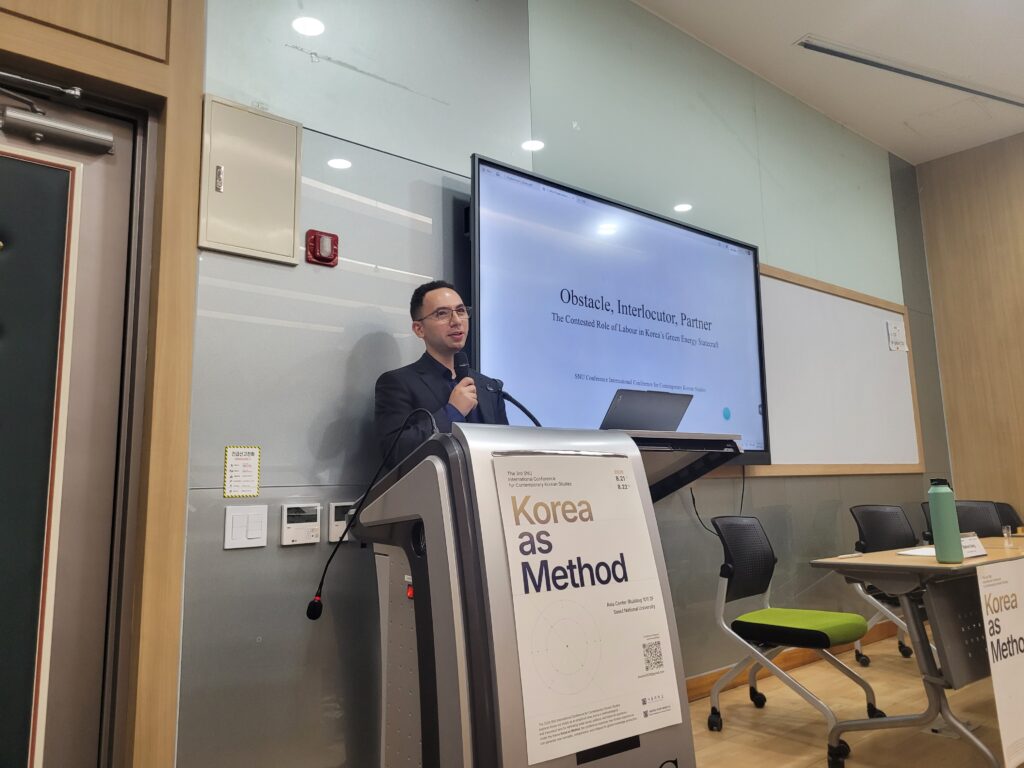
Christopher Khatouki (University of New South Wales), in “Obstacle, Interlocutor, Partner: The Contested Role of Organised Labour in South Korea’s Green Energy Statecraft,” examined the ambiguous position of organized labour within Korea’s green industrial transition. Although the Korean state has demonstrated considerable capacity to coordinate capital and promote new green industries, it has struggled to incorporate unions as strategic participants in the transition. Conservative governments have largely approached organized labour as an obstacle, while liberal governments have tended to treat unions as limited interlocutors whose views may be heard without granting them substantial influence.
Major unions, by contrast, have increasingly sought recognition as equal policy partners in the design and implementation of green industrial restructuring. Khatouki argued that this unresolved contestation reveals a central weakness in Korea’s green energy statecraft: while the state has developed the capacity to lead industrial transformation, it has not developed comparable capacities to negotiate its distributive consequences or to recognize actors beyond business as strategic partners.
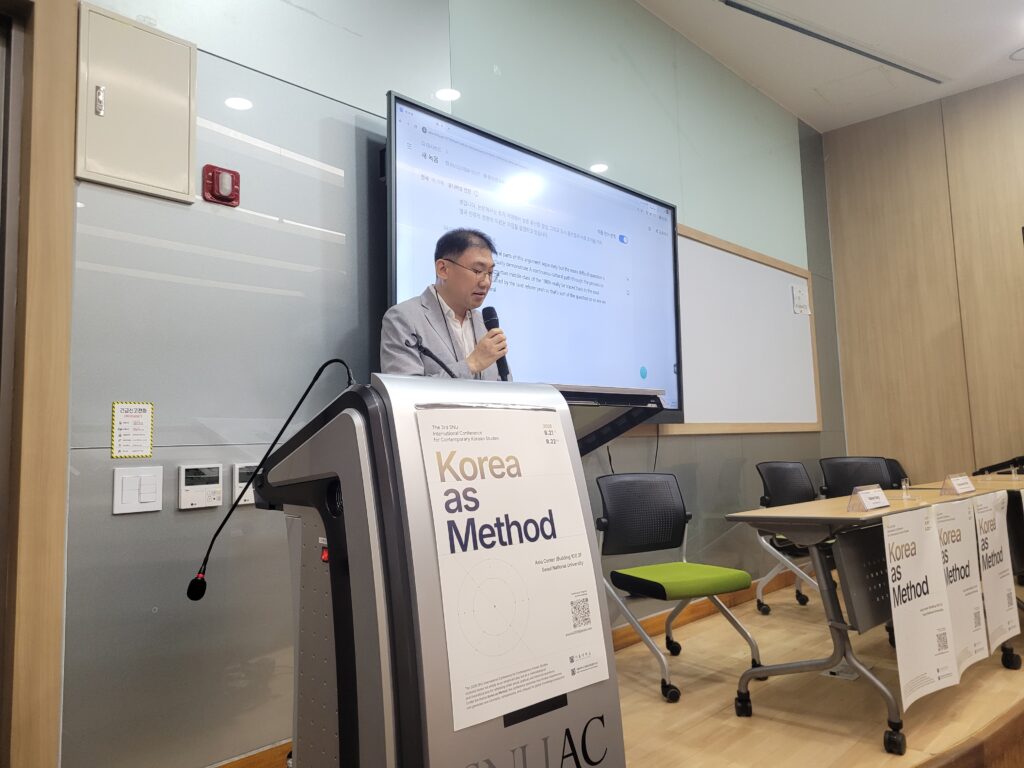
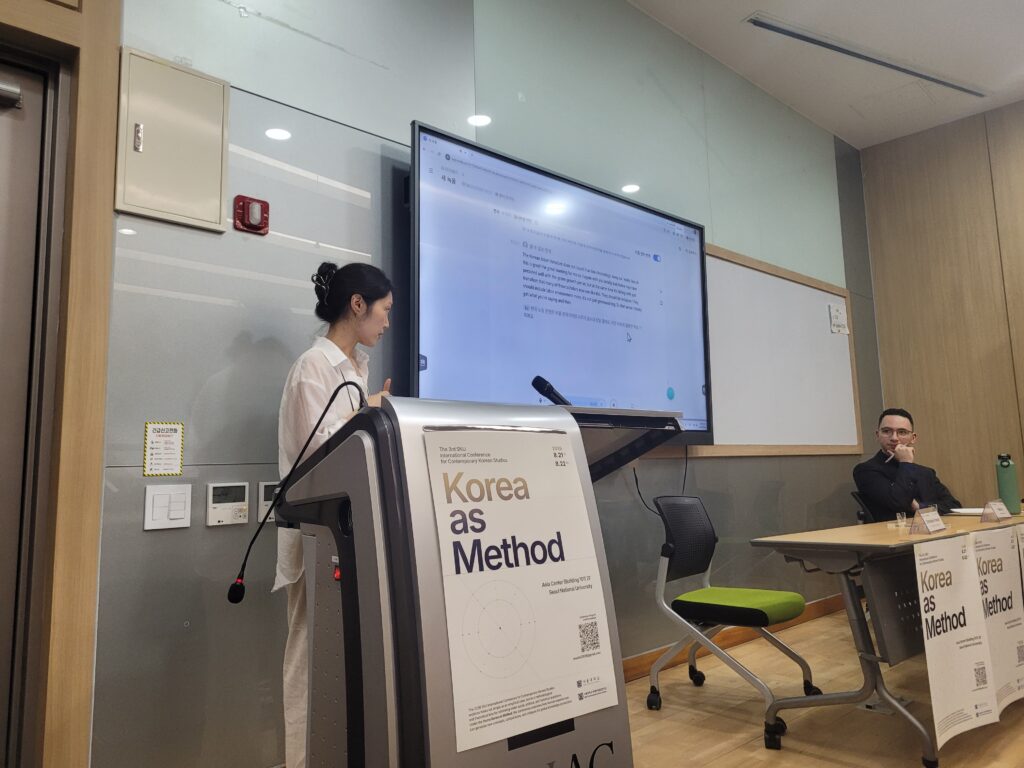
Following the presentations, Myung-Joon Park (Korea Labor Institute), Hyeonseok Park (National Assembly Futures Institute), Kahee Jo (University of Sheffield), and Joonkoo Lee (Hanyang University) offered comments on the panel.
Taken together, the three presentations shifted attention from South Korea’s economic success itself to the limits of the institutions and developmental arrangements that helped produce it. Presidential political institutions may hinder sustained social reform; Korea’s transition to high-income status may offer theoretical lessons rather than merely constitute an exception; and strong state capacity in green industrial policy may remain socially incomplete if organized labour is excluded from meaningful participation. The session thus presented Korean political economy not as a finished model of successful development, but as an ongoing process in which relations among the state, political parties, business, and labour must be reconfigured to address the challenges of social reform, distribution, and sustainable transformation.