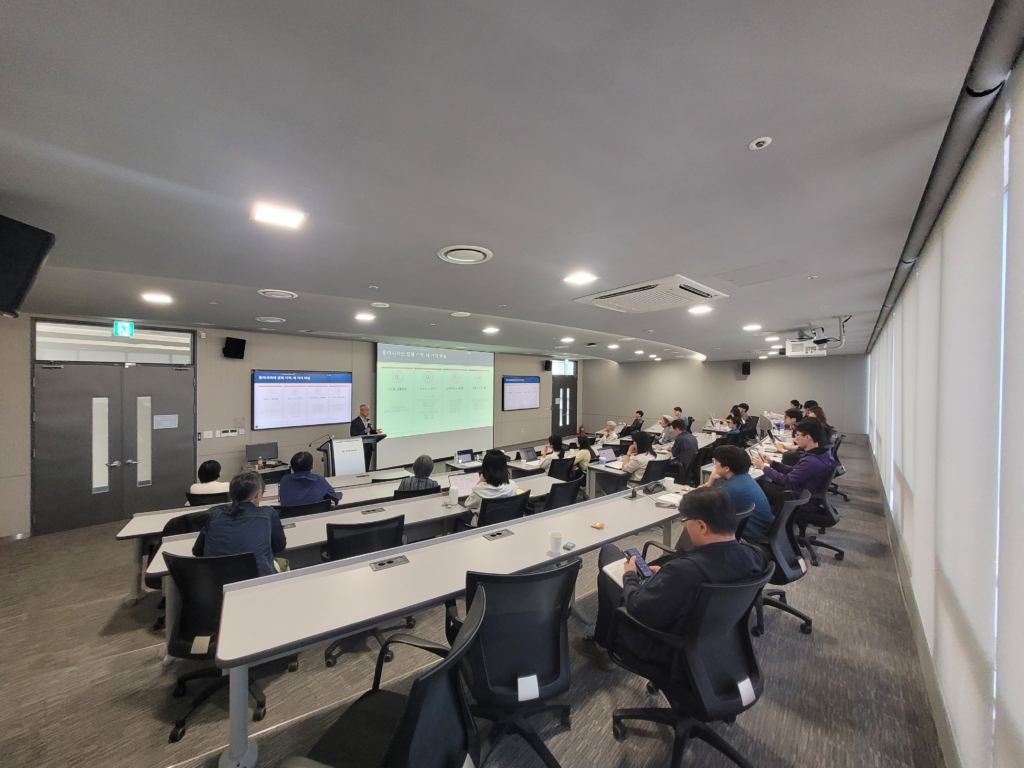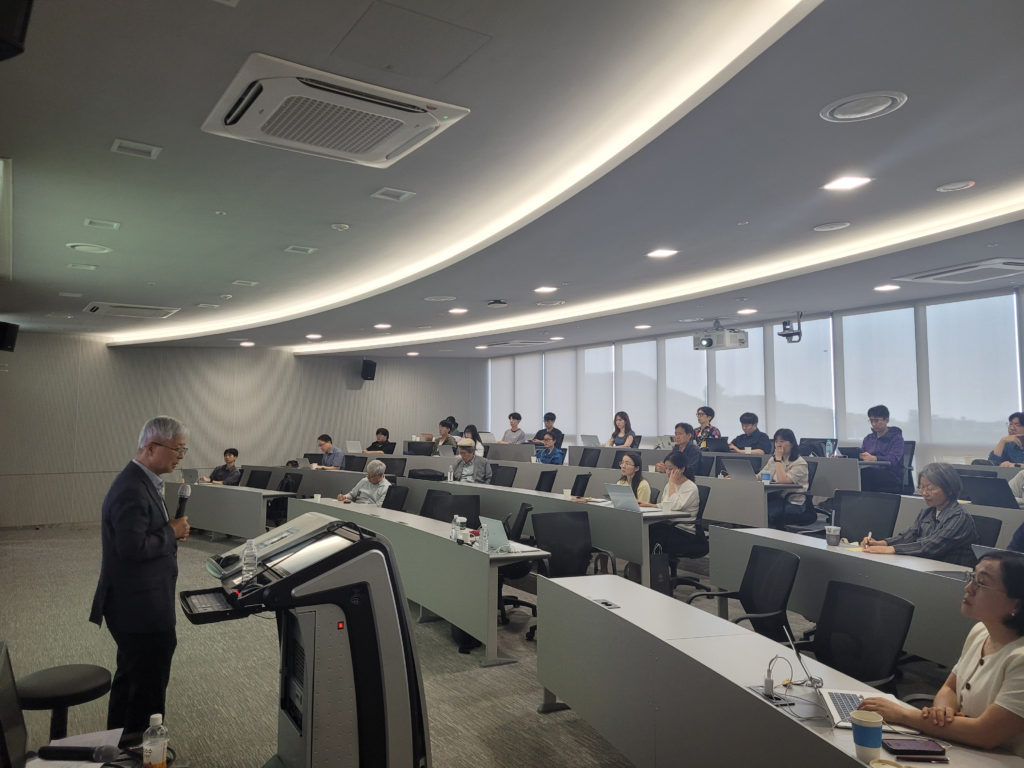
On May 14, 2026, the Political Economy Team of The SNU Contemporary Korean Studies hosted a colloquium featuring Professor Shin Kwang-Yeong, Professor Emeritus of Sociology at Chung-Ang University. Titled “Understanding the Inequality Regime of Contemporary Korean Society,” the event introduced the analytical framework of the “inequality regime,” a concept designed to capture the multiple, interlocking dimensions of inequality, and examined how inequality in Korean society has been shaped over the past seven decades from historical and comparative sociological perspectives.
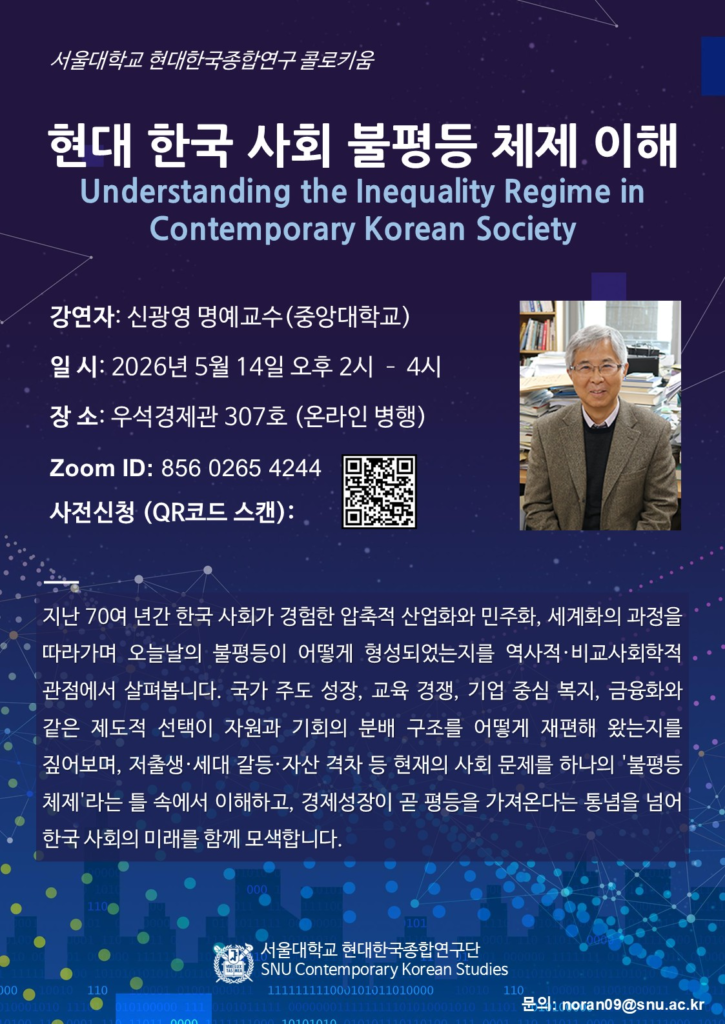
Professor Shin opened the discussion by emphasizing that Korea presents a complex case that defies conventional explanations such as the Kuznets curve, which predicts that inequality declines as economies grow. Despite rapid and compressed modernization, Korea has experienced persistently high levels of income inequality. He argued for a multi-layered analytical approach spanning the global, national, and individual levels. The lecture then explained the internal and external conditions shaping twentieth-century Korea before tracing inequality indicators across five dimensions (class structure, education, welfare, financialization, and demographic change) to characterize the Korean inequality regime. Professor Shin concluded by outlining the structural transformations needed to shift from a growth-centered developmental state toward a sustainable state oriented around quality of life.
The lecture was followed by a lively discussion, in which participants raised questions about how to characterize the Cold War as an external condition shaping Korea’s development, the role of the developmental state in an era of AI and the future trajectory of inequality, the conceptual definition of the “inequality regime,” and the prospects for social mobility in Korea.
The event was held in a hybrid format, with 25 participants attending in person and approximately 40 joining online, bringing total attendance to around 65. The colloquium provided a meaningful opportunity for researchers to reflect on the complexities of inequality and to take stock of the key debates shaping the field of Korean inequality studies today.