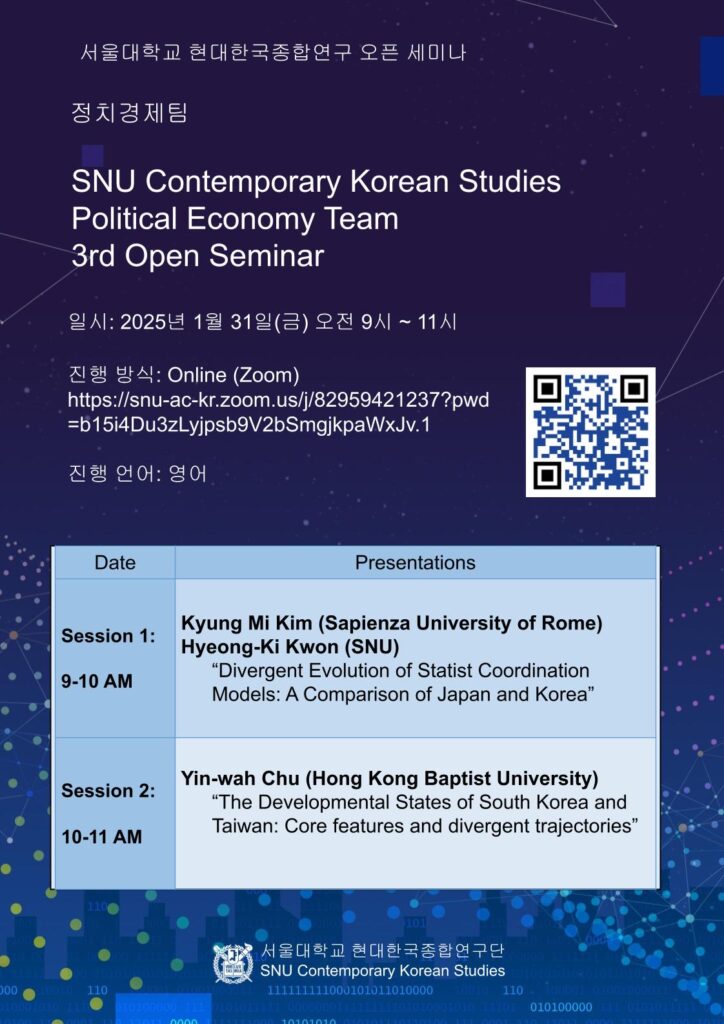
Date and Time: Friday, January 31, 2025, 9:00–11:00 a.m.
Format: Online / English
Speaker 1: Kyung Mi Kim, Sapienza University of Rome; Hyeong-Ki Kwon, Seoul National University
Title: “Divergent Evolution of Statist Coordination Models: A Comparison of Japan and Korea”
Speaker 2: Yin-wah Chu, Hong Kong Baptist University
Title: “The Developmental States of South Korea and Taiwan: Core Features and Divergent Trajectories”
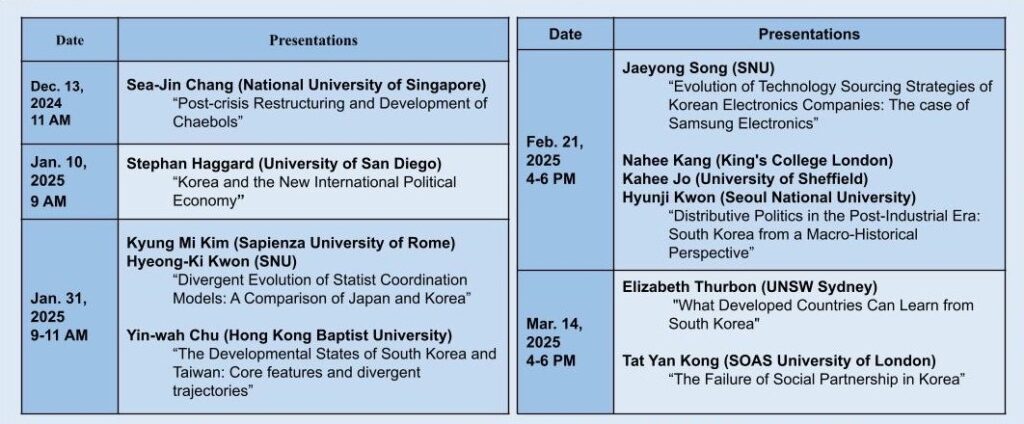
We are pleased to announce the third session of the regular open seminar series hosted by the Political Economy Team of Seoul National University’s Center for Contemporary Korean Studies.
This seminar will examine Korean political economy from a comparative historical perspective, focusing on the developmental trajectories of state coordination models in Korea and Japan, as well as the core features and trajectories of the developmental states of Korea and Taiwan. The seminar will provide an opportunity to explore in depth how the economic and political development of major East Asian countries has unfolded differently within historical, geopolitical, and social-structural contexts.
Speaker 1: Kyung Mi Kim, Sapienza University of Rome; Hyeong-Ki Kwon, Seoul National University
Title: “Divergent Evolution of Statist Coordination Models: A Comparison of Japan and Korea”
Speaker 2: Yin-wah Chu, Hong Kong Baptist University
Title: “The Developmental States of South Korea and Taiwan: Core Features and Divergent Trajectories”
Zoom Link: https://snu-ac-kr.zoom.us/j/82959421237?pwd=b15i4Du3zLyjpsb9V2bSmgjkpaWxJv.1
Passcode: 941880
For inquiries, please contact: namkungaya@snu.ac.kr
Seminar Review
The open seminar hosted by the Political Economy Team of the Center for Contemporary Korean Studies was held online on January 31 from 9:00 to 11:00 a.m. The seminar featured an in-depth discussion on state-led models of economic coordination and comparative perspectives on developmental states. It consisted of two presentations, with Professor Kyung Mi Kim of Sapienza University of Rome, Professor Hyeong-Ki Kwon of Seoul National University, and Professor Yin-wah Chu of Hong Kong Baptist University participating as presenters.
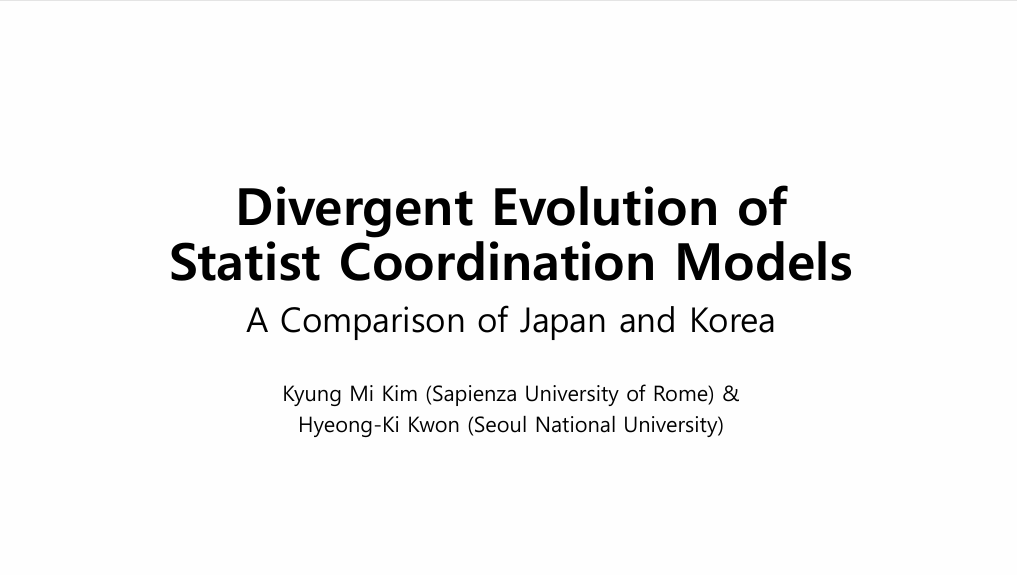
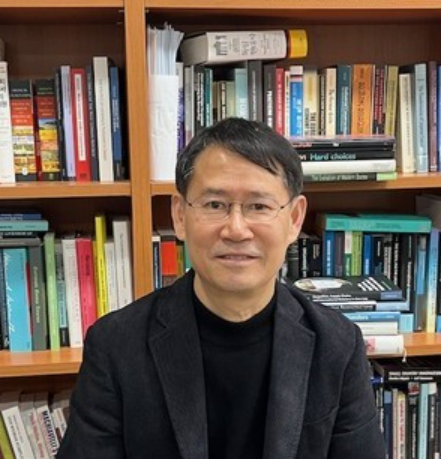
The first presentation, jointly delivered by Professor Kyung Mi Kim and Professor Hyeong-Ki Kwon, was titled “Divergent Evolution of Statist Coordination Models: A Comparison of Japan and Korea.” The presentation analyzed how state-led modes of economic coordination in Japan and Korea have developed differently according to historical and institutional factors. Drawing on a theoretical framework, the two scholars compared and explained the differences between the two countries’ coordination models in terms of policy flexibility and coordination mechanisms.
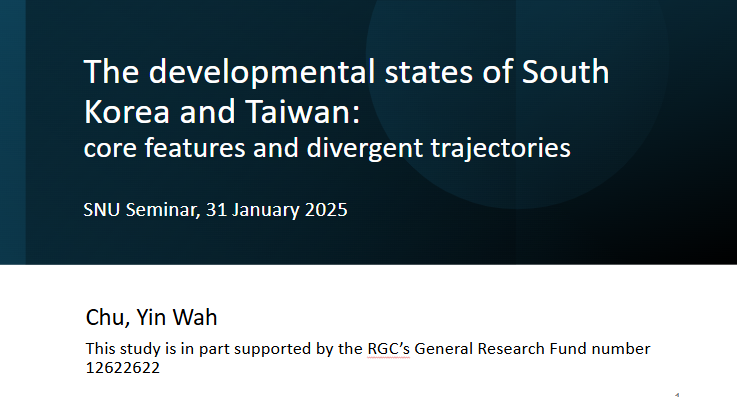
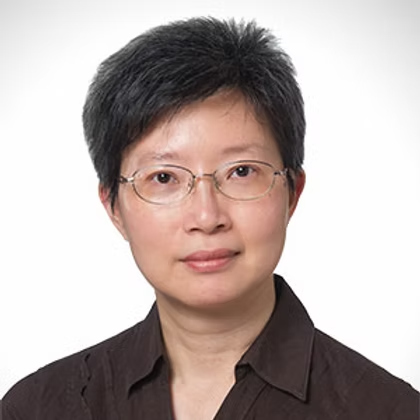
The second presentation was delivered by Professor Yin-wah Chu, titled “The Developmental States of South Korea and Taiwan: Core Features and Divergent Trajectories.” Professor Chu explained why the developmental state models of Korea and Taiwan followed different policy trajectories despite sharing similar starting points, and analyzed differences in government intervention, relations with the private sector, and economic performance in the two countries.
In the general discussion that followed, participants emphasized that the presentations made an important contribution to deepening scholarly understanding of economic development and the role of the state in Korea, Japan, and Taiwan. Participants confirmed that comparing and analyzing the institutional characteristics and developmental trajectories of each country is essential for the study of East Asian economic models, and suggested the need for more refined comparative research and empirical data analysis in the future.