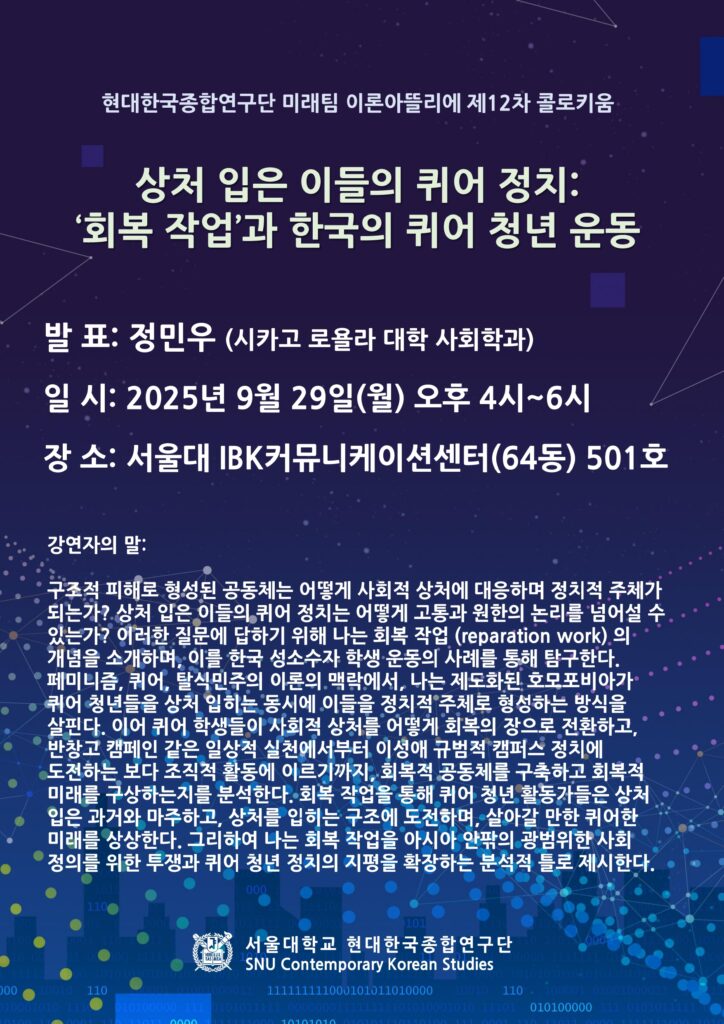
<Overview> How do communities formed through structural harm respond to social wounds and become political subjects? How can the queer politics of the wounded move beyond the logic of suffering and resentment? To address these questions, I introduce the concept of “reparation work” and examine it through the case of LGBTQ+ student activism in South Korea. Drawing on feminist, queer, and postcolonial theory, I explore how institutionalized homophobia wounds queer youth while also shaping them as political subjects. I then analyze how queer students transform social wounds into sites of reparation, building reparative communities and imagining reparative futures through practices ranging from everyday actions such as the Band-Aid campaign to more organized efforts that challenge heteronormative campus politics. Through reparation work, queer youth activists confront wounded pasts, challenge the structures that produce harm, and imagine livable queer futures. I propose reparation work as an analytic framework for expanding the horizons of queer youth politics and broader struggles for social justice within and beyond Asia.
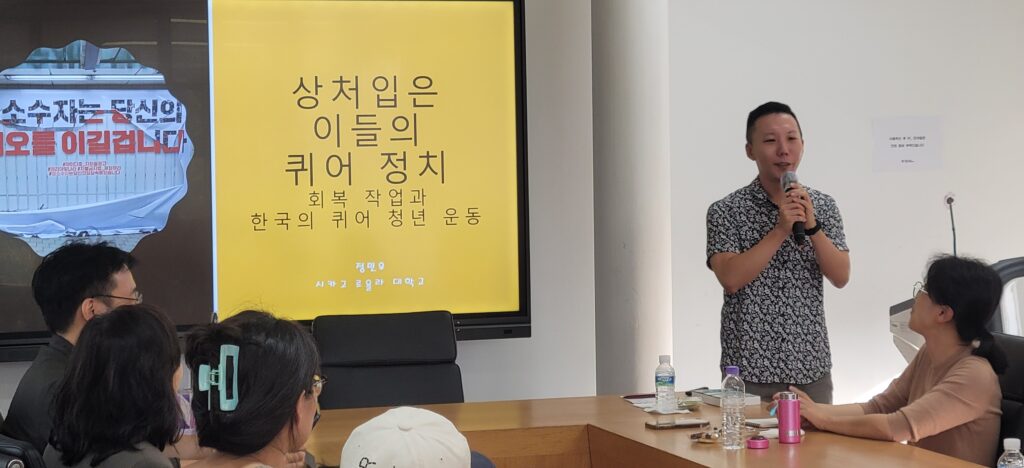
On September 29, 2025, the K-Future Team held a Theory Atelier centered on “Queer Politics of the Wounded: ‘Reparation Work’ and Queer Youth Activism in South Korea,” a lecture by Minwoo Jung, Professor of Sociology at Loyola University Chicago. Professor Jung’s research examines how gender, sexuality, nation, race, and imperialism intersect with social movements and the global knowledge economy.
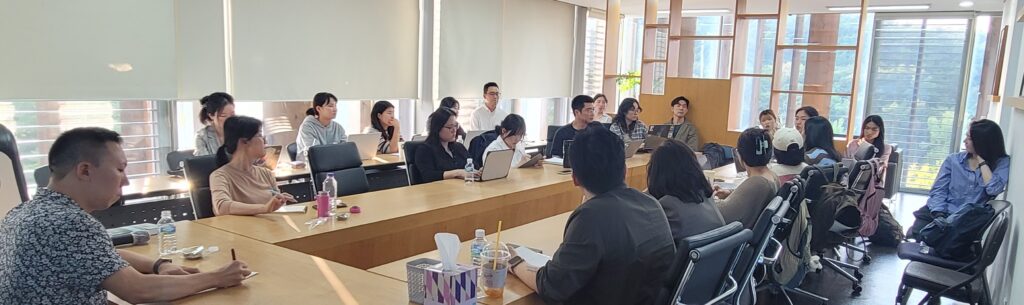
Through the case of LGBTQ student activism in South Korea, the lecture examined the wounds that institutionalized homophobia has left on queer youth, and how those wounds become conditions for political subjectivation. “Reparation work” was presented not as the resolution of pain, but as a form of queer politics that lives with wounds while cultivating everyday practices, communal care, and the capacity to confront structural violence.