The first session of the 1st International Conference for Contemporary Korean Studies, organized by the Seoul National University Contemporary Korea Research Group, was held under the title “Reimagining Korea: Identity and Values in a Changing World and Korea in Transition.” Chaired by Sung-Chung Lee (Seoul National University), the session featured presentations by Grace Kao (Yale University), Liora Sarfati (Tel Aviv University), and Merose Hwang (Hiram College). Through discussions of the globalization of K-pop, the cosmopolitanization of Korean shamanism, and the politics of youth death and mourning, the three speakers examined how the boundaries, values, and identities associated with contemporary Korea are being reconfigured amid rapid social and global change.
Grace Kao (Yale University), in “K-Pop’s Place on the US Billboard Hot 100 Chart,” examined K-pop’s trajectory on the US Billboard Hot 100 and considered how efforts to enter the global music market are reshaping the identity and value of K-pop. For Korean entertainment companies, appearing on the Billboard charts represents more than commercial success; it also serves as symbolic recognition of K-pop’s presence in the Western music market. At the same time, however, this ambition creates pressure to adapt music to what companies perceive as the preferences of a global audience.
Kao noted that K-pop production has itself become increasingly transnational, involving international songwriters and producers, non-Korean members, English-language releases, and locally developed groups outside Korea. These developments raise fundamental questions about what makes K-pop “Korean” and whether its growing global success might ultimately loosen the association between K-pop and Korea. Rather than offering a fixed definition of Koreanness, Kao emphasized that the boundaries of K-pop are themselves changing rapidly and should be treated as an important object of inquiry.
Liora Sarfati (Tel Aviv University), in “The Cosmopolitan Vernacular: Korean Shamans (Mudang) in the Global Spirituality Market,” reconsidered the conventional understanding of Korean shamanism as an essentially local and vernacular religious tradition. She examined how contemporary mudang increasingly participate in a global spiritual market through relationships with foreign clients, transnational networks, digital media, and ritual practices extending beyond Korea. Sarfati defined cosmopolitanism not simply in terms of geographical mobility, but as an openness to incorporating different cultural worlds and perspectives.
Through ethnographic cases of shamans working with foreign clients in Korea, practitioners conducting Korean shamanic practices abroad, and rituals mediated through digital technologies, Sarfati argued that hybridity does not necessarily signal the disappearance of tradition. Rather, urbanization, globalization, popular media, and new forms of communication demonstrate the flexibility of Korean shamanism as a living tradition. Its capacity to incorporate new actors and practices while maintaining connections to Korean ritual forms illustrates how vernacular traditions can become cosmopolitan without losing their historical roots.
Finally, Merose Hwang (Hiram College), in “The Ethics of Grief: Reflections on Recent Youth Deaths in South Korea,” examined how contemporary Korean society remembers and mourns large-scale youth deaths through a comparison of the Sewol ferry disaster and the October 29 Itaewon tragedy. Rather than treating these events solely as isolated accidents, Hwang situated them within longer historical and political conditions that shape public safety, state responsibility, and the social recognition of victims.
Hwang paid particular attention to the unequal politics of grievability: while some victims are publicly recognized as innocent lives deserving collective mourning, others may be portrayed as responsible for their own deaths and consequently rendered less “grievable.” She also explored how bereaved families have transformed personal grief into public practices of remembrance and accountability through memorial spaces, archives, testimony, artistic activities, commemorative events, and political mobilization. Mourning, in this account, becomes not only a process of healing but also a social and political practice through which questions of safety, responsibility, and collective memory are negotiated.
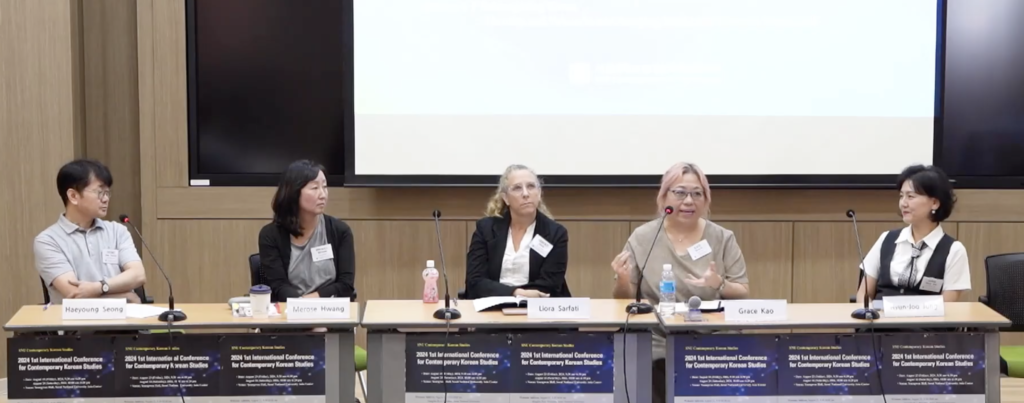
Following the presentations, comments and discussion further developed the session’s shared questions. Participants considered how K-pop negotiates “Koreanness” as its production becomes increasingly global, what possibilities and limitations arise from describing Korean shamanism as cosmopolitan, and what responsibilities states and communities bear in remembering and mourning the victims of social tragedy. The discussion suggested that the question of “what is Korean” cannot be answered simply by identifying a fixed cultural essence, but must instead be approached through the ongoing processes of translation, hybridity, mobility, and contestation through which identities are continually reconstructed.
Taken together, the three presentations approached the values and identities of contemporary Korea not as fixed or self-contained categories, but as products of changing relationships and boundaries. The “Koreanness” of K-pop is continually negotiated within global networks of production and consumption; the locality of Korean shamanism intersects with increasingly cosmopolitan forms of practice; and the meaning of death and mourning is reshaped through relations among the state, civil society, and communities of memory. The session thus highlighted the importance of understanding Korean identity not as something located exclusively on one side of the divide between tradition and the global, domestic and transnational, or authenticity and hybridity, but as something continually produced through the movement and renegotiation of these boundaries.