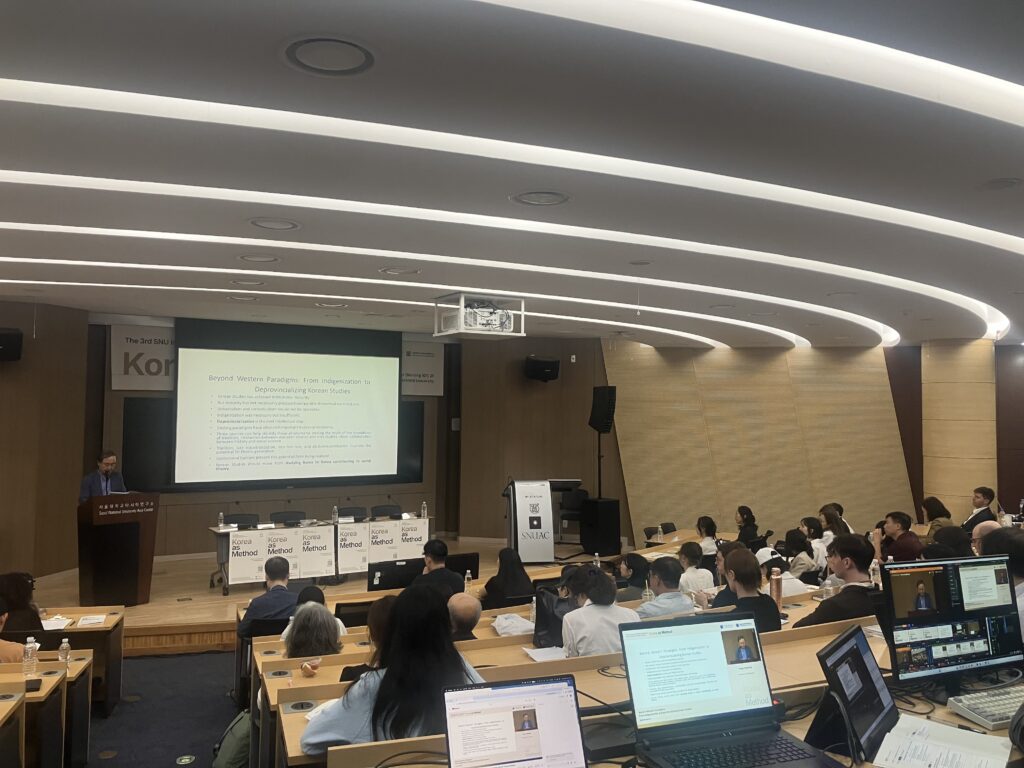
At 11:20 a.m. on the first day of the conference, Professor Yong-Chool Ha of the University of Washington delivered the keynote address, “Beyond Western Paradigms: The Korean Style of Social Sciences and the Role of Tradition,” at Youngwon Hall. Ha began by reflecting on a central paradox in the development of Korean Studies: while the field has achieved considerable institutional maturity, this growth has not necessarily been accompanied by theoretical contributions of comparable significance to the broader social sciences.
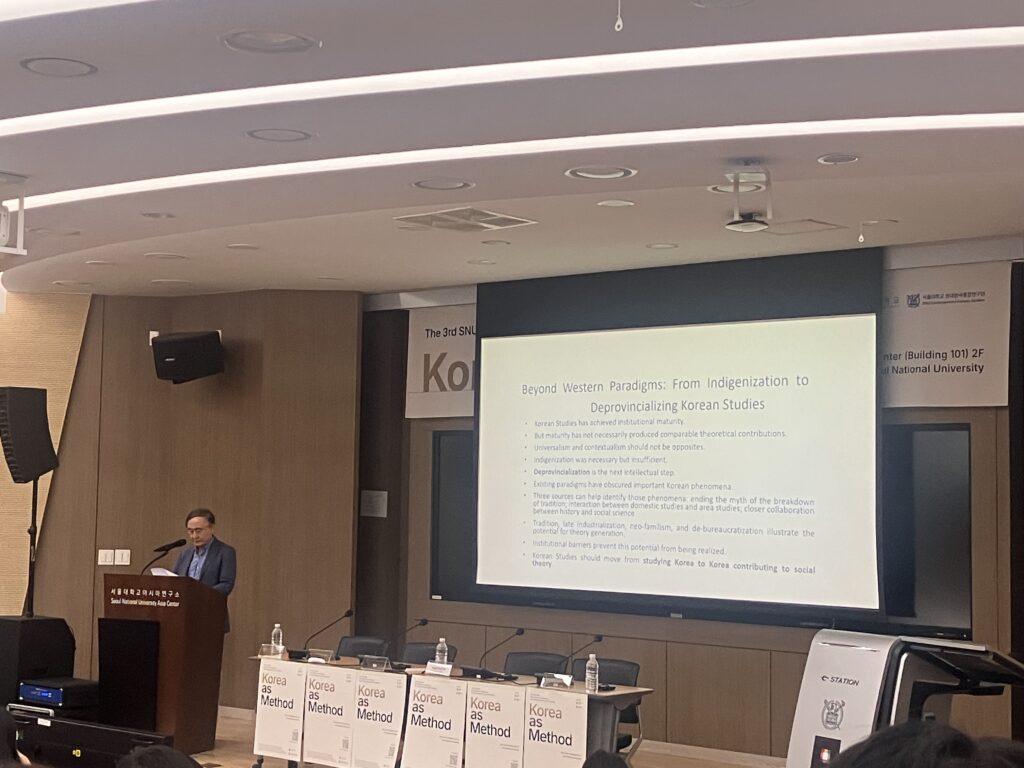
Ha argued that universalism and contextualism should not be treated as mutually exclusive approaches to the study of Korea. The indigenization of social science was a necessary step toward identifying and explaining the historical and social particularities of Korean experience, but, he maintained, indigenization alone is insufficient. The next intellectual task for Korean Studies is what he termed “deprovincialization.” Rather than leaving Korea in the position of a peripheral case to which theories developed elsewhere are merely applied or tested, Korean Studies should use Korean experiences to reconsider established concepts and generate new theoretical insights.
One reason this potential has remained underdeveloped, Ha suggested, is that dominant social-scientific paradigms have obscured important phenomena in Korean society. He proposed three directions through which such phenomena might be brought into clearer view. The first is to abandon the “myth of the breakdown of tradition”—the assumption that modernization simply displaced or dissolved traditional social relations. Instead, scholars should examine how tradition has persisted, changed, and interacted with modern institutions. The second is to foster stronger interaction between domestic studies, which often examine Korea primarily within national boundaries, and area studies, which situate Korea within broader regional and comparative contexts. The third is to encourage closer collaboration between history and the social sciences so that long-term historical processes can be more effectively connected to social-scientific concepts and theory building.
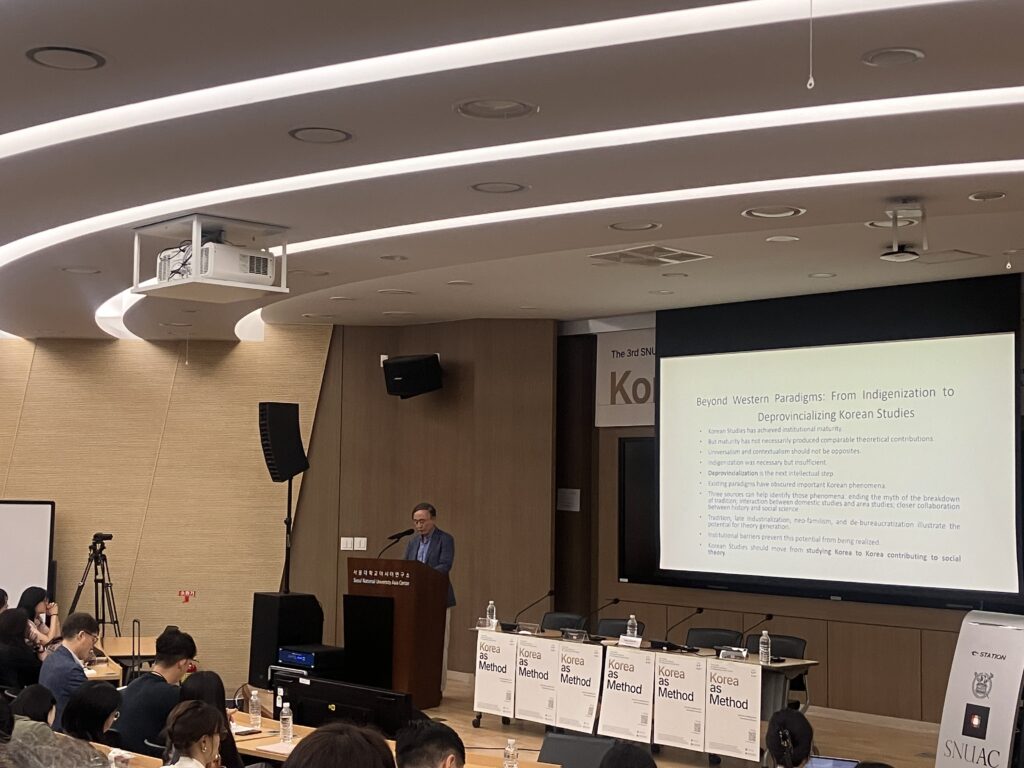
Ha further argued that several features of the Korean experience illustrate the potential for such theory generation. The continuing role of tradition within modern social arrangements, the experience of late industrialization, the emergence of neo-familism, and processes of de-bureaucratization all provide opportunities not simply to describe Korean particularities but to develop concepts with broader comparative and theoretical relevance. These phenomena, he suggested, demonstrate how research grounded in Korea can contribute to social theory rather than merely remain an object of existing theories.
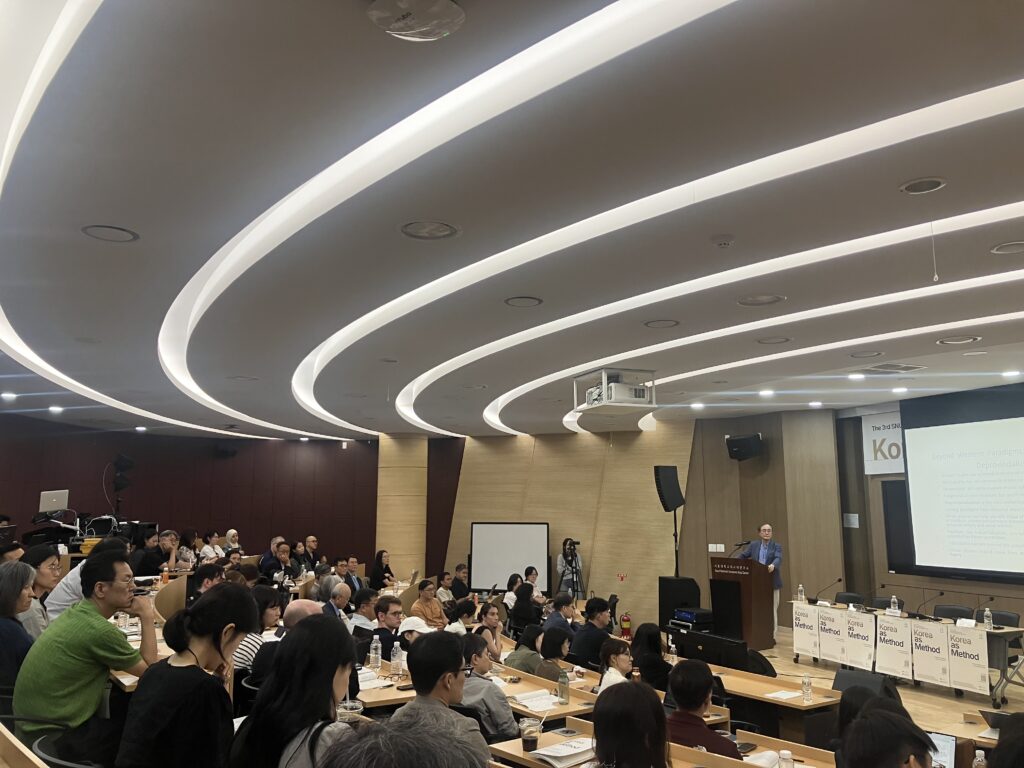
At the same time, Ha stressed that institutional barriers continue to prevent this theoretical potential from being fully realized. For Korean Studies to move beyond its current stage of institutional maturity, it must therefore make a broader intellectual transition: from simply studying Korea to enabling Korea to contribute to the production of social theory. The keynote address thus called for a reorientation of Korean Studies—one that treats Korea’s historical and social experiences not only as phenomena to be explained through established paradigms, but also as intellectual resources from which new questions, concepts, and theories can emerge.