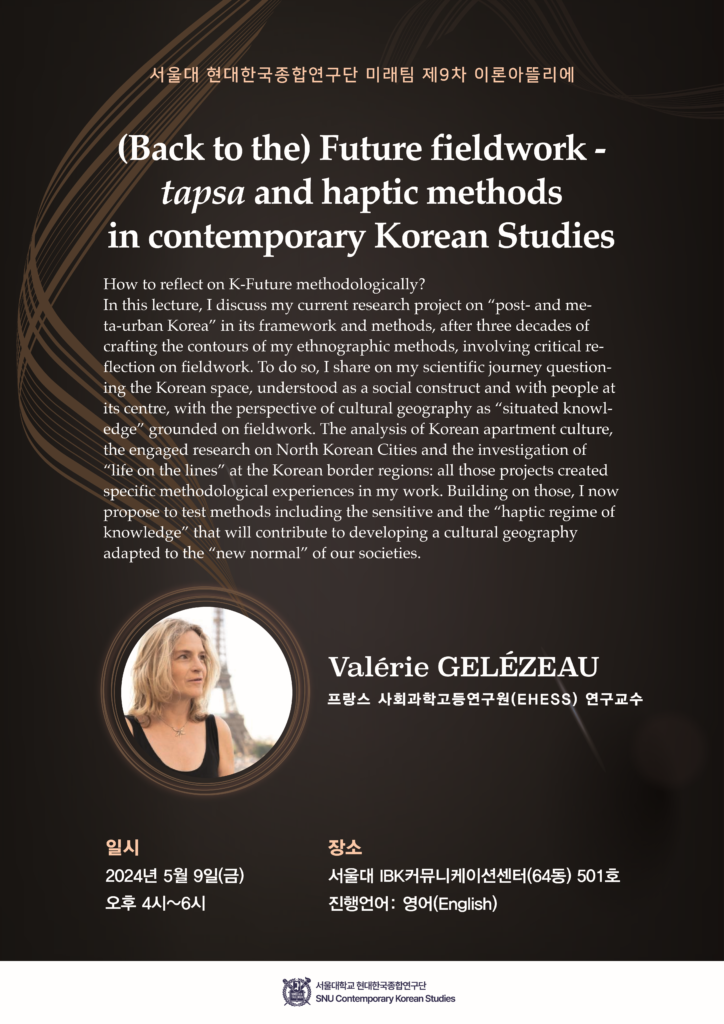
<Overview> How to reflect on K-Future methodologically? In this lecture, I discuss my current research project on “post- and meta-urban Korea” in its framework and methods, after three decades of crafting the contours of my ethnographic methods, involving critical reflection on fieldwork. To do so, I share on my scientific journey questioning the Korean space, understood as a social construct and with people at its centre, with the perspective of cultural geography as “situated knowledge” grounded on fieldwork. The analysis of Korean apartment culture, the engaged research on North Korean Cities and the investigation of “life on the lines” at the Korean border regions: all those projects created specific methodological experiences in my work. Building on those, I now propose to test methods including the sensitive and the “haptic regime of knowledge” that will contribute to developing a cultural geography adapted to the “new normal” of our societies.
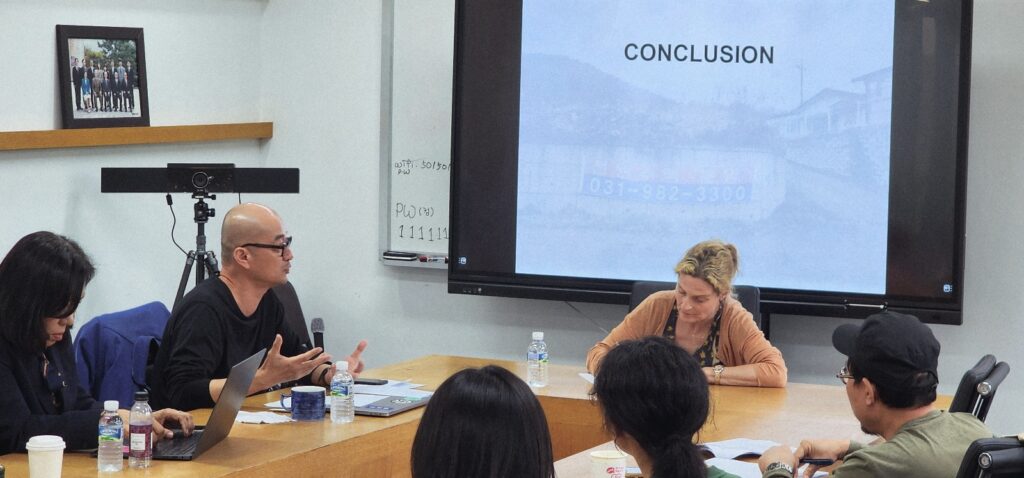
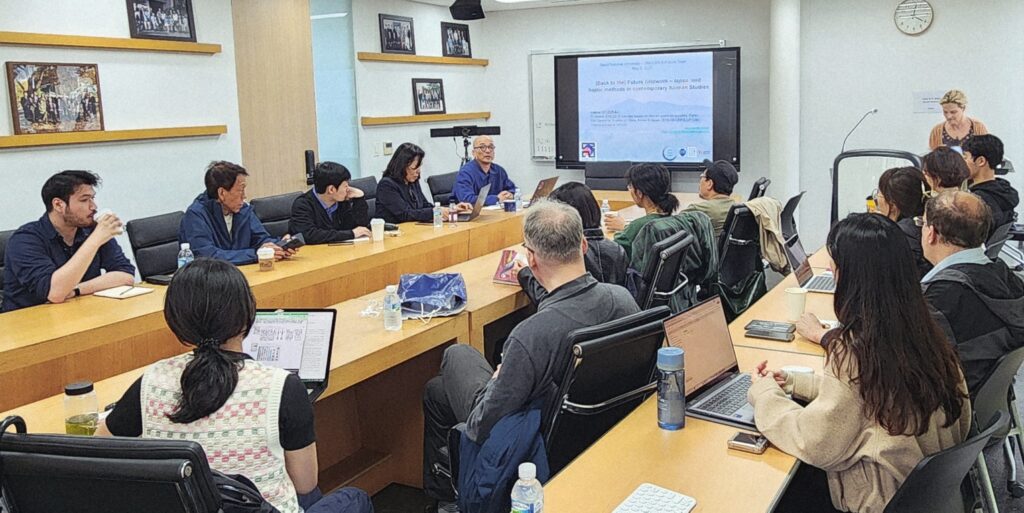
On May 9, 2025, the K-Future Team held a Theory Atelier centered on “(Back to the) Future Fieldwork: Tapsa and Haptic Methods in Contemporary Korean Studies,” a lecture by Valérie Gelézeau, Professor at the École des hautes études en sciences sociales (EHESS). Drawing on her long-standing work on Korean apartment culture, North Korean cities, and inter-Korean border regions, Gelézeau reflected on the methodological stakes of K-Future through tapsa(답사), walking, and haptic modes of fieldwork.
At the center of the lecture was ‘walking’ as an embodied, political, and epistemological practice. Walking makes perceptible the uneven conditions of access and blockage, visibility and withdrawal, through which space is encountered in the field. In cases ranging from Songdo, Samcheok, and Pyongyang to inter-Korean border regions and the DMZ Peace Trail, Gelézeau situated contemporary Korean Studies within a form of fieldwork attuned to the bodily experience of hybrid and discontinuous spaces.